Mercedes-Benz does not currently see enough demand from its own customers to justify a separate extended-range electric vehicle, or EREV. Christoph Starzynski, the company’s vice-president for product strategy and product steering, told Motor1 that Mercedes already offers plug-in hybrids with more than 100 kilometres of electric range in Europe. His question was practical: if a customer can already complete everyday journeys electrically and still has a petrol engine for longer trips, would moving to a much larger electric range with the same combustion-engine backup be compelling enough?
The comment is not a rejection of electrification or of hybrid powertrains. Mercedes continues to sell battery-electric cars, plug-in hybrids and combustion models with electrical assistance. It is a narrower judgement about whether another architecture would solve a problem that the current product range already addresses for most of the brand’s buyers.
What an EREV actually changes
An extended-range electric vehicle is driven by an electric motor. It has a battery that can be charged from the grid, while a petrol engine starts when the battery state of charge becomes low and operates a generator. In the usual series-hybrid layout, the combustion engine does not mechanically drive the road wheels through a conventional transmission. The driver therefore receives electric propulsion throughout the journey, even when the electricity is being produced on board.
The arrangement can offer a useful compromise. The battery may be smaller than the pack fitted to a long-range battery-electric vehicle, which can reduce mass and cost. At the same time, the fuel tank can provide a reserve for long journeys in places where fast charging is scarce. The compromise is not free: the vehicle still carries an engine, exhaust equipment, fuel and maintenance requirements, and it creates local emissions when the generator runs.
A conventional plug-in hybrid is not identical. Depending on the design, its combustion engine can drive the wheels directly or work with the electric motor in a parallel hybrid system. Mercedes’ current argument is that this flexibility is more valuable than creating a separate EREV category. A customer can drive on electricity during the daily routine and retain petrol propulsion for a trip that exceeds the battery’s usable range.
Mercedes’ electric-range argument
Starzynski referred to Mercedes plug-in hybrids offering upwards of 100 kilometres of electric range in Europe. He also questioned whether a customer would really switch from roughly 60 miles of electric driving to roughly 200 miles if the vehicle remained a hybrid rather than becoming a full EV. The figures in the interview are a way of framing the product decision; they are not a claim that every Mercedes plug-in hybrid has the same range or that every market offers the same versions.
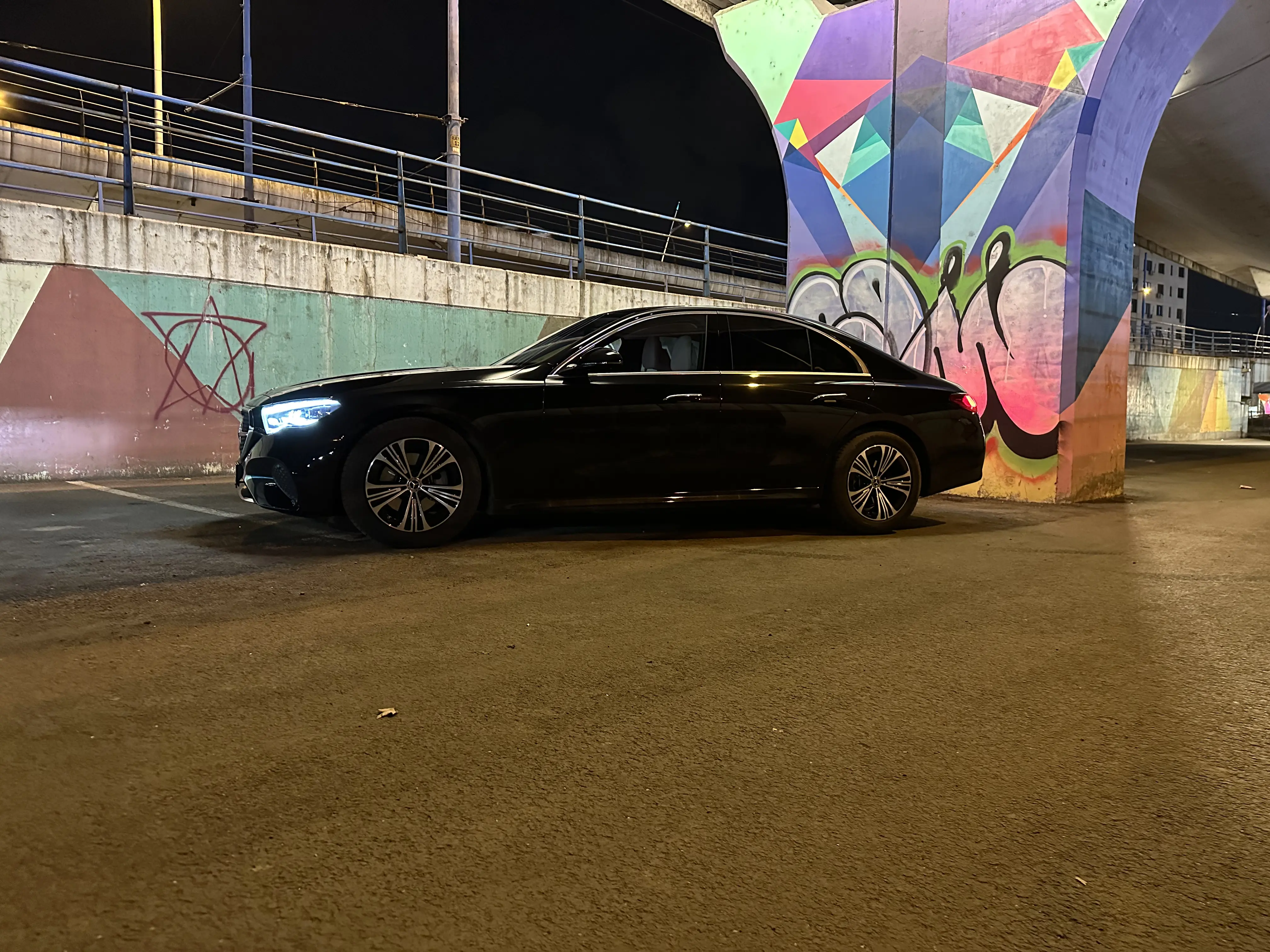
Mercedes’ own technical material gives concrete examples. The company says the E 300 e can cover up to 118 kilometres in electric mode under the WLTP procedure. Its communication about the S 580 e 4MATIC quotes more than 100 kilometres of WLTP electric range and a 60 kW DC charging option. Mercedes also says that around 40 plug-in-hybrid variants in its portfolio can provide up to 130 kilometres of electric range according to WLTP.
Those cars are not EREVs. They show why the company considers a plug-in hybrid a sufficient answer for a large part of the use case. A driver covering 40 or 60 kilometres each day may be able to charge at home and complete the regular commute without starting the petrol engine. The longer trip remains possible without relying on a public charger at every stage.
WLTP figures still need context. Real range changes with temperature, speed, traffic, gradients, payload, wheels, tyres and climate control. The official number is useful for comparison between vehicles, but it is not a promise that the same distance will be available in winter motorway driving.
Charging is central to the comparison
An EREV can reduce anxiety about a long trip, but it does not remove the need to charge. To obtain the efficiency benefit of electric driving, the owner must connect the car regularly. If the battery is rarely charged, the petrol generator supplies a larger share of the energy and the vehicle’s real-world efficiency depends on its mass, aerodynamics and generator calibration.
The same limitation applies to a plug-in hybrid, perhaps more visibly. Its larger battery and electric motor make sense when the owner charges at home, at work or at a regular destination. A driver without reliable access to a socket may carry the extra hybrid hardware without using the electric part often enough to justify it. Mercedes’ public statement does not claim that plug-in hybrids are the best answer for every customer; it says the company does not currently see enough internal demand for a different solution.
The practical answer therefore depends on the route. A daily commuter with an overnight charging point may find a 100–120 km WLTP plug-in range adequate. Someone covering 200 kilometres every day without charging at the destination has a different requirement. A full EV may be preferable for the first customer, while an EREV could be attractive to the second, but Mercedes has not announced that it will serve that profile with a production model.
The company has evaluated range extenders before
The current position follows earlier reporting about Mercedes prototypes. In 2024, Autocar reported that the company had stopped testing range-extender drivetrains after an advanced engineering programme. One EQS-based test vehicle was described as using a turbocharged 1.0-litre two-cylinder petrol engine as a generator. A rear electric motor produced about 268 bhp, while the battery was smaller than the production EQS pack.
According to the high-level source quoted by Autocar, Mercedes concluded that a range extender was a transitional technology with relatively short-term sales benefits and comparatively high production costs. This was a report about prototypes and development decisions, not an official specification for a future car. It also does not prove that every possible EREV layout has been permanently ruled out.
The earlier programme matters because it shows that Mercedes understands the engineering trade-off. Packaging the generator, fuel system, cooling, exhaust and battery requires space and adds components. The system can be efficient at a steady operating point, but it cannot turn a hybrid vehicle into a zero-emission car once the generator is running. A full EV remains mechanically simpler in operation, provided the charging network and the customer’s route make it practical.
A flexible strategy rather than one technology
Mercedes-Benz Group’s 2025 annual report presents a portfolio that expands battery-electric vehicles while retaining efficient combustion engines and plug-in hybrids. The report says Mercedes-Benz Cars had 13 all-electric models in the portfolio during 2025 and planned additional electric architectures for the Core and Top-End segments in 2026. The company’s climate plan describes plug-in hybrids as a bridging technology and gives the up-to-130-km WLTP figure for roughly 40 variants.
At the other end of the range, the company’s CLA 250+ with EQ Technology is officially listed with up to 792 kilometres of WLTP range in Europe, depending on specification. That gives Mercedes two clear product answers: a highly efficient BEV for buyers prepared to charge, and a plug-in hybrid for buyers who want electric daily use plus petrol flexibility. The absence of an announced EREV does not mean the company has abandoned its electric programme.
It also leaves room for the strategy to change by market. Starzynski acknowledged that some regions may have stronger demand for range extenders. Charging infrastructure, driving distances, taxation, fuel prices and customer expectations are not identical worldwide. A decision that makes sense for a Chinese city outside the largest urban centres may not have the same value for a European Mercedes customer with access to home charging and a dense motorway network.
What has not been confirmed
Mercedes has not announced a production EREV for Europe, and it has not published a price, battery capacity, electric range or launch date for a future model using this architecture. The available evidence supports a more limited conclusion: Mercedes has tested range-extender concepts in the past, currently sees its plug-in hybrids as sufficient for its customer base, and continues to expand both BEVs and hybrid vehicles.
For buyers, the choice is less about the label and more about charging access. A plug-in hybrid only delivers its best case when it is plugged in regularly. A full EV needs a route and charging routine that the owner can live with. An EREV could combine electric drive with long-distance flexibility, but it would retain the complexity of two energy systems. Mercedes’ current view is that the extra complexity does not yet buy enough additional value for its customers.
Sources
- Mercedes-Benz Group — E 300 e environmental check and up to 118 km WLTP electric range
- Mercedes-Benz Media — S 580 e 4MATIC and 60 kW DC charging
- Mercedes-Benz Group — Climate Transition Action Plan 2025
- Mercedes-Benz Group — Annual Report 2025
- Autocar — Mercedes-Benz abandons range-extender EV trials