The Nissan Qashqai is 20 years old, measured from its public debut at the 2006 Paris motor show. Nissan says more than 4.1 million examples have been sold in Europe across three generations, while almost 250,000 European buyers have chosen the e‑POWER version since that powertrain arrived in autumn 2022.
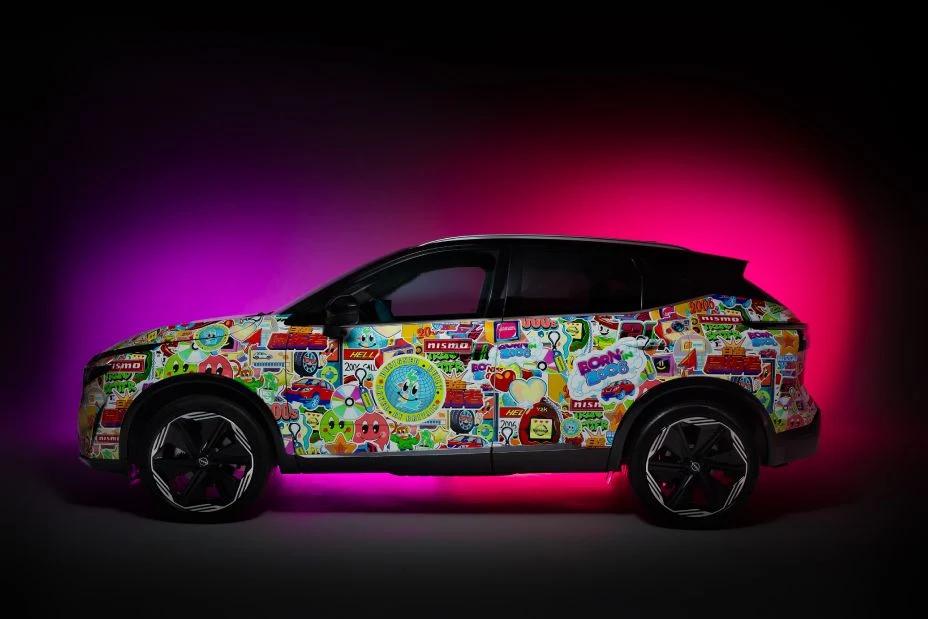
The lead photograph is an official Nissan press image of a one-off anniversary Qashqai. Its Y2K-inspired wrap is part of the birthday campaign, not a production trim level offered for sale.
Nissan abandoned a conventional Almera successor
Qashqai began with a change of plan inside Nissan’s European operation. In the early 2000s, the company had taken the design of a conventional Almera replacement close to completion. Its teams instead pursued a vehicle that placed a higher seating position and SUV-influenced body over the footprint, operating costs and everyday practicality expected from a family hatchback.
The production model appeared in Paris in autumn 2006 and went on sale in 2007. Nissan reports 100,000 European sales in the first nine months, enough for the Sunderland plant to add production shifts. By January 2011, global sales had reached one million, including more than 750,000 in Europe.
Qashqai was not the first vehicle ever to blend passenger-car and SUV traits. Its more defensible significance is commercial: it proved that this combination could become a high-volume European family car. Nissan now counts more than 50 competitors in the compact-crossover category and says the segment represents over four million vehicles of annual European industry volume. Those category totals are Nissan’s assessment rather than a harmonised registration class used identically by every market body.
Designed, engineered and built in Britain
The European Qashqai has retained a clear development chain through all three generations. Styling work was led by Nissan Design Europe in London. Engineering took place at Nissan Technical Centre Europe in Cranfield, with work also attributed to Barcelona, and production has remained at Nissan’s Sunderland factory.
For the anniversary, Nissan reports more than 4.1 million European sales, plus approximately 500,000 vehicles produced for markets elsewhere. The model has been sold in over 100 countries and has received more than 110 international awards, including over 20 national Car of the Year titles. The release does not provide a full country-by-country annual sales table, so those are cumulative manufacturer figures.
Nissan links the programme and its UK manufacturing base to 6,000 direct jobs in Sunderland and a further 30,000 positions across the supply chain. Sunderland builds other vehicles as well, which means the employment total should not be read as a Qashqai-only headcount. It nevertheless shows why the model matters beyond showroom volume.
e‑POWER uses the engine as a generator
The third generation added e‑POWER to the European range. Unlike a conventional parallel hybrid, the petrol engine does not mechanically drive the wheels. It generates electricity, while the traction motor alone provides wheel torque. There is no external charging connection, so fuel and regenerative braking supply the energy.
Nissan says almost 250,000 Qashqai e‑POWER vehicles have been sold in Europe since autumn 2022. The latest European specification quoted in the anniversary material produces 151 kW, or 205 hp, and reaches 100 km/h in 7.6 seconds. Official combined WLTP fuel use is 4.3–4.5 l/100 km. A technical note gives up to 1,250 km from the 50-litre tank, but real range varies with speed, traffic, temperature, load and driving style.
National specifications still differ. Nissan Romania’s current page lists the earlier 140 kW or 188 hp e‑POWER version, rated at 330 Nm, 0–100 km/h in 7.9 seconds and 5.2–5.3 l/100 km WLTP. It also lists 138 hp and 156 hp mild-hybrid alternatives. The new 205 hp figure should therefore not be presented as a configuration already on sale in every European country.
The product still follows the original packaging idea
The Romanian-market technical page gives a useful snapshot of the current body. Qashqai is 4,425 mm long, 1,835 mm wide excluding mirrors and 1,625 mm tall, with a 2,665 mm wheelbase. Depending on powertrain and specification, the e‑POWER luggage compartment is quoted at 404–436 litres. The Romanian site displays a starting price of €30,990, subject to engine, trim, options and current commercial terms.
Those dimensions help explain the original proposition more clearly than anniversary language. Qashqai provides a raised body and driving position in a length that remains close to a conventional family hatchback or estate. Over two decades, competitors adopted the same basic packaging, and buyers gained far more choice. Historical sales do not decide whether today’s Qashqai is the best purchase; price, boot space, official consumption and the exact powertrain available locally remain the relevant checks.
The Y2K car is a one-off, not a special edition
Nissan worked with digital artist @heymoonly on a “sticker bomb” treatment using neon colours and early-2000s visual references. The cabin adds velour seat covers, a colourful steering-wheel wrap, period pop CDs and a working iPod loaded with a mid-2000s-inspired playlist.
No price, order book or production allocation has been announced. The safest description is therefore a one-off campaign car, not a limited edition. Nissan has also opened a digital Qashqai Heritage Collection containing original design sketches, archive photographs, videos and milestones from the three generations.
The 20th anniversary brings together two different stories. One is historical: Qashqai helped turn the compact crossover into a mainstream European product and accumulated 4.1 million regional sales. The other is current: Nissan is using e‑POWER to keep the model distinct in a crowded segment, but the newest 205 hp specification has not yet appeared consistently across national catalogues.