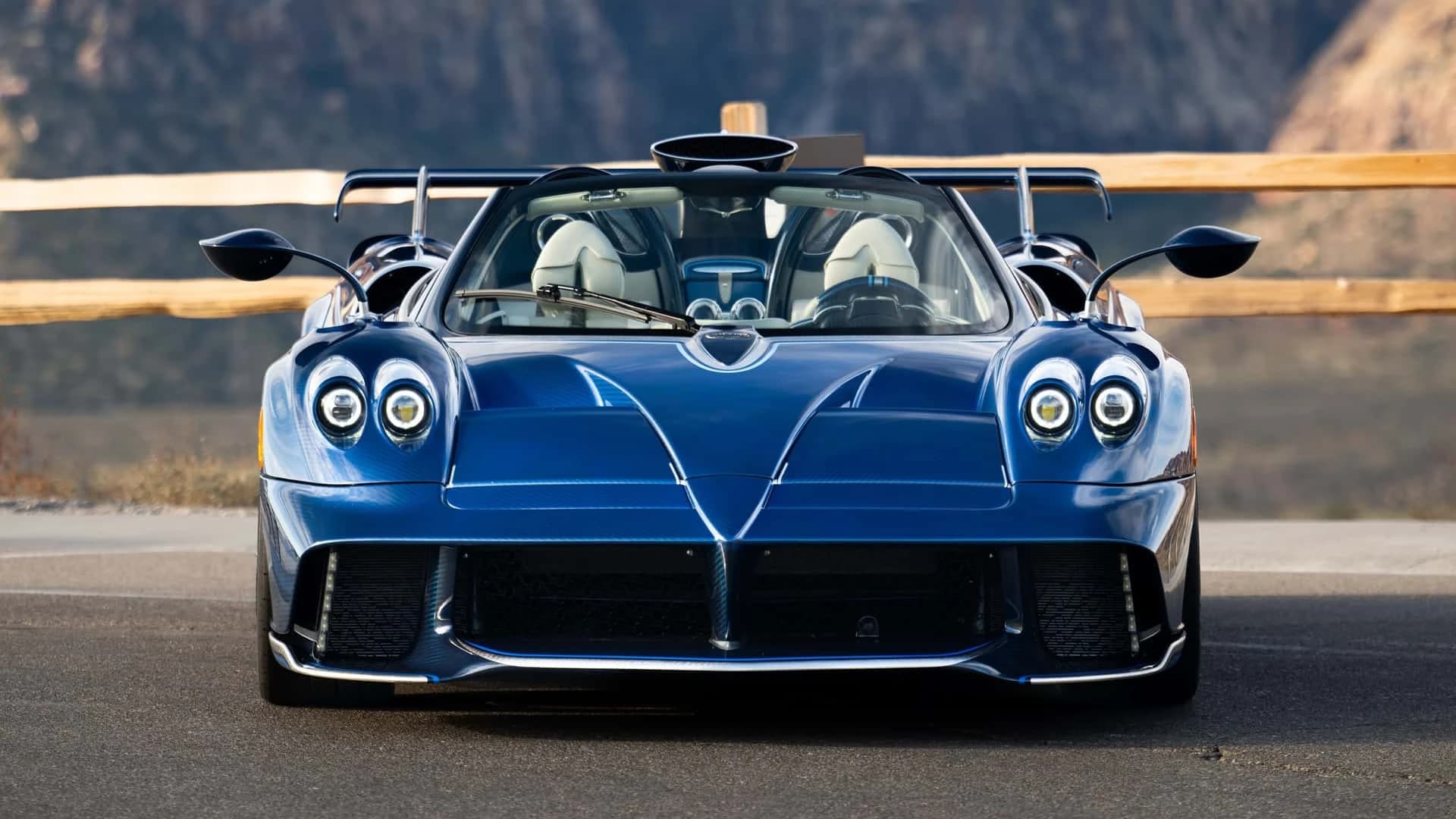
Pagani has completed its three-car Huayra 70 series with the Anima, a bespoke open-cockpit creation presented at the Concours at Wynn Las Vegas. The manufacturer identifies it as the third and final Huayra 70 from its Grandi Complicazioni division. That closes the anniversary trio; it does not announce the end of every future project carrying the Huayra name.
The immediate attractions are tangible: a seven-speed manual, exposed shift hardware, diamond-dust-infused paint and a white ceramic six-outlet exhaust. The missing numbers matter too. Pagani’s announcement does not supply an Anima-specific power rating, torque figure, acceleration time or price. Specifications from another special Huayra should not quietly fill those gaps.
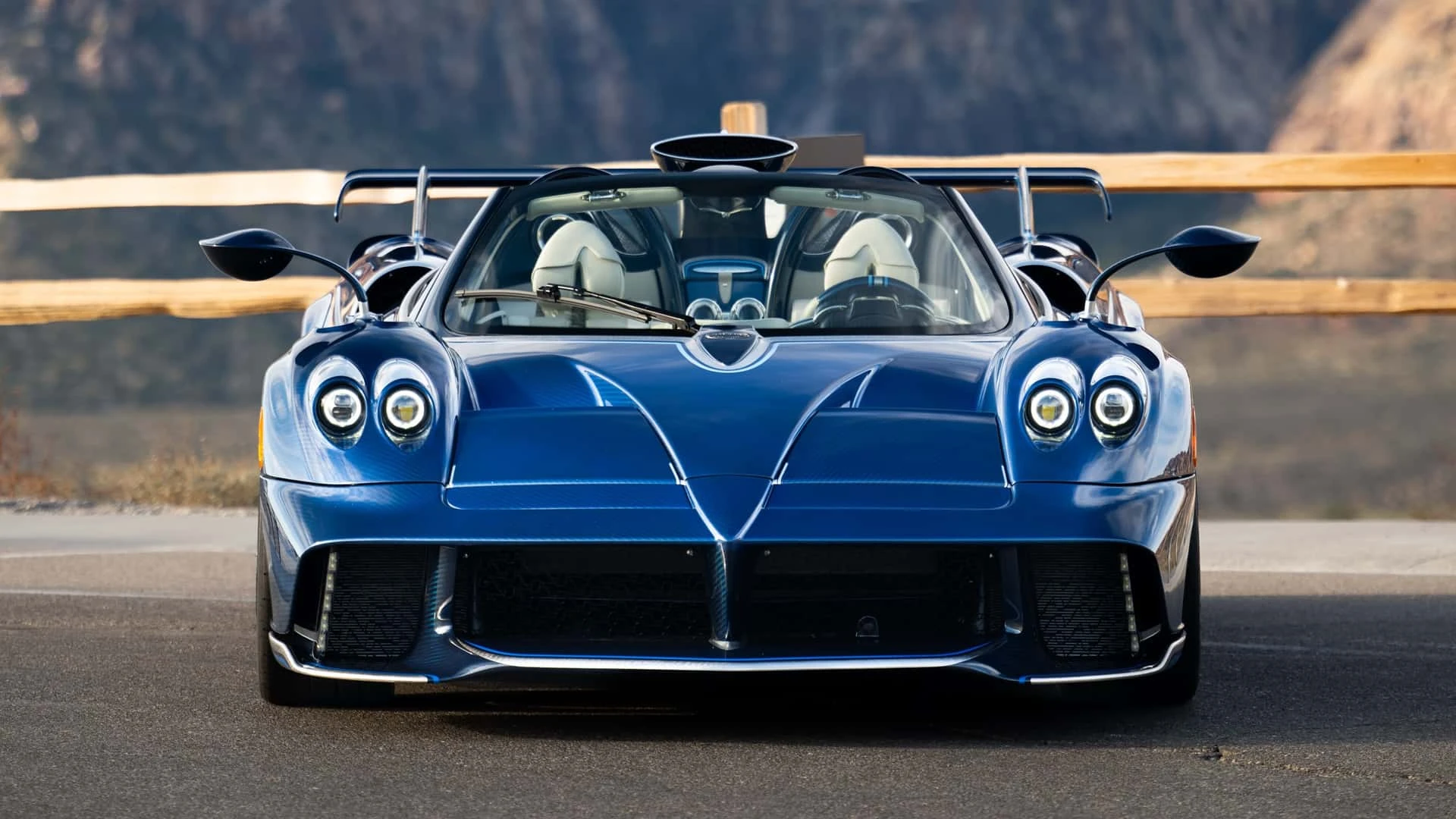
The Anima viewed from the front. Photo: Pagani.
A final chapter with a defined scope
The Anima follows the Trionfo and the Derecho in the series celebrating Horacio Pagani’s 70th birthday. Pagani’s release of 7 July 2026 provides a firm earlier reference: it introduced the Derecho for its Goodwood Festival of Speed world premiere and explicitly called it the second of three anniversary cars. The company’s Anima announcement now completes that sequence.
Reporting from the unveiling by duPont REGISTRY dates the reveal to 31 October 2026 and says Horacio Pagani personally removed the cover. Wynn’s own event information confirms the concours weekend ran from 29 October to 1 November, with the main exhibition on 31 October. According to the event report, all three Huayra 70s appeared together in public at Las Vegas.
What the four views reveal
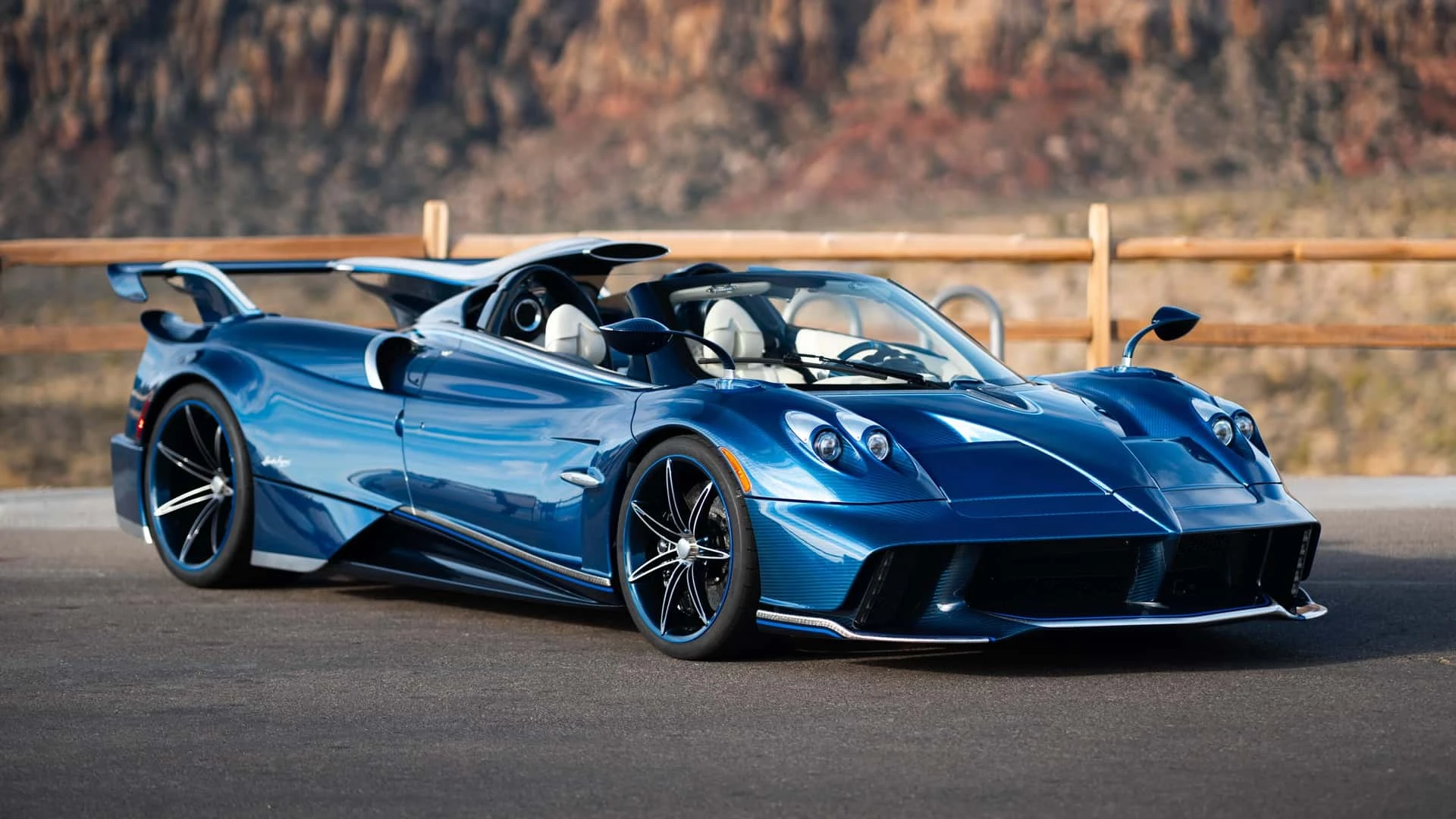
Front three-quarter view showing the side. Photo: Pagani.
From the front, the Anima has a pronounced lower splitter and a wide arrangement of cooling openings beneath its separate headlamp housings. The front three-quarter photograph also shows the side treatment: extended carbon sections along the sills, the open passenger compartment and the sculpted bodywork surrounding it. This is the available side-oriented view rather than a perfectly perpendicular profile photograph.
At the rear, the fixed wing sits above a heavily opened tail and substantial diffuser. The visible mechanical components are part of the car’s presentation, not hidden behind a continuous painted cover. An intake and vertical fin rise behind the cockpit, with individual rollover structures behind the seats. Pagani specifically confirms that the six-pipe exhaust has a bespoke white ceramic finish.
These are observations about the photographed car. They are not evidence of a measured downforce increase or a faster lap time. No Anima-specific aerodynamic test data accompany the announcement, so the size of the wing cannot responsibly be converted into a performance claim.
Precious materials without a published materials bill
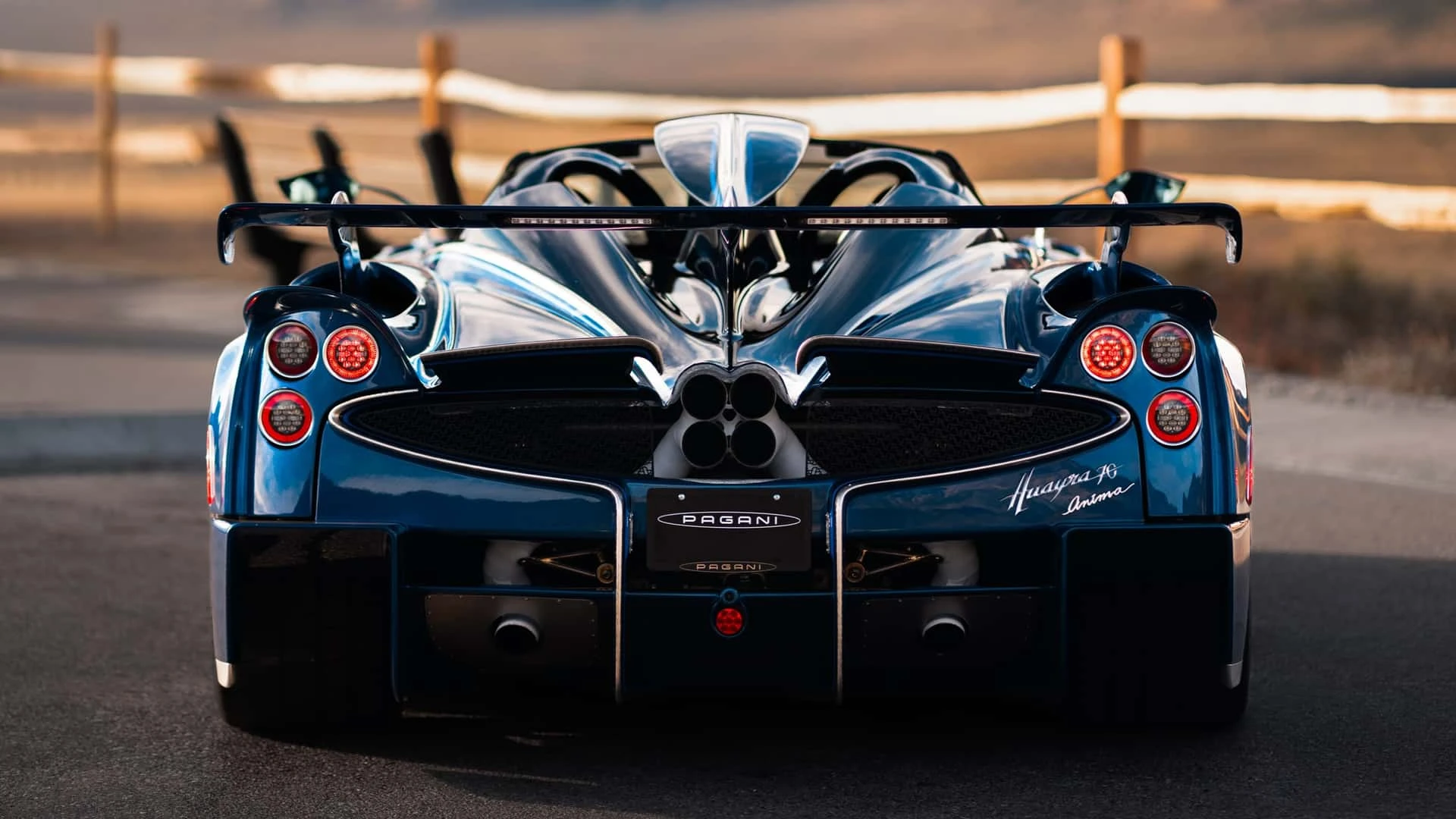
Rear view with fixed wing and white exhaust outlets. Photo: Pagani.
Pagani describes a Custom Metallic finish infused with diamond dust, combined with Inky Blues and a hand-decorated platinum-leaf stripe. Exposed carbon remains visible through the overall treatment. The company does not give the quantity of diamond, the cost of the finish or a separate valuation for the platinum detail.
The cabin photograph shows white upholstery, blue accents and exposed metal controls. The gear lever’s mechanical linkage is deliberately visible between the seats, alongside a three-pedal layout. That makes the manual transmission a feature a reader can identify, rather than an abstract promise of greater involvement. No driving assessment is implied: Carboratory has not tested this one-off.
The confirmed engine numbers belong to other cars
The most useful official comparison is the Derecho’s published technical sheet. It specifies a 5,980 cc twin-turbo V12 developed for Pagani by Mercedes-AMG, rated at 635 kW at 6,000 rpm and 18°C. Torque is listed as 1,100 Nm from 2,800 to 5,900 rpm. Its seven-speed transverse manual gearbox is supplied under the Pagani by Xtrac name, with rear-wheel drive.
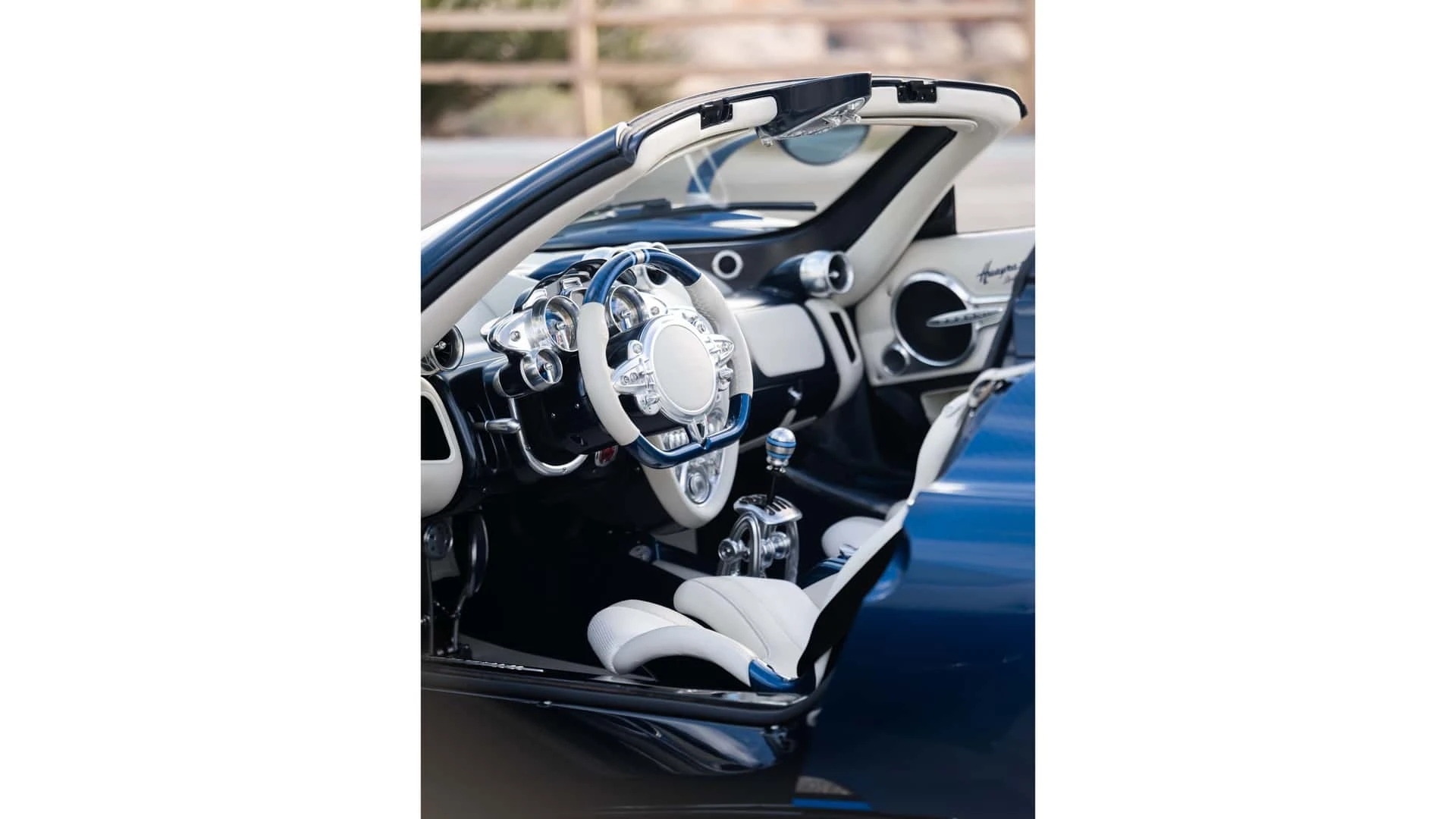
White-and-blue cabin with manual gear lever. Photo: Pagani.
The same document gives the Derecho an electronically limited maximum speed of 350 km/h. Those are manufacturer specifications for the Derecho, not confirmed Anima results. The shared family background makes them relevant context but cannot establish identical calibration, weight or performance for a separately commissioned car.
Pagani’s technical description also gives the Derecho a central monocoque in Carbon-Titanium HP62 G2 and Carbo-Triax HP62, chromium-molybdenum steel subframes and carbon-fibre body panels. Its brakes use carbon-ceramic discs measuring 398 mm at the front and 380 mm at the rear. Again, those details identify the documented comparison car; the Anima’s launch message does not provide an equivalent complete chassis specification.
Why the Epitome remains part of the story
The manual Huayra precedent was publicly established on 2 July 2024, when Pagani introduced the Epitome as the first Huayra with a manual gearbox. Its official technical sheet lists the same 635 kW and 1,100 Nm, together with a seven-speed Pagani by Xtrac transmission. A description of the Epitome as the first manual Huayra is historically precise; describing it as the only one today would ignore the later anniversary cars.
The Epitome release also explains how Grandi Complicazioni works with individual clients. Division head Lorenzo Kerkoc described nine months spent developing the concept with the customer, followed by ten months of engineering design. Those timings belong to that particular project. They do not establish how long Pagani spent creating the Anima.
For the new car, the confirmed story is the completion of a three-part commission and the unusually explicit display of its materials and mechanical controls. Its price, exact output and measured performance remain undisclosed in the sources consulted. Until Pagani publishes an Anima-specific specification, the final chapter is best understood through those confirmed details rather than borrowed headline numbers.