
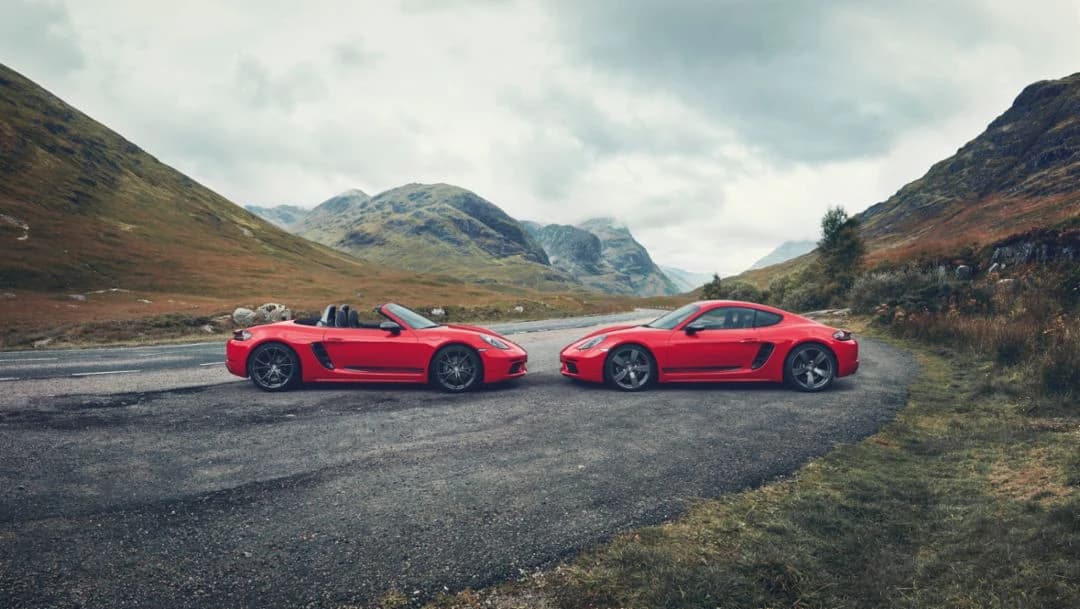
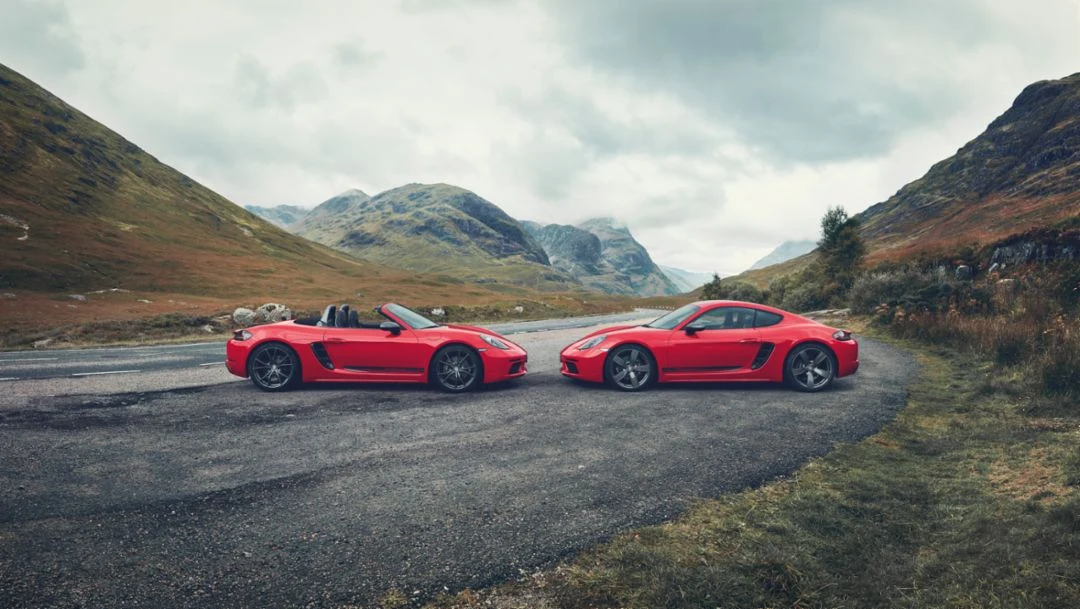
Porsche’s latest product strategy does not include a petrol-powered return for the Boxster and Cayman. Published after the company’s Capital Markets Day on October 7, 2026, the Sportwagenschmiede ’35 plan describes the next 718 Boxster and Cayman as all-electric models. Porsche expects the two sports cars to contribute to sales in their first full year of production in 2028.
What Porsche has actually confirmed
The wording in Porsche’s strategy is more specific than a general statement about electrification. The company names the all-electric 718 Boxster and Cayman as part of its future product portfolio. It also gives a separate description for a new B-segment SUV planned for presentation in 2028. That SUV is expected to be offered with internal-combustion and plug-in hybrid powertrains and to make a contribution to sales and profitability in 2029 after production ramps up.
There is no equivalent combustion or plug-in hybrid entry for the future 718 in the published plan. Porsche does not list a petrol derivative, a hybrid derivative or a separate launch phase for one. The careful conclusion is not that the company can never change its plan, but that a combustion-engine Boxster or Cayman is not part of the announced roadmap.
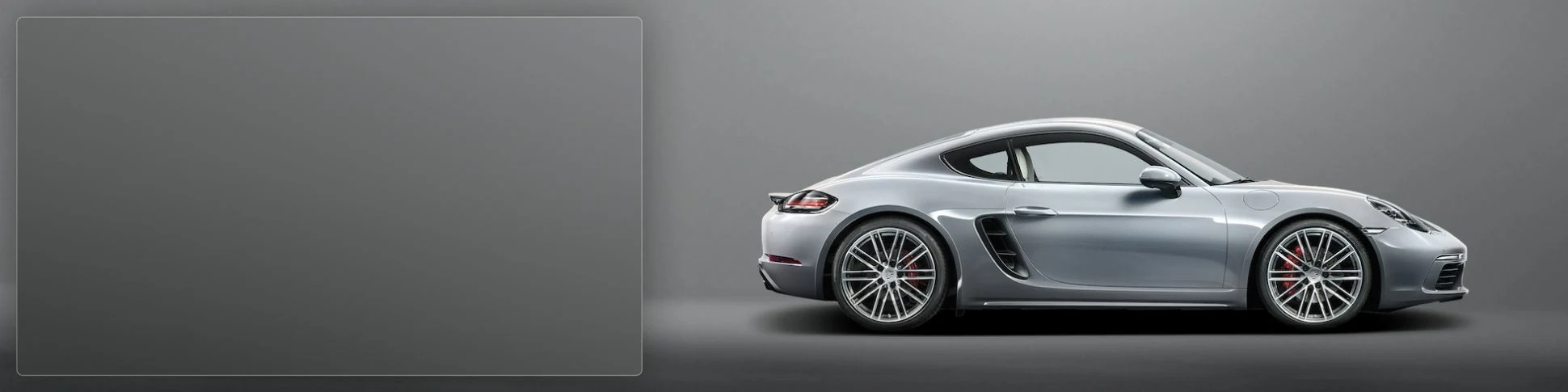
The distinction matters because Porsche is not abandoning combustion engines across its entire portfolio. The strategy gives future combustion and plug-in hybrid products a clear place in the SUV programme, while it places the two-door 718 sports cars in the battery-electric part of the range. This is a model-line decision rather than a promise that every Porsche will become electric at the same time.
The petrol 718 has already ended production
The decision concerns a successor to a model line whose combustion production has already ended. Porsche’s 2026 delivery reports state that production of the combustion-engined 718 ended in October 2025. The current-generation Boxster and Cayman therefore represent the end of the petrol-powered mid-engined family as it has been sold in recent years.
The transition is visible in Porsche’s delivery numbers. During the first quarter of 2026, the 718 Boxster and 718 Cayman recorded 1,792 deliveries, 60 per cent fewer than in the same period a year earlier. In the first half of the year, the two models reached 2,789 deliveries, down 73 per cent year on year. Porsche links the decline to the end of combustion 718 production and the resulting limited product availability.
These figures are not a direct comparison between a petrol car and an electric successor. They describe a model line at the end of its production cycle, when supply depends on remaining inventory and market allocation. They do, however, show why a gap between generations can be large before the replacement reaches full production.
Why a petrol return was discussed
Porsche adjusted its broader product strategy in 2025 because demand for exclusive battery-electric vehicles was growing more slowly than expected. The company said some electric launches would be rescheduled and that its portfolio would continue to combine combustion engines, plug-in hybrids and battery-electric models. At the same time, Porsche kept the future two-door sports car in the 718 segment within its BEV offering.
That combination created room for speculation about a petrol Boxster or Cayman returning after the electric models. A combustion version could preserve the sound, refuelling routine and familiar responses that many buyers associate with a mid-engined Porsche. It would also require a separate engineering programme or a major adaptation of an electric-first architecture, with consequences for packaging, crash structure, cooling and weight distribution.
The October 2026 strategy does not confirm such a programme. Instead, it repeats the electric positioning of the future 718 and assigns the combustion-plus-plug-in-hybrid mix to the future B-segment SUV. The two product decisions appear in the same strategy document but serve different customer and technical requirements.
What remains unknown about the electric 718
Porsche has not published the full specification of the next Boxster and Cayman. Battery capacity, system output, WLTP range, kerb weight, charging times, prices and market-specific delivery dates remain unconfirmed in the strategy document. The reference to 2028 concerns the first full year of production support for sales, not necessarily the exact date on which every country will receive customer cars.
The public plan also does not explain whether the Boxster and Cayman will share the same battery, motor layout or performance versions. An electric sports car can use rear-wheel drive, all-wheel drive or different motor outputs across a range, but those are engineering details Porsche has not released here. It would be speculation to turn the 2028 production target into a technical specification.
For buyers in Europe, the change will eventually make charging access part of the ownership decision. A petrol 718 can be refuelled in minutes and carries a known operating routine. An electric successor will be judged by charging speed, motorway range, cold-weather performance and the availability of reliable public chargers. Porsche has not yet stated the final numbers for those practical questions.
Porsche is keeping a mixed portfolio
The end of the combustion 718 does not mean that every Porsche model is moving on the same schedule. Porsche’s strategy keeps the 911 as a core sports car, develops the future electric 718, and plans a new B-segment SUV with combustion and plug-in hybrid choices. The company has also said that the Panamera and Cayenne will continue with combustion and plug-in hybrid powertrains well into the 2030s.
That mixture explains why the Boxster and Cayman decision should be read narrowly. The future 718 is electric because Porsche has assigned that technology to the two-door sports-car line. The same company is using internal-combustion and plug-in hybrid systems where it expects different market and packaging requirements. The strategy is not a single powertrain rule for every model.
The current conclusion
Based on Porsche’s product plan published on October 7, 2026, a petrol comeback for the Boxster and Cayman is not scheduled. The next 718 generation is planned as an all-electric family, with the first full production year expected in 2028. The combustion-powered cars end with the current series, whose production finished in October 2025.
Porsche could revise a future product cycle, but no such revision has been announced. The verified position today is narrower and clearer: combustion and plug-in hybrid Porsche models remain in the wider strategy, while the future Boxster and Cayman are officially listed as electric cars.


