
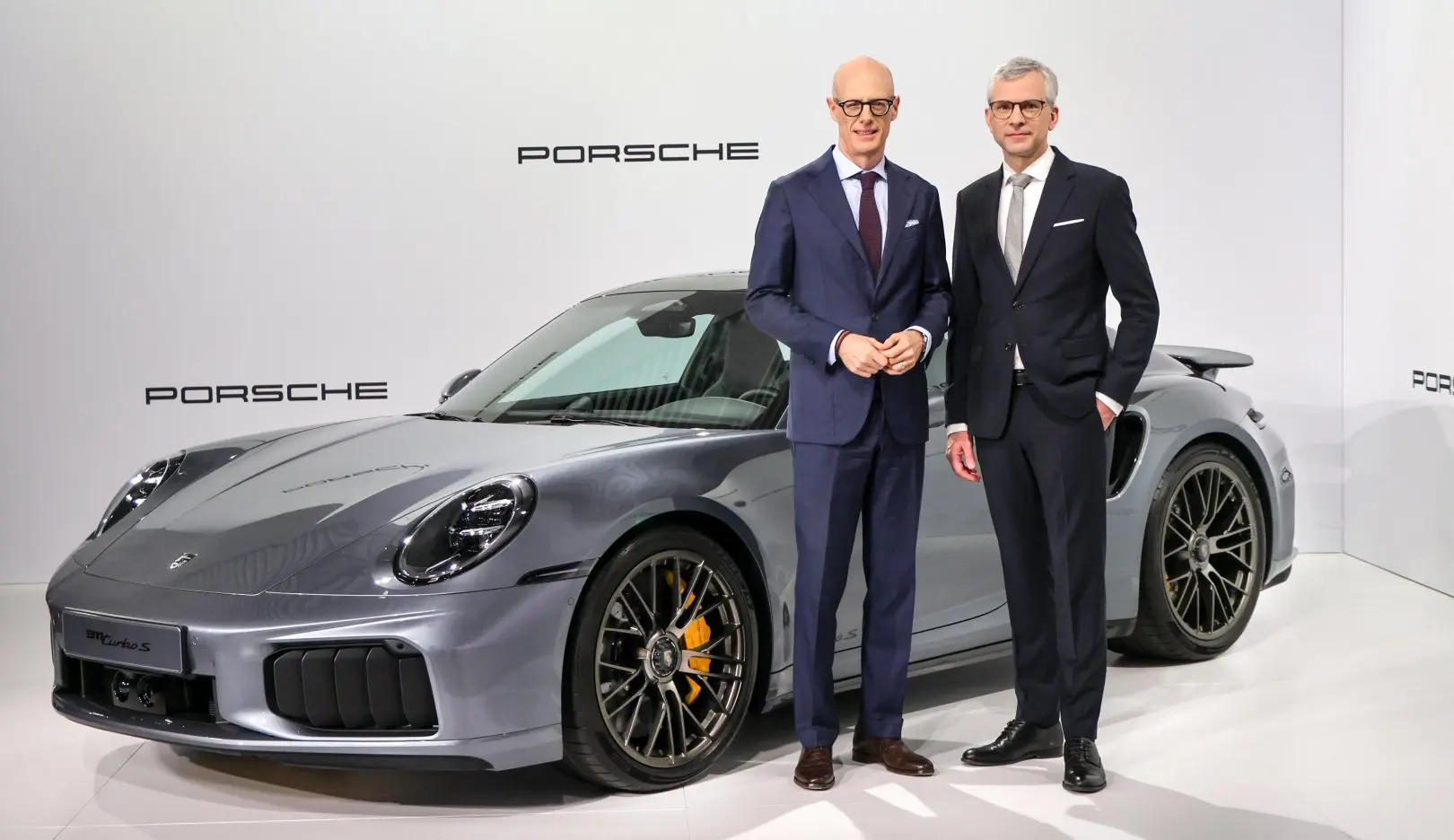
Michael Leiters and Jochen Breckner beside a Porsche 911 Turbo S. Photo source: Porsche AG.
Porsche keeps petrol engines: a gas Macan returns in 2028 while the 911 stays non-electric
Porsche is recalibrating its electrification plan without abandoning electric cars. Chief executive Michael Leiters says the future range will combine combustion engines, hybrids and battery-electric models. In that plan, the Macan is due to receive a combustion-engine version again in 2028, while Porsche continues to rule out a fully electric 911.
The position comes as the German sports-car maker tries to reduce the financial pressure created by a rapid product transition, weaker demand in China and high spending on electric technology. Leiters does not describe the change as a retreat from EVs. He presents it as a mixed strategy in which customers can choose different powertrains according to the market and the vehicle segment.
A petrol Macan is planned for 2028
The electric Macan became the compact SUV’s new generation in Europe, but Porsche no longer treats a battery-only range as suitable for every market. The company is preparing a combustion successor, targeted for 2028, which would be sold alongside the Macan Electric rather than replacing it.
That decision changes the original direction of the Macan nameplate. Porsche introduced the electric model as part of a transition in which combustion engines would gradually become less important. Outside the European Union, however, the company continued to offer the petrol Macan until production ended in the summer of 2026. Porsche’s first-half delivery report shows that the model line still contained both combustion and electric vehicles during the phase-out period.
Porsche has not disclosed the future Macan’s engine size, output, price or platform. It has also not confirmed whether the vehicle will use a mild-hybrid or plug-in hybrid system. Those details should not be treated as known specifications. The confirmed point is the planned return of a combustion-powered Macan around 2028.
Why Porsche is still investing in EVs
Leiters has rejected the idea that he is opposed to electric cars. Porsche is continuing the development of the Cayenne Electric and electric sports cars in the 718 family. The Taycan and Macan Electric remain part of the portfolio as well. The company’s argument is that it should not impose one technology on every model when demand differs between regions and vehicle categories.
Porsche delivered 60,991 vehicles in the first quarter of 2026, 15 per cent fewer than in the same period a year earlier. First-half deliveries reached 122,306 units, down 16 per cent year on year. Porsche attributed the decline to the end of combustion 718 production, the changing ramp-up pattern of the electric Macan and the end of tax incentives for electric and hybrid cars in the United States.
The results do not show the same trend for every model. Porsche reported 30,534 911 deliveries in the first half, an increase of 19 per cent. The Macan line declined by 22 per cent. These are manufacturer-reported global deliveries, not an independent measurement of demand for each powertrain.
The 911 remains combustion-powered and hybrid
Porsche’s position is firmer with the 911. The company has said that it will not build a fully electric version of the sports car. The current 911 Carrera GTS uses the T-Hybrid system: a six-cylinder boxer engine works with electric components, but the car is not powered exclusively by a battery.
The distinction matters to Porsche’s product plan. A performance hybrid can support output and efficiency without changing the car into a battery-electric sports car. Porsche has described the in-house hybrid system as a long-term building block for the 911 rather than a temporary step before an EV arrives.
The company has not said whether every future 911 variant will use hybrid assistance or how long a non-hybrid combustion version will remain available. Porsche has also not announced a plug-in hybrid 911. In this model, the battery and electric motor must be integrated without excessive weight or a major increase in size, two practical limits for a rear-engined sports coupe.
Strategy 2035 also means fewer variants
Porsche’s Strategy 2035 is organised around brand and customers, products and technology, and the company’s operations. At its annual general meeting in June, Leiters said the portfolio had become too complex and that the number of variants would be reduced. In the United States, Porsche has already discontinued two Taycan body styles in response to local demand.
The company has also agreed a future package with employee representatives. It includes a socially responsible reduction of a further 5,000 jobs by 2035, mainly through natural attrition, partial retirement and voluntary agreements. Combined with earlier measures, the planned reduction is close to 9,000 positions. Porsche has committed €2.1 billion in cumulative investment at its Zuffenhausen and Weissach sites, while extending employment and site protection to 2035.
For buyers, this does not yet amount to a new European price list or a confirmed list of withdrawn versions. Porsche has not published every model it will retain, cancel or launch. The available evidence supports a three-powertrain strategy, but it does not mean every Porsche model will offer all three options.
Porsche plans to present the full Strategy 2035 at its Capital Markets Day in October. Until then, the return of the petrol Macan and the decision to exclude an electric 911 are strategic directions, not complete technical briefs for future cars.


