Renault presented the Renault 8 Gordini Concept on 24 September 2026 at Renault Carwalk. The official press pack describes a two-seat electric coupe with a 270 hp electric motor, a low and wide body and motorsport-inspired styling. After Carwalk, the show car is scheduled for the Renault stand at the Paris Motor Show between 12 and 18 October 2026.
The brand places the concept in a five-year run of one-off reinterpretations of its 128-year history, ahead of the Renault Collections museum in Flins, due to open to the public in about fifteen months. Earlier pieces in that line include the R17 electric restomod with Ora Ïto and the Renault 5 Diamant art car with Pierre Gonalons. The release does not announce a series version, price, WLTP range or a commercial calendar.
What the concept is, in numbers
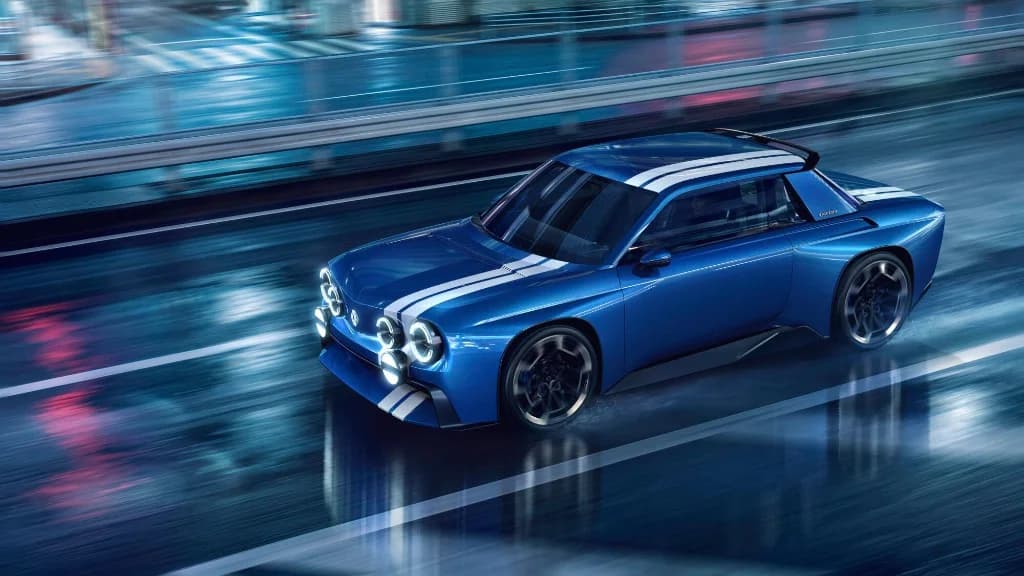
Renault quotes 4.12 m length, 1.88 m width and 1.27 m height, with 19-inch front and 20-inch rear wheels. The two-door coupe is more aggressive than the original four-door saloon, with a V-shaped front and six circular lamps. The wide, sculpted rear is meant to recall the rear-engine, rear-wheel-drive architecture of the 1964 car; the stated difference today is the 270 hp electric drive. A slight rear rake, absent on the original, is also noted.
Alexandre Malval, Renault’s vice-president of design, says the team wanted to spark emotion by drawing on heritage and modernity, and that the style exercise reinvents the Renault 8 Gordini for today. He adds that emotion here means real passion for cars, not nostalgia. Those are manufacturer statements; the pack contains no independent test figures for acceleration, range or mass.
From “la Gorde” in 1964 to an exploratory design study
The 1964 Renault 8 Gordini used a 95 hp rear-mounted engine and driven rear wheels. Renault describes it as efficient but demanding, a “voiture-école” for a generation of drivers including Jean Ragnotti. Putting the Gordini name on a sports version of a volume model, the company says, made performance more accessible roughly a decade before the GTI boom; the twin white stripe became the visual signature.
Amédée Gordini, nicknamed “the sorcerer,” first worked with Renault in 1957 on the Dauphine Gordini, where power rose from 32 hp to 37 hp according to the same release. The later R8 Gordini cemented the double white stripe in motorsport lore. The press text also recounts Gordini’s working method: instructions at the milling machine rather than a drawing board, with the finished part then sketched by a draughtsman. That belongs to brand heritage storytelling, not to a homologated data sheet for the 2026 concept.
A 100% Renault design from more than 300 sketches
Unlike the R17 collaboration with Ora Ïto, Renault presents the 8 Gordini Concept as entirely in-house. An internal Renault Design contest generated more than 300 sketches, from classic retro to futurist, heritage-modern hybrids and GT looks. Two proposals were built as 2:5 scale models; a new sketch then combined the preferred elements of both.
Malval says the original’s almost front-to-rear symmetry was updated for a more dynamic stance: flowing cabin lines, a wide track, prominent wings and larger rear wheels as a visual nod to rear-wheel drive. Exterior designer Kévin Goncalves links the rectangular wheel arches to the athletic rear fenders and the visual mass of the back end.
Café-racer thinking and 1964 references
Renault ties the concept to the café-racer idea familiar from custom motorcycles: strip non-essentials and show materials clearly—an approach it also cites on the Renault 5 Turbo 3E. On the Gordini Concept, the old chrome side trim becomes a sculpted body edge; visible bonnet shut-line joints disappear, as on racing cars.
Retained cues include Gordini lettering with the original badge’s grooves, a new “8” emblem built from eight segments, shell-shaped mirrors, a full-width grille at the base of the windscreen and a rear vent grille. The side relief moulding now ducts air to a vent. Six 3D circular projectors sit in the bodywork; flush tail-lamps are said to be nearly invisible when off. An interior crest nods to the diamond logo and to “la Gorde” for enthusiasts.
Thomas Altet, colour and materials designer, says the paint starts from Bleu de France, rebuilt in three layers with mother-of-pearl and a blue-tinted binder so the historic hue returns on the edges in light. The twin white stripe is no longer only a graphic: Goncalves describes it as a structural element that aligns the scuttle grille and the lit graphic inside the rear lamps, then continues into the cabin along the top of the dashboard, shifting from white to blue.
Cabin: aluminium, Alcantara and digital round dials
Inside, a brushed-aluminium horizontal band carries thick-rimmed round digital dials whose bezels echo the 3D headlamps. Plastics give way to aluminium and Alcantara®; carbon used for the body does not appear in the passenger cell. Ambient light sits under the dash. The red chrono button at the centre of the fascia is presented as the one control meant to catch the eye.
Shell seats use a blue corduroy centre on a black structure, as a contemporary take on period flat seats without headrests. Door stitching with Alcantara® is likened to circuit kerbs. Stéphane Maiore, Renault interior design director, says the original perforated metal instrument plate is reinterpreted as a horizontal support for aligned round displays under a continuous line that frames the driver’s view. Interior designer Robin Biondi adds that part count was cut to a minimum, with each piece serving structure and appearance.
What the release still leaves open
There is no battery capacity, WLTP range, torque, kerb weight, platform name, charging time or homologation claim in the 24 September pack. There is no price and no production volume. Paris, 12–18 October 2026, is the confirmed public date after Carwalk; the longer-term destination named by Renault is the Flins heritage collection, not a dealer price list.
For readers, the story is a one-off electric object that restates Gordini cues—blue paint, twin stripe, multi-lamp front, rear-drive visual drama—without announcing a road-car successor. Treating it as a future showroom model would go beyond the official text.
Photo: Renault – Renault 8 Gordini Concept press imagery, stored locally as WebP.
Sources
- Official Renault press release, 24 September 2026: “Renault 8 Gordini Concept: when the rear-wheel-drive legend enters the electric era”
- Mondial de l'Auto 2026 – practical information
- Renault Group media site