Official Rivian product image from the manufacturer's technology page, used editorially.
Rivian is recalling 98,828 electric vehicles in the United States because a stability-control notification can, in a rare set of circumstances, cover the rear-view camera image when Reverse is selected. The company has released a free over-the-air software correction. The action is registered as NHTSA campaign 26V597 and Rivian campaign FSAM-1866.
The population consists of 62,259 R1S SUVs, 34,088 R1T pickups and 2,481 R2 SUVs. Rivian told the National Highway Traffic Safety Administration that it knew of no customer reports, crashes, injuries or fatalities related to the condition in any market as of its 16 September 2026 filing. More than 95% of the affected fleet had already installed software containing the remedy by that date.
The unusual sequence that triggers the problem
This is not a case in which the camera hardware routinely fails when the driver shifts into Reverse. The official Part 573 report describes a specific chain of events. A driver first turns stability control off while using one of the drive modes that allows it, leaves the vehicle for a period, then returns. The centre display may show a safety alert reminding the driver that stability control remains disabled and asking whether the vehicle should return to a mode in which it is active.
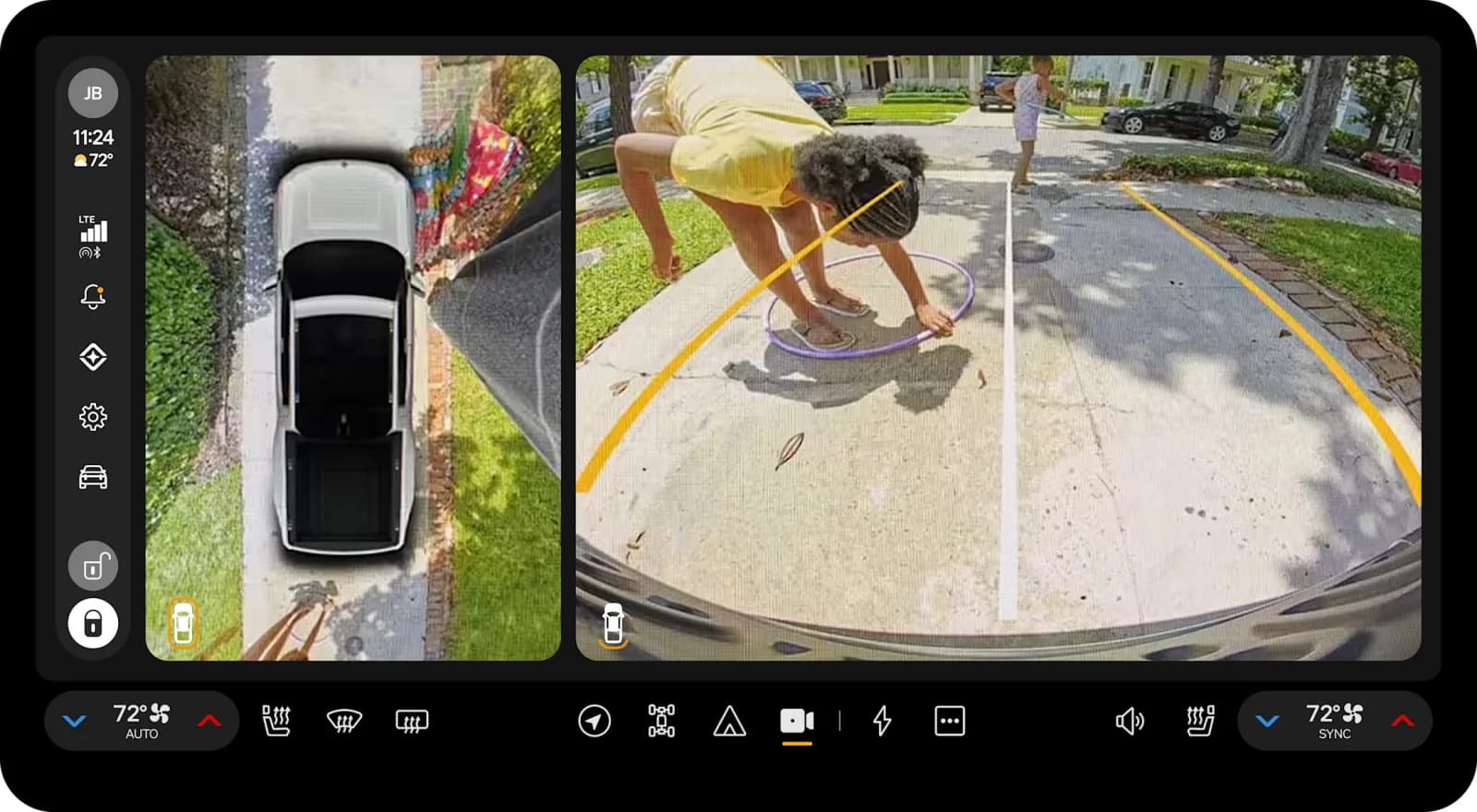
If the driver selects Reverse without answering that prompt, the drive-mode notification may overlap the camera image. The image reappears when the vehicle starts moving and its speed becomes non-zero. It can also be restored by selecting the camera page on the centre display.
That short period before movement is the compliance issue. Federal Motor Vehicle Safety Standard 111 requires the rear-view image to be available at the start of a backing event. A prompt that obscures the picture can reduce the driver's view of a child, pet or low object immediately behind the vehicle, even if the camera feed becomes visible a moment later.
NHTSA therefore records the campaign under back-over prevention software. The filing does not identify a failed camera, cable or display panel. The camera can be operating and producing a picture while the user interface draws another element above it. That distinction explains why the remedy is code rather than replacement hardware.
Which R1S, R1T and R2 vehicles are covered
The 98,828 total is divided by model and production record. The R1T group covers certain model-year 2022–2026 trucks built from 23 August 2021 through 6 July 2026. The R1S group covers certain model-year 2022–2027 SUVs built from 30 March 2022 through 6 August 2026.
Rivian's newer R2 is also included. The filing identifies certain model-year 2027 R2 vehicles produced from 23 April through 10 August 2026. Rivian says vehicles built after 10 August contain corrected software from production.
A model name and model year do not establish that one particular vehicle is subject to the campaign. Rivian selected the population using manufacturing records, and eligibility is determined by VIN. According to the recall schedule, affected VINs are due to become searchable through NHTSA on 9 November 2026. Rivian also plans to mail owner notifications on or before that date.
The NHTSA filing describes a US recall. It should not be treated as confirmation of an identical campaign in every country where a Rivian may be registered or privately imported. Owners outside the United States should ask Rivian to check the VIN and installed software rather than infer coverage from the US model-year range.
What the OTA remedy changes
The suspect component is listed simply as various software. For R1S and R1T, the affected definition includes software versions before 2026.23. For R2, it includes versions before 2026.31.40. The corrective release prevents the stability-control prompt from blocking the rear-view image during the required period.
Because the fix arrives over the air, an affected owner does not need a hardware replacement for this campaign. Rivian advises owners to install the latest available vehicle software if they have not already done so. Delivery by OTA is convenient, but it is not the same as confirmed installation: the vehicle must receive the package and complete the update.
Rivian reported that 95% of affected R1 vehicles and 96% of affected R2 vehicles had the remedy installed by 16 September. That means most cars were corrected before formal owner letters went out. The remaining population can include vehicles that were offline, updates that were deferred, or vehicles that changed hands before installation.
The percentages also need careful reading. They are Rivian's installation figures at the filing date, not a prediction and not evidence that any random R1 or R2 is fixed. The owner-facing check is the individual vehicle's software status and, once the database is populated, its VIN record.
How Rivian found the noncompliance
The company discovered the behaviour during internal testing. From July through September 2026, Rivian investigated the operations required to reproduce it, determined the potentially affected population and evaluated the implications under FMVSS 111. On 10 September, it concluded that a possible noncompliance could not be ruled out. The Part 573 report followed on 16 September.
The absence of reported crashes does not remove the need for a recall. Compliance is measured against whether the image is displayed when the standard requires it, not only against the number of incidents accumulated before discovery. Here, the user interface can fail that timing requirement even though the picture returns as soon as the vehicle moves.
Until the update is confirmed, a driver who sees a message covering the camera view should not begin reversing in the expectation that the image will return. The prompt can be answered or the camera page selected first, and the area behind the vehicle should be checked directly and through the mirrors. Cameras and parking sensors remain aids; they do not replace observation by the driver.