Rolls-Royce has begun the global road-testing programme for Project Nightingale, its two-seat electric convertible limited to 100 client cars. The programme covers 350 collective weeks of work and will take prototypes from Mediterranean roads to the Arctic Circle and the deserts of the Arabian Peninsula. Testing will extend to altitudes of 2,750 metres.
The announcement, issued on 21 September 2026, does not disclose final power, battery capacity, homologated range or price. Project Nightingale remains a production concept undergoing validation. Rolls-Royce says the cars will be built by hand at Goodwood, with customer deliveries due to begin from 2028.
What 350 collective weeks means
The figure is an accumulated engineering workload rather than a 350-week countdown to production. Multiple prototypes, specialists and test activities can contribute at the same time. Rolls-Royce has not published a total mileage, a full country list or the minimum and maximum ambient temperatures for the complete campaign, so the headline number cannot be compared directly with another manufacturer's durability programme.
Road work starts in Southern Europe. Prototypes will later encounter the Arctic Circle, Arabian deserts, temperature extremes and high-altitude routes. The stated 2,750-metre ceiling is intended to cover the environments in which the commissioning clients plan to use their cars. It is also a reminder that these vehicles are being developed to travel, rather than remain static in collections.
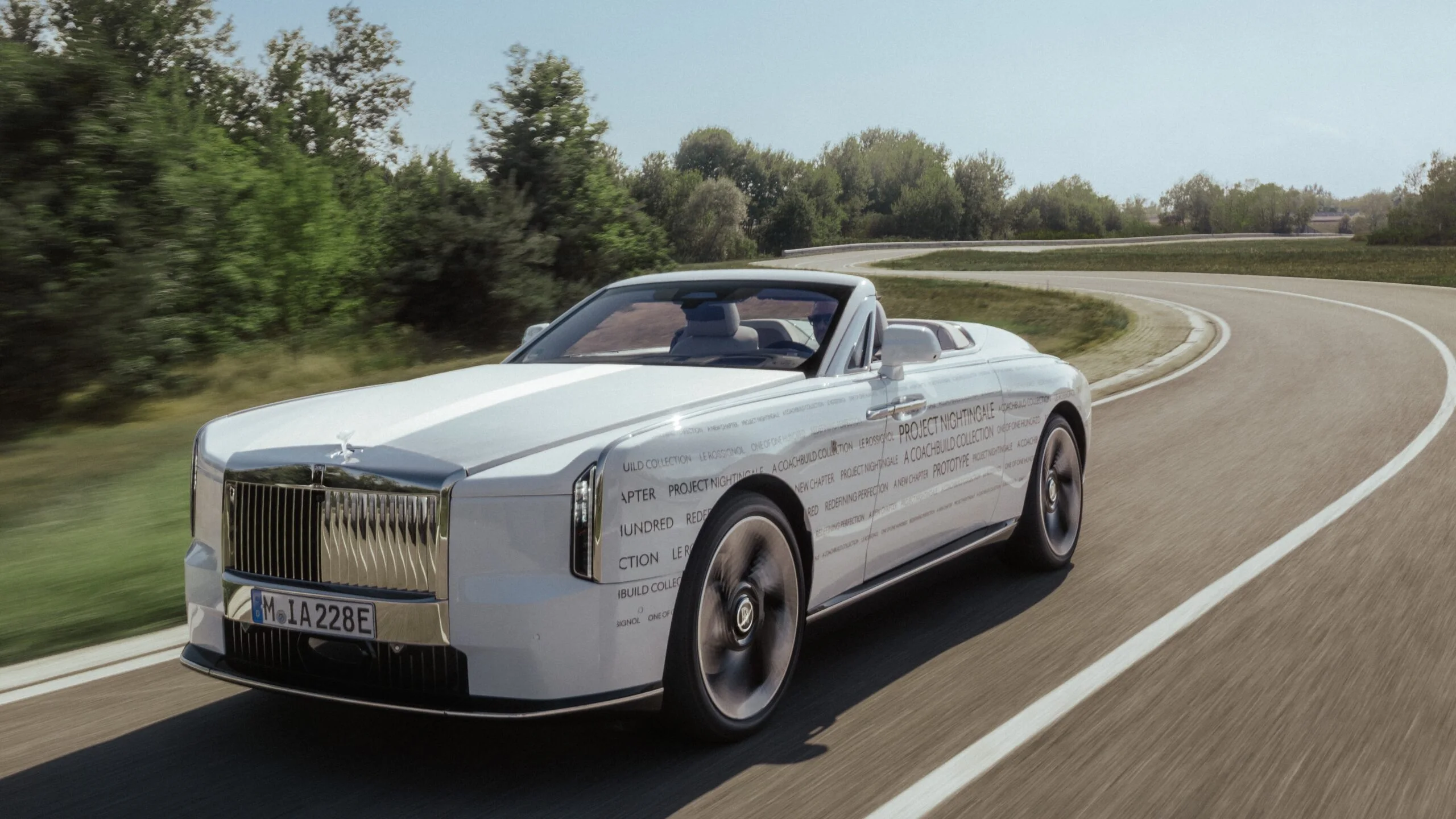
A white Project Nightingale prototype carrying development camouflage. Image: Rolls-Royce, published by ProMotor.
The Southern European start has a historical connection. The Nightingale name comes from Le Rossignol, the house Henry Royce built for his designers and engineers near his winter residence on the French Riviera. Early in the 20th century, Rolls-Royce engineers conducted speed and endurance work from this base and the marque's Châteauroux test facility, including journeys between Monte Carlo and London.
Aerodynamic work began almost three years ago
The road campaign follows a development process that started nearly three years earlier. Static prototypes have completed more than 1,430 hours of aerodynamic modelling, including digital simulations and wind-tunnel testing. Rolls-Royce will validate that laboratory work at a private high-speed facility.
The company says Project Nightingale prototypes will be tested at up to 155 mph, approximately 250 km/h. That number describes the validation speed; it is not confirmation of the production car's governed top speed. The distinction matters because the final technical specification has not been released.
Engineers will use those runs to analyse and reduce wind noise. In an open electric car, the absence of combustion-engine noise makes airflow, tyre sound and structural vibration more exposed to the occupants. Rolls-Royce says it wants wind noise to become barely perceptible, but it has not supplied a decibel target or a measurement protocol. The claim therefore remains a development objective rather than an independently measured result.
An electric wind deflector and a roof tested at 80°C
Project Nightingale has a fully electric wind deflector developed specifically for the car. Its purpose is to prevent high-pressure air behind the cabin from curling forward towards the occupants. Testing at different speeds will examine cabin turbulence and whether the device can help retain warmth when the roof is lowered in cold weather.
The fabric roof contains a sound-deadening layer combining cashmere, textile and high-performance composites. Rolls-Royce has scheduled ten separate tests covering the fabric, closing mechanism and performance at temperatures up to 80°C. The 80°C figure is a component-test condition, not a forecast of the outdoor temperature in which customers will drive.
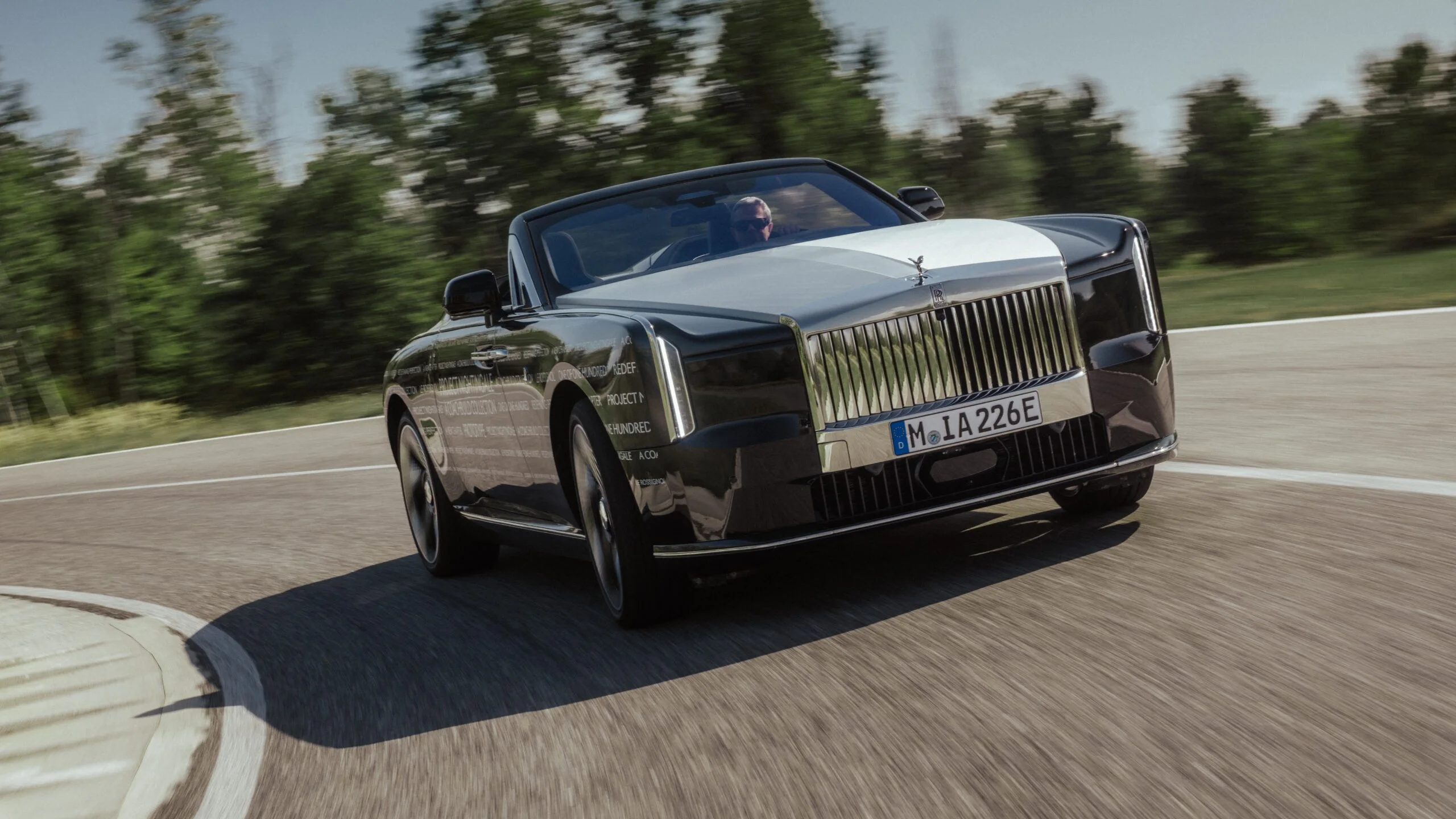
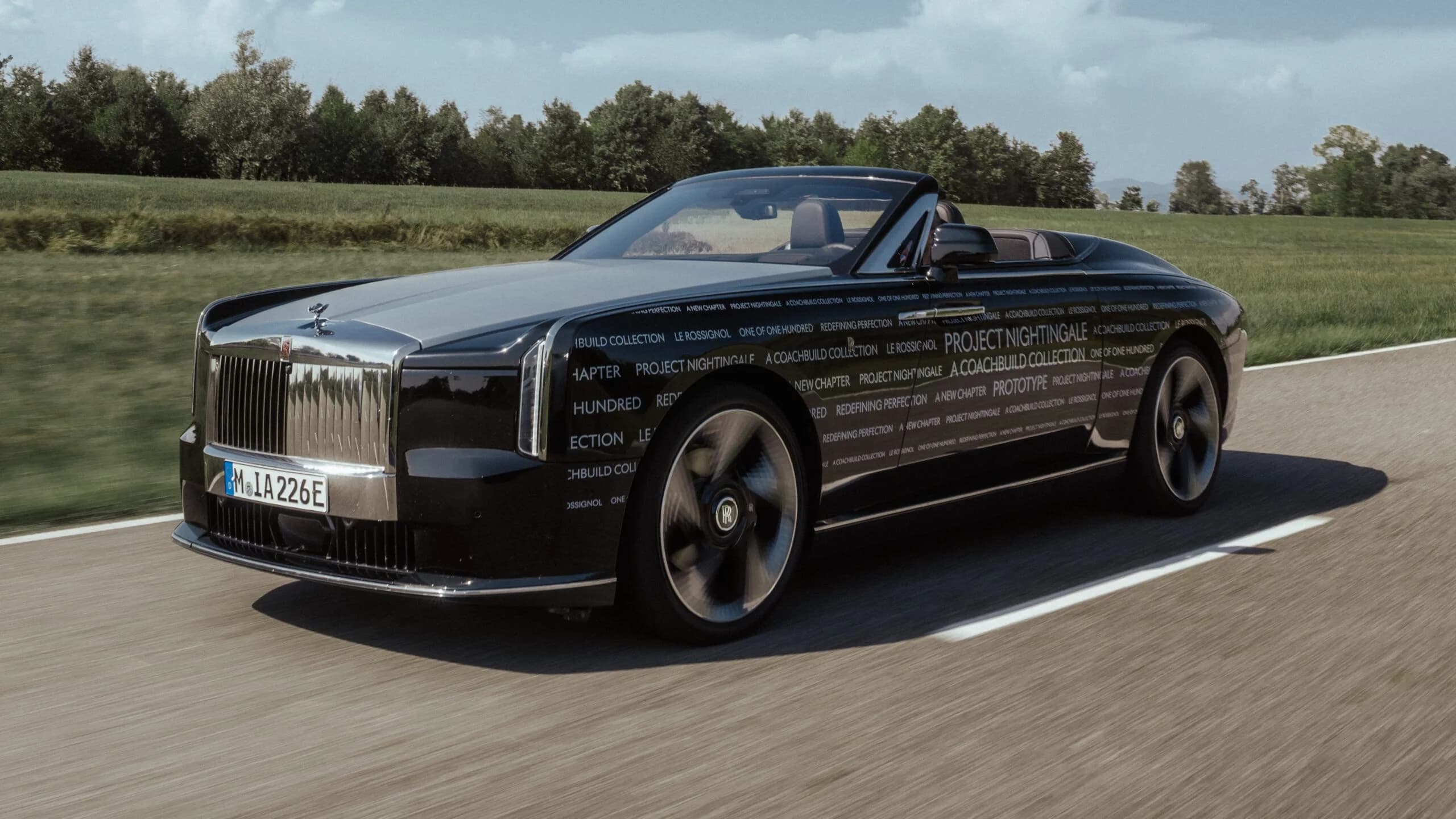
A black prototype during dynamic testing. Image: Rolls-Royce, published by ProMotor.
At the rear, the Piano Boot opens sideways on a cantilever. Rolls-Royce says the mechanism will complete as many as 15,000 opening and closing cycles. Engineers will also assess the sound of the closing movement. The company has not translated the cycle count into an expected number of years in service, so it should be read as a laboratory durability target rather than a warranty statement.
What is already known about Project Nightingale
Project Nightingale is a 5.76-metre, two-seat convertible underpinned by the aluminium Architecture of Luxury spaceframe. It is nearly as long as a Phantom saloon despite having a compact cabin for two. The car rides on 24-inch wheels, the largest fitted to a Rolls-Royce to date.
Its proportions and details refer to the experimental 16EX and 17EX cars of 1928 and to Streamline Moderne design. The grille uses 24 vanes. At the back, an Aero Afterdeck made from a single carbon-fibre element manages high-speed stability without a separate spoiler. The electric drivetrain allows that structure to occupy space that would otherwise be needed for exhaust hardware.
None of those design details provides the missing powertrain information. Rolls-Royce has not stated the usable battery capacity, motor output, charging peak, kerb weight or official driving range. It is therefore premature to treat Project Nightingale as a longer, open-top Spectre on the basis of visible similarities or the shared all-electric strategy.
All 100 cars will be offered by invitation and coachbuilt at Goodwood. Clients are already taking part in a multi-year programme connected to the car's creative and technical development. The current test campaign is the next measurable phase: validating aerodynamics, roof operation, cabin airflow, high-altitude behaviour and unusual hardware such as the Piano Boot before deliveries start from 2028.