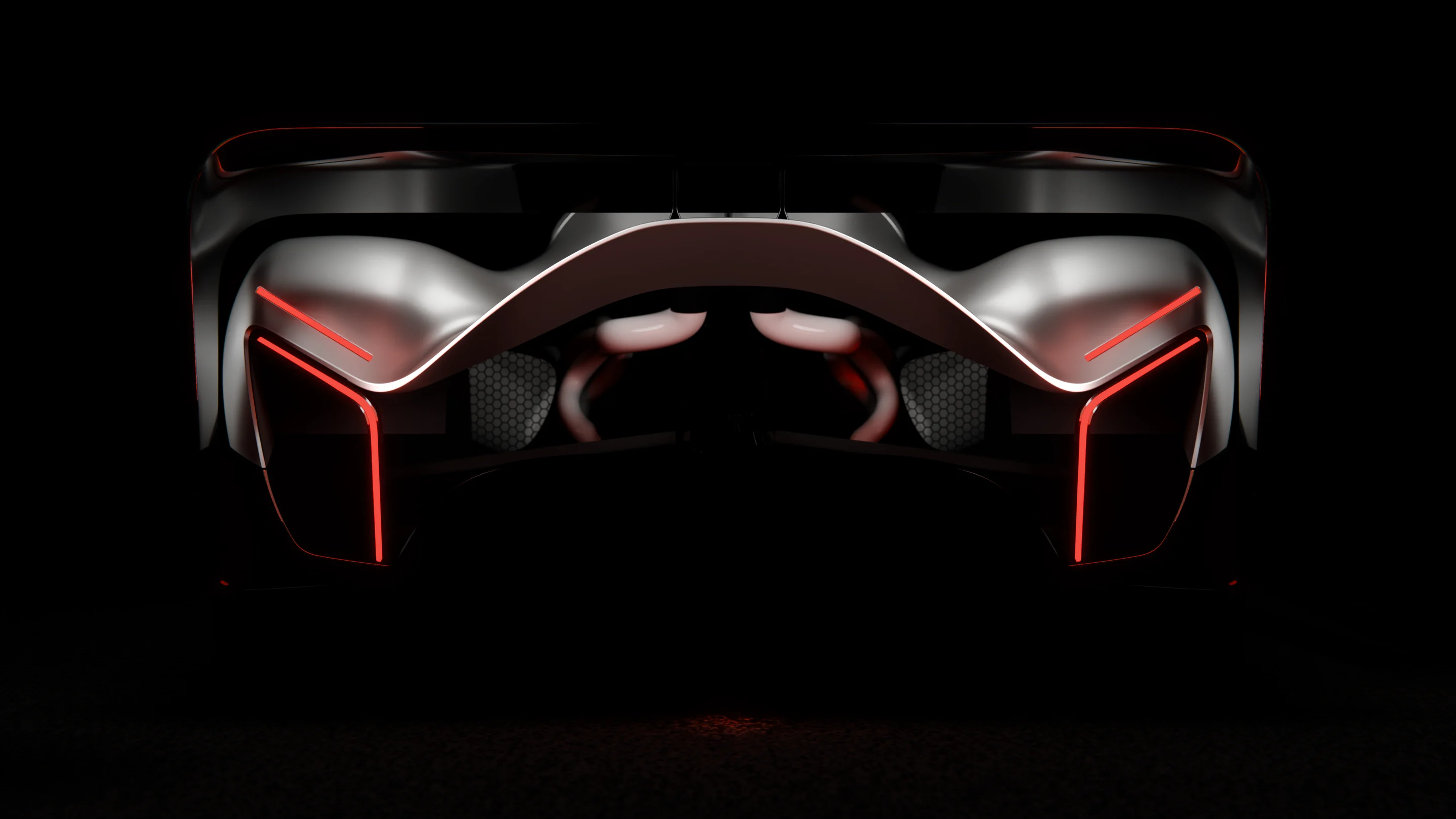
Image: Sanrivatti official media. It shows the proposed One design; the vehicle remains under development.
Sanrivatti has revealed the exterior of its first hypercar and published four targets for the One: 800 hp at 9,000 rpm, 700 Nm, a 1,100 kg dry weight and a projected 330 km/h maximum speed. The Dutch project plans a naturally aspirated V10 and a central, head-forward driving posture called the Apex Position.
These are development targets rather than independently verified results. The vehicle currently running on track is Prototype Zero, an engineering mule built to test posture, controls, upper-body support and the perception of movement. Sanrivatti explicitly says that mule is not a preview of the finished car.
A 5.5-litre Judd V10 is the intended centrepiece
Launch information reported by Auto Express identifies a mid-mounted 5.5-litre naturally aspirated V10 from Judd Power. Sanrivatti’s own site confirms the 800 hp at 9,000 rpm and 700 Nm targets, but does not yet disclose the gearbox, driven wheels, gear ratios, emissions equipment or homologation route.
Judd is the racing-engine name used by British specialist Engine Developments. John W. Judd, managing director of Judd Engines, framed the engine around throttle response and the way its output builds through the rev range, not just its peak number. That explains the engineering intent, although it does not establish the durability, emissions or performance of a complete One.
Dividing the published power target by the dry-weight target produces roughly 727 hp per tonne. That is a calculation based on two proposed values, not a measured power-to-weight ratio. Dry weight also excludes operating fluids and should not be compared directly with a road car’s kerb mass.
Apex Position puts the driver where a dashboard normally begins
The defining feature is not the engine. Sanrivatti places the driver centrally, farther forward and more upright, with the head close to the front axle and the legs drawn rearward. Prototype Zero uses rear-positioned pedals as part of a posture that resembles a superbike rider leaning over a fuel tank.
The company says the arrangement expands the driver’s view and makes acceleration, braking and cornering easier to read through the body. It has not shown the final cabin or explained ingress, restraint systems, airbag packaging, crash structures or the range of driver sizes it can accommodate. Those are fundamental questions for any claim that the architecture can move from a track experiment to a customer car.
The unusual posture may also demand more flexibility and upper-body support than a normal cockpit. Sanrivatti says proprietary systems are being developed around control and body movement, but has not published their mechanical design. Comfort over a long session, road legality and accessibility therefore remain unknown.
The visibility claim comes from an in-house virtual study
Sanrivatti released a digital comparison in October using Corner Three at Silverstone. Ten benchmark hypercars and track cars were placed at the same point. The company says Apex Position exposed 3.2 times more circuit surface than the comparison layouts and delivered a 28-degree vertical field of view, versus 15.5 degrees in the reference hypercar.
The study is useful development evidence but not an independent test. Sanrivatti has not named all ten vehicles, released the CAD files or published a repeatable external protocol. Its figures should be attributed to the company, rather than treated as a certified ergonomic advantage.
Moving the eye point forwards can logically reveal a braking zone, turn-in, apex and exit sooner. The packaging trade-off is equally real: steering, front suspension, impact structures and occupant protection all compete for space near the same part of the car. Sanrivatti is moving between digital simulation, a physical simulator and Prototype Zero before fixing the architecture.
The dramatic body is still a design statement
Official images show a very low nose, thin lighting, a single-piece canopy, large side intakes, an elevated exhaust and a substantial rear wing. Open rear surfaces are intended to manage air and release heat. The reported chassis plan includes double-wishbone pushrod suspension, AP Racing carbon brakes, forged magnesium-alloy wheels and track-oriented Michelin tyres.
Wheelbase, dimensions, aerodynamic load, tyre sizes and weight distribution have not been released. Sanrivatti also says the chassis is not final. The images should consequently be read as the intended design direction, not photographs of a homologated production example.
Sanrivatti now has a physical development base
The company moved into an approximately 618 m² headquarters at Cleantech Park Arnhem in September 2026. The site combines offices, digital design areas and a workshop for prototype construction, components, mock-ups and assembly. That gives the programme more substance than a collection of renders, although a facility does not guarantee production.
Cleantech Park Arnhem covers 90 hectares and hosts about 130 organisations employing roughly 3,000 people, according to Sanrivatti’s announcement. Founder Santiago Sánchez Rivero grew up in Uruguay and studied automotive engineering in the Netherlands before establishing the project. The team says it is advancing towards a running prototype of the One and subsequent track testing.
Price, production and road status remain unanswered
Sanrivatti has not announced a price, production total, delivery date or confirmed sales markets. There is no published European type-approval plan, crash-test programme, warranty or service network. The company invites prospective customers to register interest, but it is not presenting a public order book with contractual specifications.
That boundary matters because the One combines difficult objectives: very low mass, a road-car-shaped safety cell, a large naturally aspirated engine and an occupant position close to the front structure. Each can be engineered; demonstrating them together is the next test.
The project already has a recognisable identity. A 9,000 rpm V10 and head-forward cockpit are more specific than the usual startup promise of extreme speed. The credible milestone will be a full prototype running with the announced engine, body and control layout. Until then, 800 hp, 1,100 kg and 330 km/h remain Sanrivatti’s targets, not Carboratory test results or certified production specifications.