smart has confirmed that its new electric #2 two-seater will be followed by a BRABUS version. Teaser images show a revised front bumper, red details and the visual treatment associated with the performance editions of other smart models. The company has not released the important numbers yet: power, acceleration, top speed, suspension changes, price and launch timing remain unknown.
The announcement follows the world premiere of the standard smart #2 at the 2026 Paris Motor Show. The small electric car brings smart back to the two-seat city-car format after the brand spent several years expanding its European range with electric SUVs. The BRABUS derivative should give that compact package a sharper response and a more assertive appearance, but the teaser is not evidence of a finished performance specification.
The confirmed technical basis
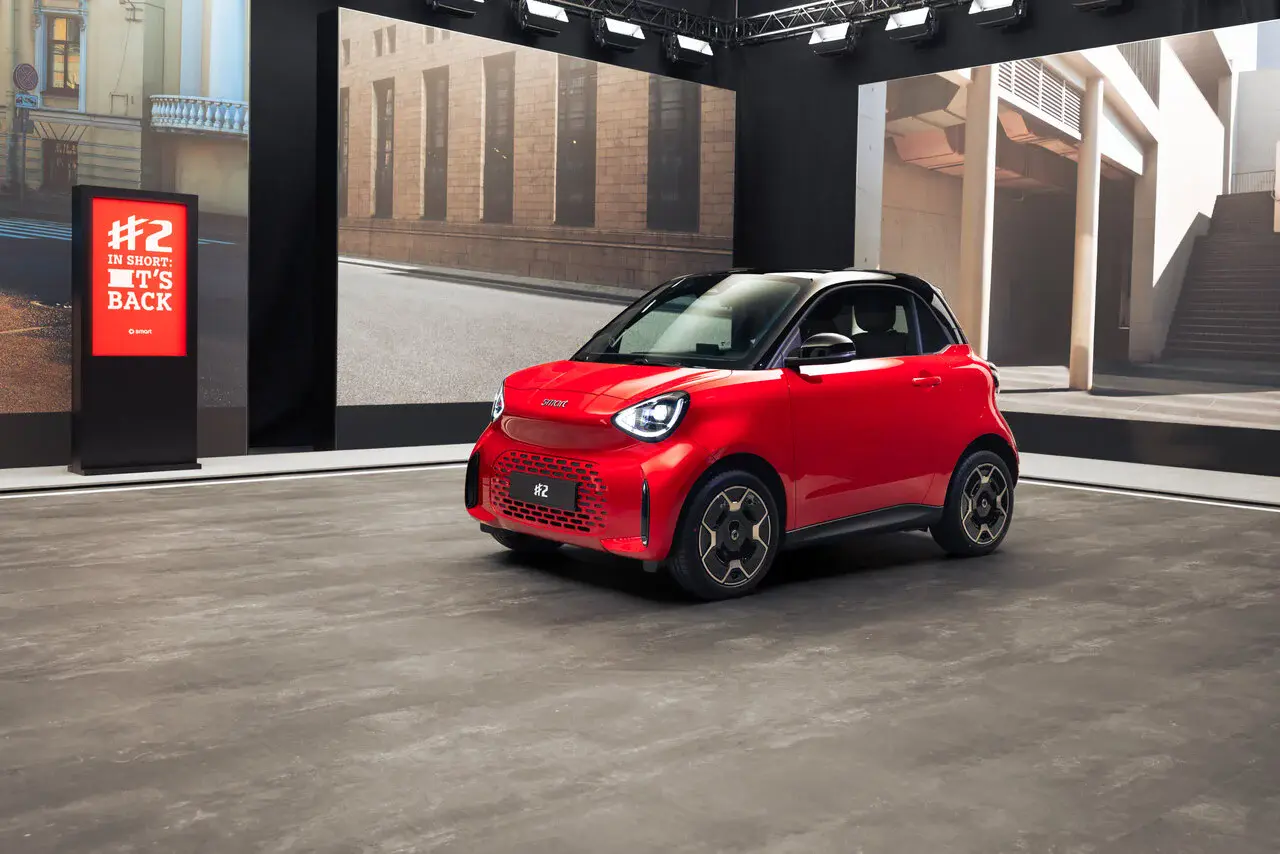
The smart #2 is a two-door, two-seat electric car. It measures 2,746 mm in Pure, Pure+ and Premium versions, while the limited Couture Edition is 2,764 mm long. It uses smart’s Electric Compact Architecture, or ECA, a platform developed specifically for the new two-seater rather than a shortened version of the architecture used by the smart #1, #3 or #5.
The standard car has a rear-mounted electric motor producing 60 kW and 130 Nm. Drive goes to the rear wheels. smart has not positioned this version as a hot hatch or sports car; the engineering priorities are compact dimensions, urban manoeuvrability and predictable stability. The short body and wheels placed close to the corners are central to that formula.
The battery is an LFP unit with a capacity of 35.8 kWh. smart quotes up to 290 km of combined WLTP range as a target value, with the European approval process still in progress when the figures were released. The quoted combined energy consumption is 13.6 kWh/100 km. AC charging supports up to 11 kW, while DC charging supports up to 65 kW. A 10–80 per cent DC charge is expected to take 20 minutes.
Those figures apply to the standard #2 and should not be copied across to the BRABUS model. A more powerful motor, different tyres or altered thermal management could change consumption, range and charging behaviour. Until smart publishes the relevant data, the performance version has no official range or consumption figure.
What the BRABUS teaser actually shows
The teaser images show additional fins or air-management details on the front bumper and red trim elements. That is enough to confirm a distinct exterior treatment, but not enough to establish how the car has been engineered. smart and BRABUS already have an official performance relationship across the electric range, so the naming is consistent with the brand’s existing product strategy.
It is not yet known whether the 60 kW motor will be replaced, upgraded in hardware or recalibrated through software. smart has not said whether the BRABUS version will retain the 35.8 kWh battery. A higher output can bring extra thermal and energy demands, particularly in a car with a small battery, so the final solution will matter more than the badge alone.
The chassis is also an open question. The regular #2 uses a five-link independent rear suspension, an unusual arrangement for a car of this size. smart has not confirmed different springs, dampers, anti-roll bars, steering calibration or brakes for BRABUS. Nor has it published a tyre specification. It would be premature to describe the car as dynamically transformed on the basis of red trim and a revised bumper.
The likely conclusion is limited but reasonable: BRABUS is expected to bring more response and more aggressive styling. The exact increase in power and the effect on acceleration must come from smart or BRABUS, not from assumptions based on the larger smart #1, #3 or #5.
Why the format matters in the city
smart gives the #2 a turning circle of 6.95 metres, measured kerb to kerb. That figure is useful in narrow streets and constrained parking areas, although it does not describe the complete driving experience. The 2.746-metre length is the most direct practical advantage of the car.
Inside, the #2 is designed around two occupants and a compact dashboard. The specification includes a 10.1-inch central display and an 8.8-inch driver display. Depending on the trim, buyers can have 4G connectivity, Wi-Fi, Bluetooth, a Sennheiser audio system and wireless charging. These features are not automatically confirmed for BRABUS.
The car also supports vehicle-to-load, allowing the battery to power compatible external equipment. smart has not published a maximum V2L output in the launch material. In a small EV, the feature could be useful for leisure equipment or emergency power, but its practical value will depend on the final equipment and the amount of energy the owner is willing to use.
Safety and the ECA platform
The Tridion Evo safety cell is the latest development of the structure associated with small smart models. smart says it protects the passenger compartment while retaining the compact exterior. The standard #2 also offers driver-assistance systems including smart Pilot Assist, adaptive cruise control with stop-and-go and Highway Assist.
Depending on the market and trim, the equipment can include blind-spot monitoring, rear collision mitigation and rear cross-traffic alert. There is not yet a public Euro NCAP rating for the smart #2. The presence of assistance systems should therefore not be turned into a claim about a final safety score.
smart developed the ECA platform using test vehicles built inside existing fortwo bodies. The company says the programme covered driving dynamics, structural strength, braking, battery performance, software, suspension durability and climate-control systems. These are manufacturer development tests. They are not independent test results for the future BRABUS derivative.
Launch timing and open questions
smart has not announced when the #2 BRABUS will be revealed, which European markets will receive it or how much it will cost. The standard #2 is planned with Pure, Pure+, Premium and a Europe-limited Couture Edition capped at 999 cars. Those trim and production details apply to the regular model and do not confirm the specification or availability of BRABUS.
For buyers in Europe, the missing practical information includes local pricing, delivery timing, warranty terms, charging equipment and the final range figure. If the BRABUS model receives more power, its official WLTP result could differ from the regular car’s 290-km target. That is a possibility, not a published fact.
The smart #2 BRABUS is therefore a confirmed project with an early visual teaser, not a fully specified performance car. The standard model’s confirmed baseline is a rear 60 kW motor, 35.8 kWh LFP battery, target WLTP range of 290 km and 65 kW DC charging. Power, acceleration, chassis hardware, pricing and launch date for BRABUS still need to be announced.
Official smart #2 press image used as contextual artwork for the upcoming BRABUS version. Image rights remain with smart.