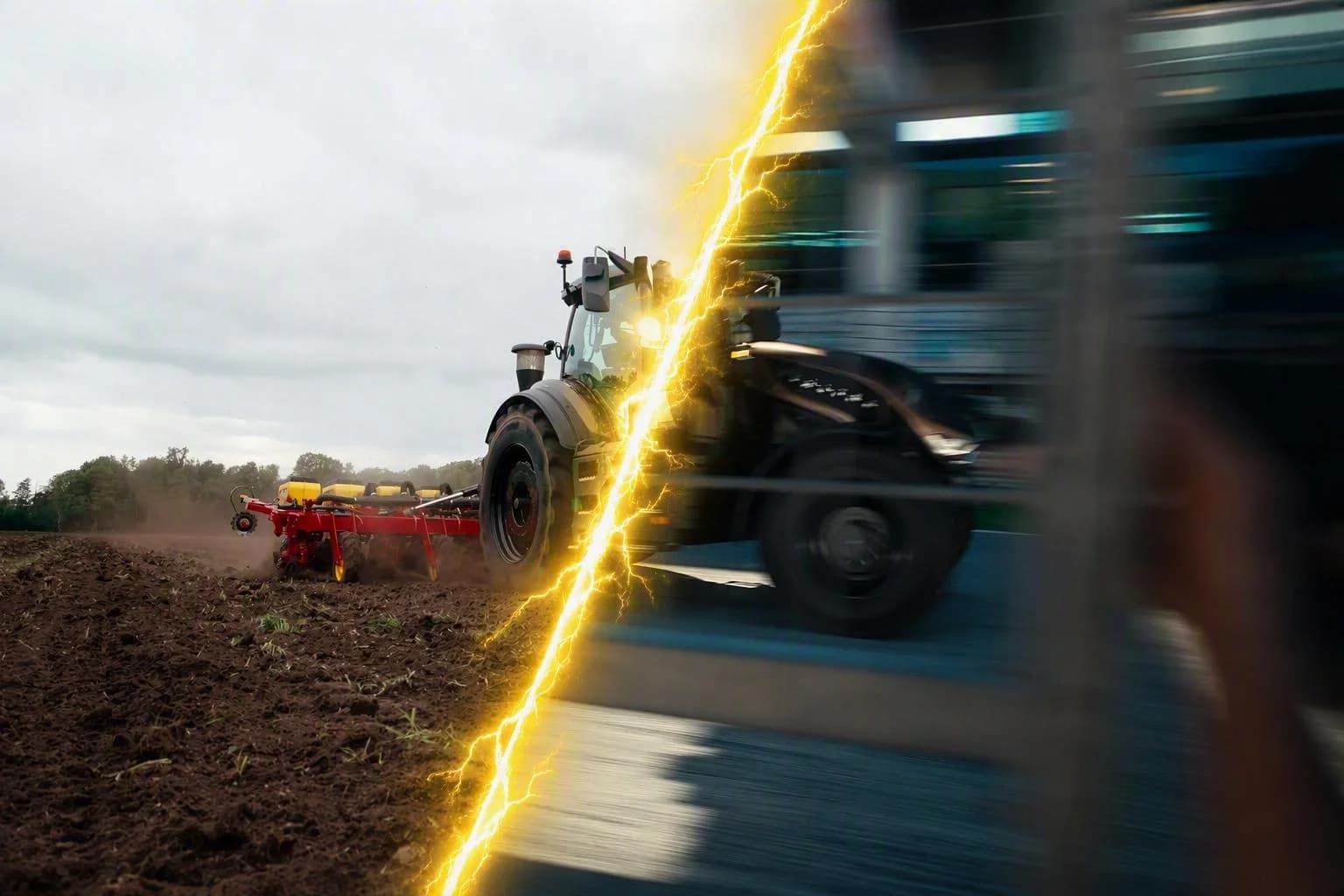
Valtra has published two results from separate challenges involving its sixth-generation T Series: a Red Bull Racing-verified speed of 87 km/h at Austria’s Red Bull Ring, and a highest measured planting speed of 40.125 km/h in western Germany. The first event examined controlled high-speed transport performance. The second paired a production tractor with a Väderstad Tempo planter and measured whether speed could be combined with accurate field work.
The Red Bull Ring result
The circuit challenge was carried out with Nokian Tyres. Valtra says the tractor set the fastest tractor lap around the Red Bull Ring, with a time of 3 minutes 36.4 seconds, while reaching 87 km/h in the filmed speed challenge. The wording matters: this is a result for a specific circuit, vehicle setup and event. It is not a general road-speed record and it does not mean every T Series specification can legally or technically travel at 87 km/h.
AGCO’s technical information for the sixth-generation range lists transport speeds of up to 57 km/h, depending on specification and local road regulations. For the circuit challenge, Valtra lists Nokian Soil King tyres, 0.8 bar tyre pressure front and rear, a 1,800 kg front weight and two 500 kg rear wheel ballast weights. The manufacturer warns that the activity was performed by trained professionals in a controlled environment and should not be attempted by customers.
That setup is part of the result. Tyre construction, pressure, ballast, surface and the verification procedure all affect a heavy tractor at an unusual speed. A headline number therefore needs to be read as the outcome of a documented demonstration, not as operating advice.
Precision planting above 40 km/h
The second challenge took place in a working agricultural setting in western Germany. Valtra and Väderstad used a production sixth-generation T Series tractor with a Väderstad Tempo planter. The highest measured planting speed was 40.125 km/h, while planting accuracy was reported at more than 95% during the challenge.
Light-barrier timing equipment was installed across several passes. The tractor used an application map and PTx guidance was unlocked to 40 km/h. Valtra describes the field conditions as realistic and says that field preparation, agronomic setup and planting parameters were managed so the performance data would be meaningful.
Eight weeks later, the teams returned to evaluate the crop. The result reported by Valtra was 92% planting accuracy at the later check, alongside a uniform and healthy stand. That 92% figure is a separate observation from the more than 95% figure measured during the planting passes. Keeping the two numbers tied to their methods and dates prevents the demonstration from being read as a single unexplained efficiency claim.
The two events also had different partners and objectives. Nokian Tyres supported the circuit challenge, while Väderstad supplied the planter for the field work. Valtra’s stated point was that modern agricultural performance depends on the interaction between tractor, implement, guidance system and operator rather than speed alone.
Where the T236 fits
The T236 sits at the top of the sixth-generation T Series range introduced in October 2026. The family covers 170 to 245 hp and uses the AGCO Power CORE75, a 7.5-litre six-cylinder engine. Valtra lists up to 245 hp and 1,184 Nm for the T236.
Smart Power Management offers Eco, Normal and Power modes. Valtra says the CORE75 can deliver up to 5% lower best-point specific fuel consumption than the previous AGCO Power 74HD engine. This is an AGCO laboratory comparison, not a Carboratory test, and the company said independent validation was expected by the end of 2026. Real-world fuel use will depend on the implement, soil, load, speed and operating cycle.
Customers can specify an AGCO ML 180 continuously variable transmission or a new ten-step powershift transmission. The range also introduces SmartTouch Gen2, with a 12-inch high-resolution screen, configurable work pages, operator and implement profiles, and an integrated help function. AGCO says the interface has ten times the processing power of its predecessor. The tractor is factory-ready for PTx FarmENGAGE, which can move tasks and agronomic information between office, tractor and field, including across mixed fleets.
What the demonstrations do and do not prove
The circuit result is a controlled performance demonstration. The planting result is more directly connected to farm productivity, but it still describes one tractor, one implement, one field project and a defined measurement procedure. Neither result replaces independent testing of fuel consumption, durability, braking, tyre wear or agronomic outcomes across different farms.
For buyers, the more practical questions remain total ownership cost, service support, implement compatibility, legal transport speed and the performance of the chosen specification. Valtra announced first deliveries of the new T Series for the end of 2026, subject to availability. Local equipment, homologation and pricing should be confirmed with the relevant dealer.
The significance of the project is its combination of controlled transport speed and precision field work. Valtra is presenting the T Series not simply as a powerful tractor, but as a machine whose engine, transmission, guidance, implement control and farm-data systems are intended to work together. The evidence is manufacturer-reported, yet the two challenges provide clear, separately measured examples of what the company wants the new generation to demonstrate.