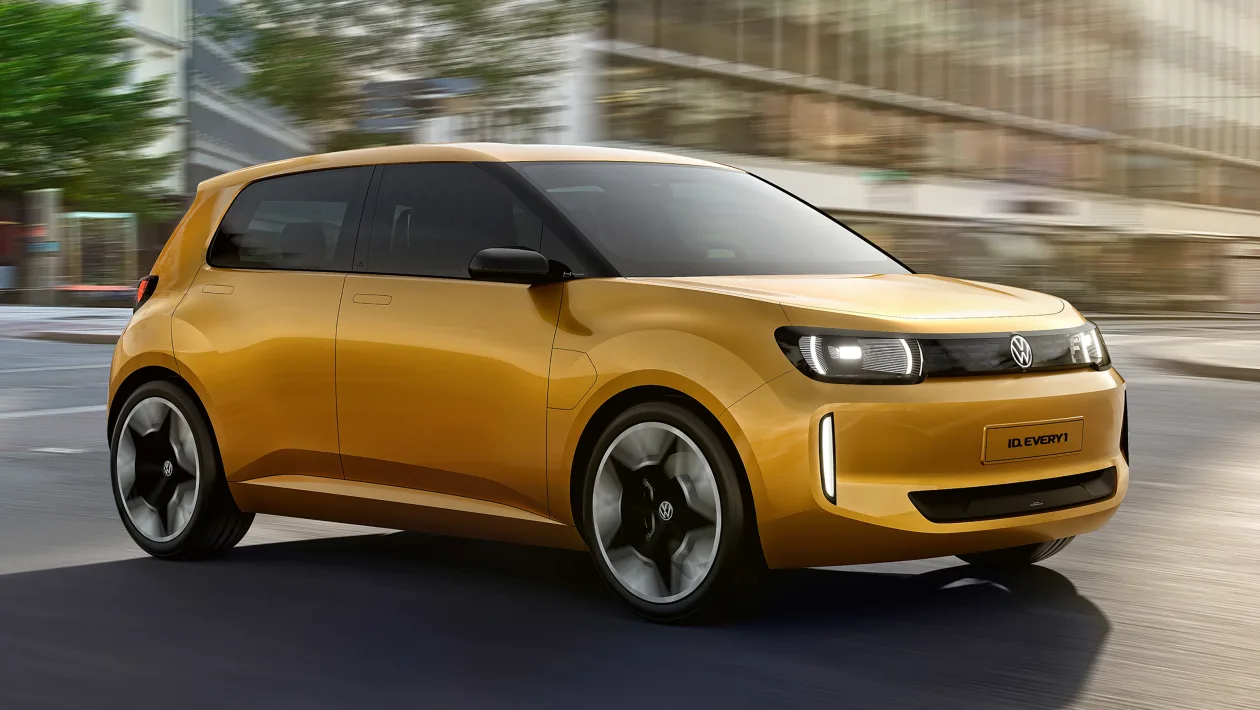
Volkswagen ID. EVERY1 uses headlights that suggest a gaze and bumpers drawn as a discreet smile. Photo source: Volkswagen
Volkswagen drops aggressive faces: future models must look more friendly
Volkswagen does not want to follow the fashion for cars with oversized grilles, very narrow headlights and a front end that looks threatening. Andreas Mindt, Volkswagen Group design chief, says the volume brand's cars should look approachable and friendly, not intimidate other road users.
Mindt's position, expressed in an interview with the Dutch publication AutoWeek, is not just a change of scenery. It explains the visual language called Pure Positive, already visible on ID. Polo, ID.3 Neo, ID. Cross and the ID. EVERY1 concept.
Why Volkswagen no longer wants cars with "angry faces"
Mindt criticises manufacturers' tendency to turn a car's front end into a sign of force. Some brands choose this solution so the car looks dominant when seen in a rear-view mirror, the designer says. In his view, that approach does not fit Volkswagen's position in the market.
"Why not give cars a friendly look? I want to live in a friendly world," Mindt explained. He also used a more direct comparison, saying he does not want cars that look "designed to kill zombies."
The statement should be read in the context of the Volkswagen brand, not as a rule applied identically to every maker in the group. Mindt acknowledges that a more dramatic design is appropriate for Lamborghini or Cupra, whose identities are built around performance and sportiness. His role, after taking charge of group-wide design on 1 March 2026, is precisely to keep the differences between brands.
What "Pure Positive" means
Volkswagen describes its new design language through three principles: stability, a pleasant appearance and "secret sauce", a term used for surprising, memorable details. Stability comes from a body that sits visually on its wheels, well-defined wheel arches and clear proportions. A pleasant appearance is achieved through horizontal lines, simple surfaces and lighting units that do not imitate a frown.
ID. EVERY1 is the easiest example to read. The headlights have graphic elements resembling pupils, and the raised lines at the bumper extremities suggest a discreet smile. Volkswagen has also used a 2/5 to 3/5 ratio between glazed surfaces and bodywork, an interpretation of the golden ratio that the company says makes the object more pleasant to look at.
The same strategy does not mean every car will become rounded or characterless. On ID. Polo, for example, the body has a wide, stable stance, but the front end is clean, without fake air intakes and without a huge decorative grille. GTI versions can have firmer accents, yet Mindt believes even a Golf GTI should keep a positive expression.
Electric cars no longer have to look deliberately different
Another change concerns the visual split between electric cars and those with combustion engines. The first models in the ID. family received futuristic shapes to show immediately that they used new technology. Mindt acknowledges that, in that process, Volkswagen drifted away from some of its traditional values.
Now that an electric car is no longer an unusual sight, the company no longer sees a need for it to signal superiority over a petrol or diesel model. Future electric Volkswagens will recover recognisable elements from Beetle, Golf, Polo and Transporter, without copying historic models directly.
ID. Polo illustrates that rapprochement: the traditional name returns on an electric car, and the silhouette is that of a conventional compact hatchback. Volkswagen says the model has a drag coefficient of 0.264, so a familiar look does not rule out the optimisation an electric car needs.
The change is visible in the cabin too
For Mindt, a "friendly" car is not defined by headlights alone. New Volkswagen interiors bring back physical buttons for frequently used functions, warmer-looking materials and a more intelligible horizontal architecture. ID. Polo and ID. Cross have a rotary volume knob and direct controls, after criticism of generations that moved too many functions onto touch surfaces.
The designer links buttons to the idea of stability and trust: the driver can find a control without working through several on-screen menus. Retro graphic modes on the instrument cluster sit in the category of details that add personality without complicating use.
Which models will follow the new direction
ID. Polo, ID.3 Neo and ID. Cross are the first production examples of the Pure Positive strategy. The next important model should be the replacement for the current ID.4, which international motoring press reports will use the name ID. Tiguan. Volkswagen has not yet published all of its commercial data.
The ID. EVERY1 concept, for its part, previews an urban electric car scheduled for 2027. It shows how far the friendly-look theme can go on a city model. For customers, though, the change will be easier to judge on production cars: not only through headlight shape, but through visibility, control ergonomics, material quality and keeping a clear identity from one generation to the next.