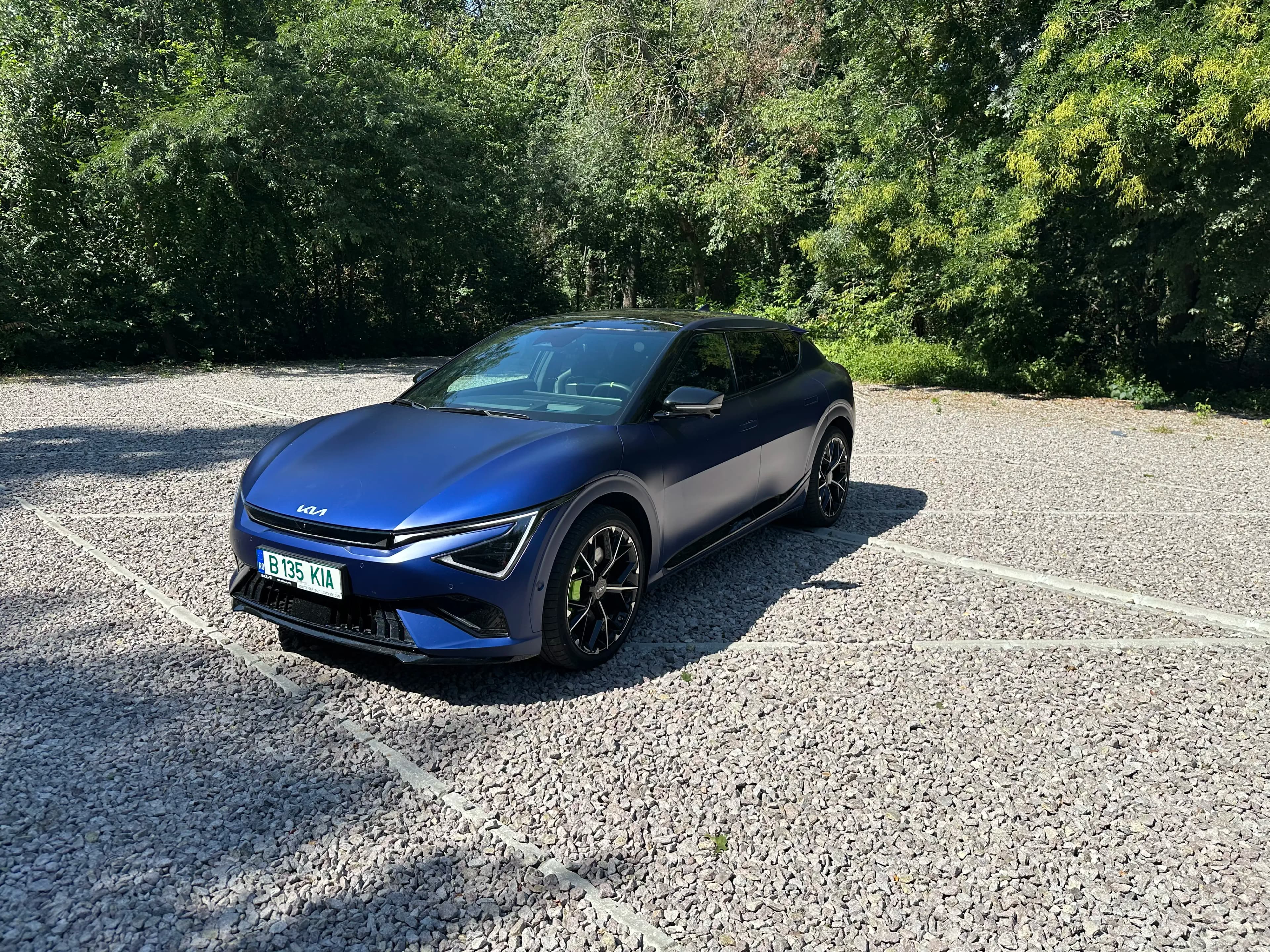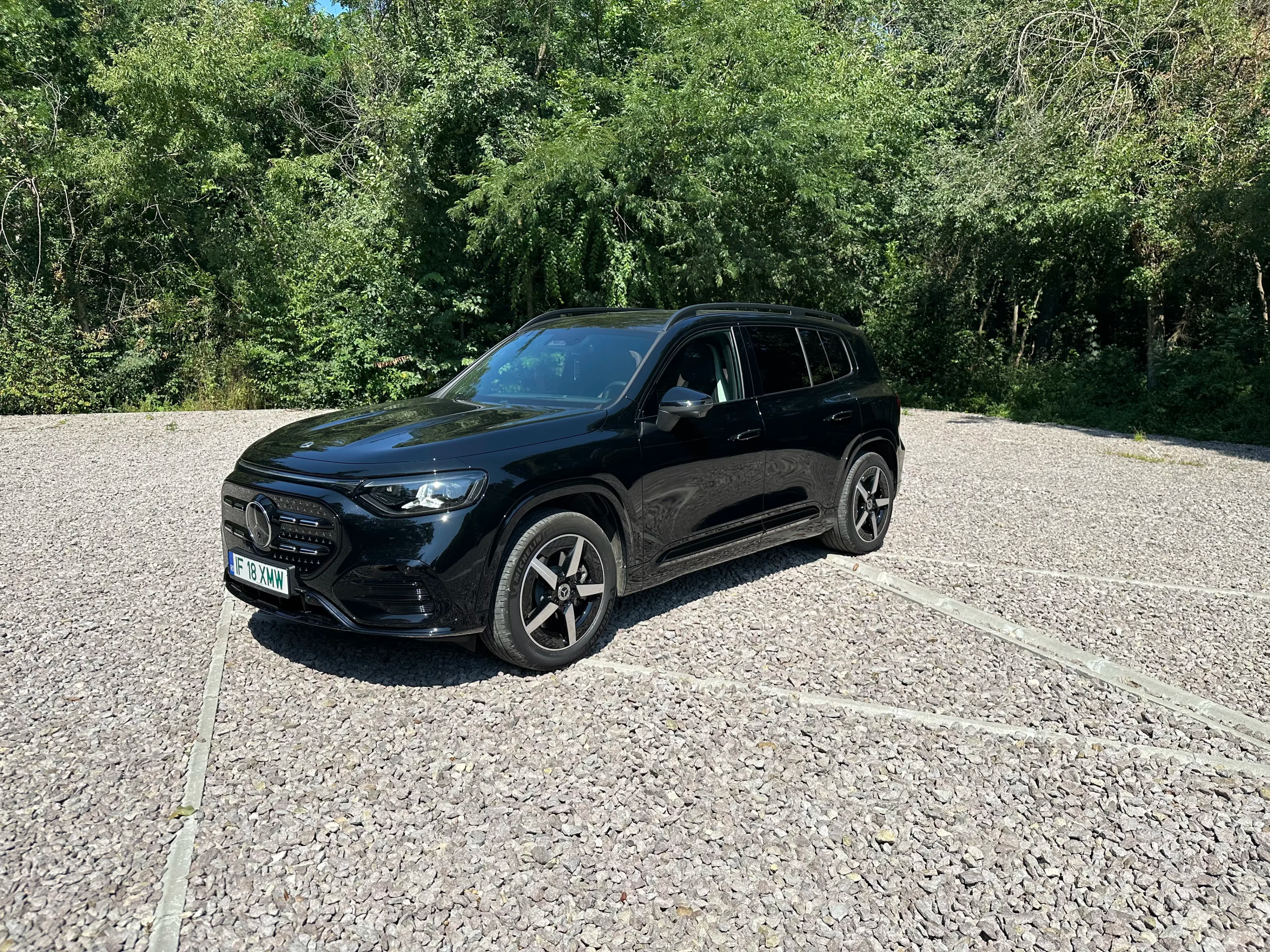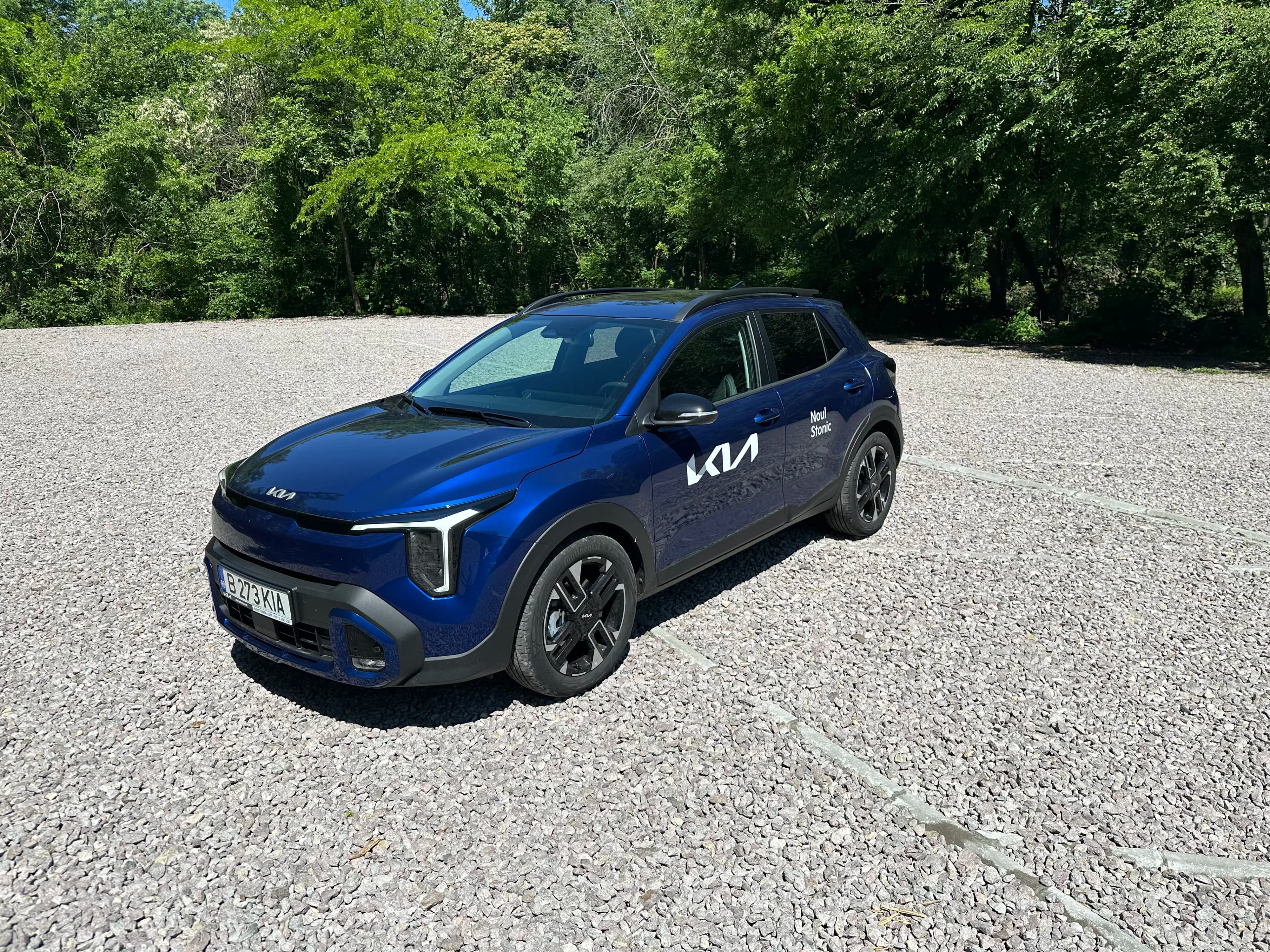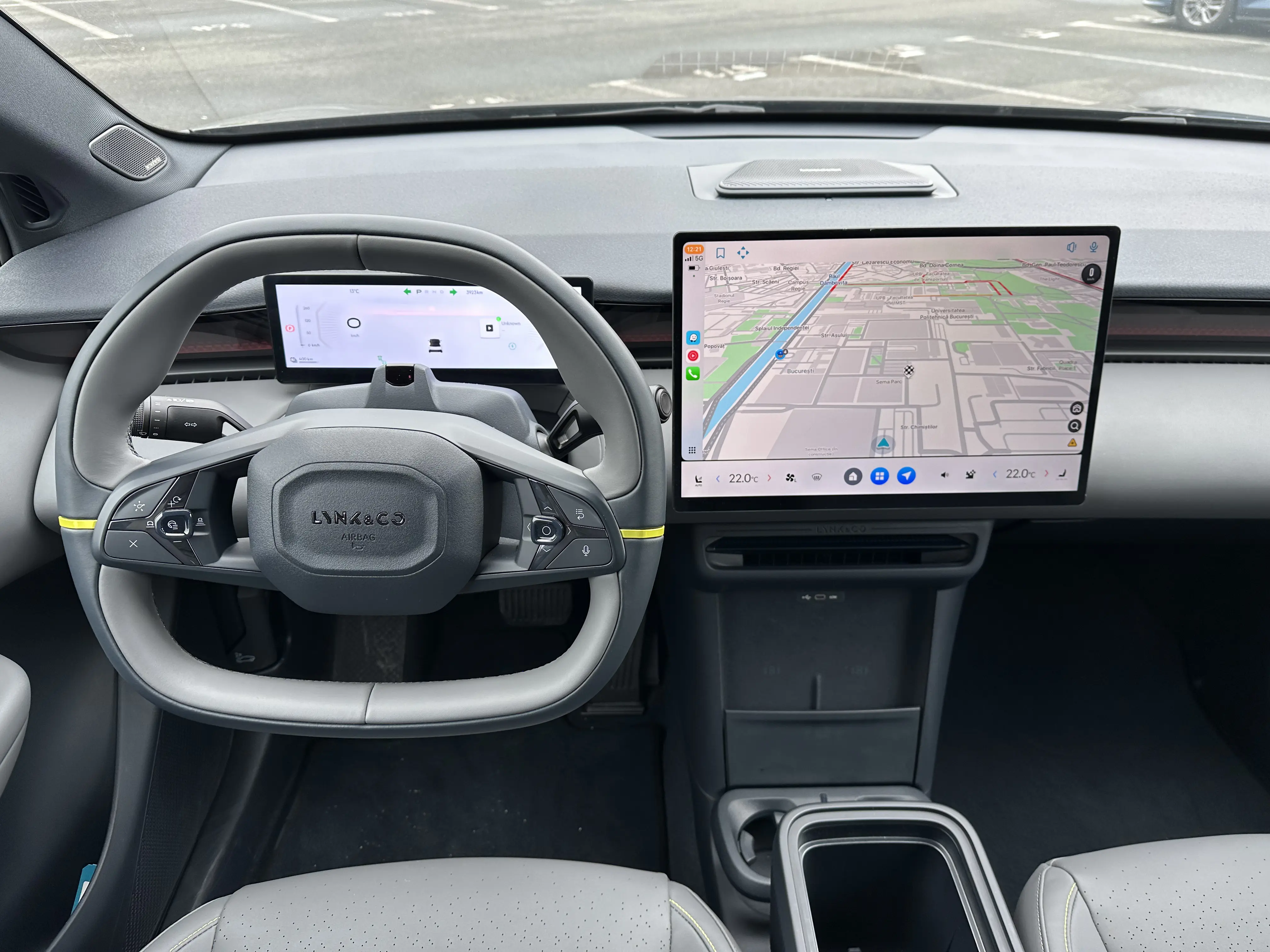
The Lynk & Co 02 test drive gave me one of the most surprising experiences with an electric car in Romania. After spending a week at the wheel of this model, I discovered why many consider it the best choice in its segment.
We tested the Lynk & Co 02 in varied conditions, from mountain roads to the busy streets of Bucharest. With 272 hp and acceleration from 0 to 100 km/h in just 5.5 seconds, this electric car demonstrates impressive performance. In addition, a starting price of €37,490 positions it competitively on the Romanian market, where options for electric vehicles are growing constantly.
Scandinavian design, practical range and build quality are just a few of the aspects that convinced me. Still, what makes this model truly special? First, the perfect balance between performance and efficiency, with an average consumption recorded at 21 kWh/100 km. The fast-charging system also transforms the daily user experience.
In today’s article I will share all the details of my findings, from technical characteristics to comparison with main competitors such as the Skoda Elroq or Volvo EX30.
What the Lynk & Co 02 is and why it matters in Romania
When we talk about the Lynk & Co 02, we are talking about a car that marks a pivotal moment for the Romanian automotive market. After analysing this model in detail, I can say it represents an ideal combination of advanced technology and accessibility in an aesthetically attractive package.
The brand’s first electric model in Europe
The Lynk & Co 02 (or “Zero Two” as brand representatives call it) is the first fully electric model from the brand launched in Europe and, implicitly, in Romania. While the model already exists in China under the name Z02, for the European market it represents an important step.
The brand portfolio also includes the 01, a plug-in hybrid SUV based on the Volvo XC40 platform, officially launched in Romania last autumn. It targets buyers who want a gradual transition from combustion engines to electric powertrains.
The decision to launch a pure electric model comes amid the growing number of electric brands in Europe. However, recent EU tariffs on electric vehicles produced in China led Lynk & Co to adjust its strategy, announcing that it will continue to rely on plug-in hybrids for the European market.
SEA2 platform and the link with Volvo EX30
In developing the 02, Lynk & Co used the SEA (Sustainable Experience Architecture) platform created by Geely, the group that owns the brand. This architecture is also used for other models such as the Volvo EX30, Smart #1 and Zeekr X.
After driving both the EX30 and the 02, I noticed notable differences in suspension tuning. The Lynk & Co 02 offers a more comfortable experience, with softer suspension that still maintains good body control, without exaggerated roll tendencies.
An interesting aspect is that in developing the new 02, the manufacturer took into account more than 4,500 suggestions received from customers of the 01 model, demonstrating orientation towards real user needs.
The SEA platform is a 400-volt architecture, which means it cannot offer staggering charging speeds, but compensates through a good balance between range and price.
Target audience and market positioning
Lynk & Co is the result of a joint venture between Chinese giant Geely and the Swedes at Volvo, with headquarters in Gothenburg. Although founded relatively recently, in 2016, the brand quickly gained popularity in Europe thanks to competitive prices and generous equipment.
Prices for the 02 model start at €37,490 for the Core version and reach €41,490 for the More variant. Moreover, through the Rabla programme, customers can benefit from a substantial reduction of €7,500, which brings the starting price down to just €29,990.
Compared with main rivals, the Lynk & Co 02 is positioned very competitively:
- Skoda Elroq — from €34,955
- Volkswagen ID.3 — from €36,340
- Volvo EX30 — from €39,000
- Renault Scenic E-Tech — from €39,900
- Peugeot e-3008 — from €45,300
The Lynk & Co 02 mainly targets a young audience looking for a modern alternative to traditional brands and who are not influenced by prejudices about the product’s Chinese origin. It also addresses those who appreciate Scandinavian design and want an electric car at an accessible price.
Exterior and interior design: Scandinavian style with modern accents
The first interaction with the Lynk & Co 02 immediately reveals Scandinavian influence in its design, but with a modern twist that attracts attention. After spending time examining every detail of the car, I discovered a vehicle that succeeds in combining Nordic elegance with futuristic accents in a balanced way.
Dimensions and proportions
The dimensions of the Lynk & Co 02 place it in the compact crossover category, comparable to a Toyota Corolla Cross. Length of 4,460 mm, width of 1,845 mm and height of 1,573 mm offer a dynamic profile, while the generous 2,755 mm wheelbase contributes to surprisingly generous interior space.
Ground clearance of 191 mm ensures a confident stance on the road and a slightly raised position above the asphalt, ideal for road conditions in Romania. The side profile also highlights an elongated bonnet and a roof line slightly inclined towards the rear, giving the car a silhouette reminiscent of a coupé without sacrificing interior space.
Despite compact exterior dimensions, I was pleasantly surprised by the space offered to passengers, especially knee room in the rear. However, the bench is optimally dimensioned for two adults, being rather narrow for three people of average stature.
Distinctive design elements
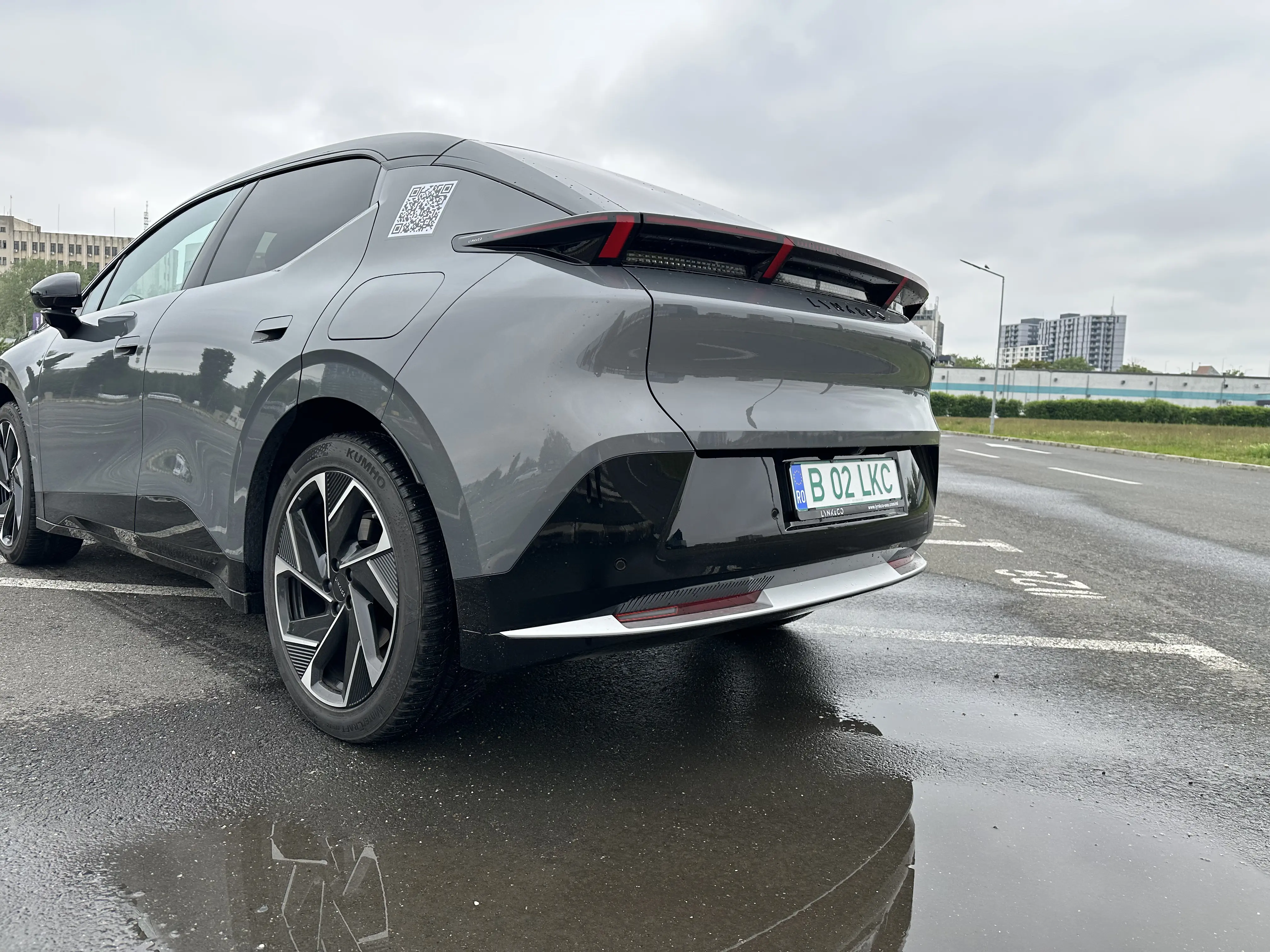
Created in the design studio in Gothenburg, the Lynk & Co 02 resembles the Zeekr X somewhat, which led many to consider it a coupé version of the group “cousin”. However, the 02 has a distinct personality, with flowing shapes and specific details that differentiate it.
The front is the element that makes the car attract glances like a magnet. Here we find a set of vertical double LED headlights and active air intakes that give it a futuristic look. The rear is dominated by slim LED tail lights that form a prominent “elephant ear” separated from the body, ending on the wings.
During the test we drove the version equipped with 20-inch alloy wheels (available on the More variant), which look excellent in person, although the version with 19-inch wheels (standard on Core) offers slightly lower consumption. The available colour palette is limited to four options, all metallic:
- Cosmic Blue
- Crystal White
- Grid Grey (the colour of the tested model)
- Magenta Red
Materials and perceived quality
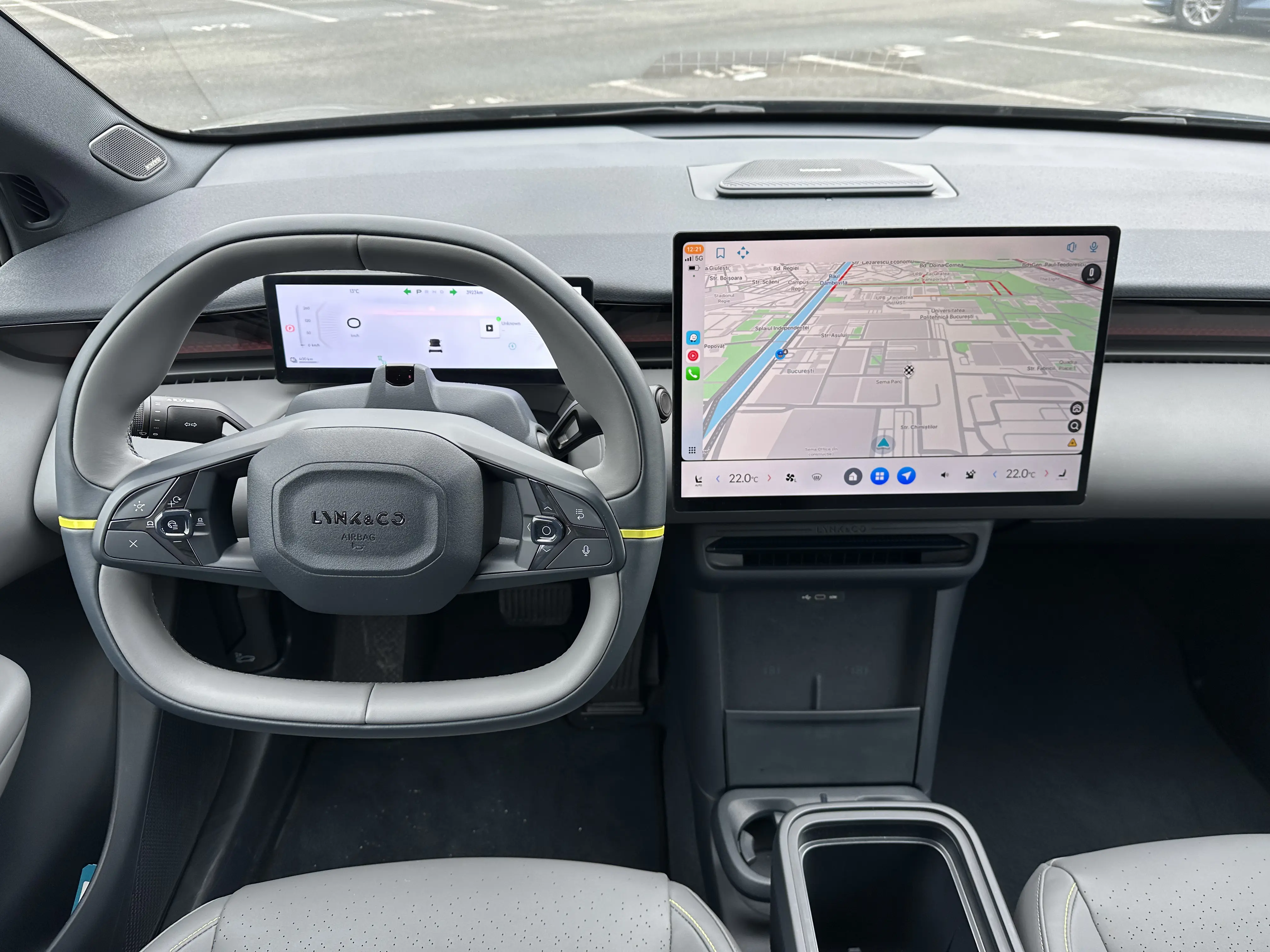
The interior of the Lynk & Co 02 combines minimalist Scandinavian aesthetics with modern technology. The first impression is positive, with a well assembled and finished cabin using quality materials. However, after closer examination, I discovered an interesting mix of materials.
On one hand, there are refined textures pleasant to the touch, especially on the More version tested. Seat upholstery, the steering wheel and certain dashboard areas use premium materials. The front seats are excellently shaped, with headrests integrated into the backrest, offering ideal lateral support.
On the other hand, these quality peaks alternate with less premium plastic areas, especially in lower zones such as the bottom of the centre console, the cup holder or the centre tunnel. A more obvious example is the steering column adjustment lever, where the plastic is unpleasant to the touch and less carefully assembled.
A distinctive interior element is the centre console, which functions as a generous storage box with a divided lid. Surprisingly, this box can be completely detached from the car and used separately, facilitating cleaning or organising personal items. Although innovative, this element sometimes seems more a design trick than a solution with clear practical utility.
Performance and driving: Lynk & Co 02 test drive in real conditions
We tested the Lynk & Co 02 on roads in Slovenia, in the Lake Bled area, on a route that combined mountain segments with a stretch of motorway. Although not very long (approximately 30–40 kilometres), the test gave me a clear perspective on this electric crossover’s capabilities.
Motor: 272 hp and 343 Nm torque
The 272 hp and 343 Nm electric motor, mounted on the rear axle, proves perfectly calibrated for daily needs. We drove the More equipment version, accompanied by two colleagues and a few small bags. Surprisingly for an electric car in this class, the motor offers enough force for safe overtakes, and power delivery is smooth and predictable.
The SEA (Sustainable Experience Architecture) platform developed by Geely and also used by the Volvo EX30, Smart #1 and Zeekr X proves to be a solid base. However, the Lynk & Co 02 has its own personality, oriented rather towards comfort than sportiness.
0–100 km/h acceleration in 5.5 seconds
In Sport mode, the 02 accelerates from 0 to 100 km/h in just 5.5 seconds—impressive performance for an electric crossover. Top speed is electronically limited to 180 km/h, although this aspect could not be verified under our test conditions.
The driving experience is typical for an electric vehicle: smooth departures (if you do not exaggerate with the accelerator pedal) and a sensation of fluid movement, free of vibrations. However, despite the sporty allure suggested by design, the car’s dynamic personality is oriented rather towards comfort.
Drive modes: Eco, Comfort, Sport, Individual
The four drive modes are well differentiated, affecting steering weight and accelerator response:
- Eco: optimised for maximum efficiency
- Comfort: balanced for daily use
- Sport: more alert steering response and quicker acceleration
- Individual: allows personalisation of parameters according to preference
Behaviour on mountain roads and motorway
On mountain roads, the suspension impressed with its ability to absorb imperfections, offering more comfort than the Volvo EX30 without sacrificing control. Roll appears only if you push hard, and the car remains stable in corners.
However, there is room for improvement in sound insulation. On damaged surfaces, road noise penetrates the cabin, especially for rear passengers. In front, the ambience is quieter.
After testing in winter conditions, with temperatures of at most 5–6 degrees Celsius, the consumption indicated on the dashboard was 21 kWh/100 km, which corresponds to a real range of 314 kilometres—a reasonable result for the given conditions. The seats and bench, very well shaped and comfortable, offer excellent support even on longer routes.
Range, consumption and charging: how efficient is it in Romania?
One of the essential aspects that interests me in any electric car is real-world range. In my test with the Lynk & Co 02, I analysed not only official figures but also behaviour in real conditions in Romania.
WLTP range vs real range
Although Lynk & Co promises generous WLTP range, reality in traffic brings, as with any EV, different values. During my test, winter conditions with temperatures of 5–6 degrees significantly influenced the performance of the 66 kWh battery. International tests also show that at high speeds (130 km/h), range drops below 300 km, making the model more suitable for the city and medium journeys.
At moderate speeds and in normal conditions, however, real range approaches official figures reasonably, which makes the 02 a practical option for daily use in Romania.
Average consumption in test: 21 kWh/100 km
On the route of approximately 30–40 kilometres that included mountain roads and motorway, I obtained consumption of 21 kWh/100 km. This result is remarkable given the test conditions: three people on board, small luggage and low temperatures with climate control active.
The recorded consumption corresponds to a real range of 314 kilometres, an honest value for an electric crossover in winter conditions. Wheel choice influences efficiency nevertheless—the version with 19-inch wheels (Core) offers lower consumption than the 20-inch (More) wheels.
AC and DC charging: times and power
The SEA platform on which the Lynk & Co 02 is built uses 400-volt architecture, which limits maximum charging speed. Both Core and More versions support DC charging of up to 150 kW, allowing recharge from 10% to 80% in approximately 30 minutes.
For AC charging, times vary: the Core version charges from 0 to 100% in 7.5 hours (11 kW), while More reduces this time to 4.5 hours (22 kW)—a significant advantage for daily use.
Differences between Core and More versions
Besides AC charging power, the major difference between the two versions is the presence of a heat pump on the More variant. This equipment proved its efficiency in test conditions in Slovenia, contributing to maintaining good range even at low temperatures.
The Core version comes with 19-inch wheels that offer better energy efficiency, while More offers 20-inch wheels with superior aesthetic appeal. In practice, the choice between the two versions depends on each driver’s priorities: maximum efficiency or greater comfort when charging and in winter conditions.
Prices and rivals: is the Lynk & Co 02 worth your money?
In the financial analysis of any electric car, price remains a decisive factor. After testing the Lynk & Co 02, I am convinced that this model represents an interesting proposition from the price-to-equipment ratio perspective.
Prices in Romania: from €37,490
Lynk & Co offers two versions for the 02 model, each with its own equipment pack and characteristics. The base Core version has a starting price of €37,490, while the premium More variant costs €41,490. The €4,000 price difference brings significant improvements, which I will discuss below.
These prices position the 02 in a competitive zone on the electric crossover market, being more accessible than many alternatives from traditional brands. In addition, assembly quality and incorporated technology justify the amounts asked.
Reductions through the Rabla programme
Excellent news for potential buyers: through the Rabla Plus programme, the price of the Lynk & Co 02 drops significantly. With a reduction of €7,500, the Core version reaches a price of just €29,990, becoming one of the most attractive options in the segment.
Thus, the combination of competitive price and Rabla subsidy transforms this electric crossover into a rational choice for the Romanian market, where charging infrastructure is developing constantly.
Comparison with Skoda Elroq, Peugeot e-3008, Volvo EX30
Compared with main competitors, the Lynk & Co 02 stands well on price:
- Skoda Elroq: from €34,955 (cheaper, but with fewer standard features)
- Volvo EX30: from €39,000 (more expensive, same group, similar platform)
- Peugeot e-3008: from €45,300 (considerably more expensive)
Despite the attractive price, it should be mentioned that at high motorway speeds, the 02’s range drops below 300 km, making it more suitable for the city and medium journeys. However, fast-charging capability partially compensates for this disadvantage.
What you get in More equipment
The More version (€41,490) justifies the price difference through:
22 kW AC charging (versus 11 kW on Core), reducing charging time from 7.5 hours to 4.5 hours
Heat pump, essential for range in winter conditions
20-inch wheels (versus 19-inch on Core)
Harman Kardon audio system with 14 speakers
Panoramic glass roof
Although the absence of Apple CarPlay and Android Auto represents a minus (an update is promised for later this year), premium equipment and comfort offered make the Lynk & Co 02 an option worth considering for those looking for an alternative to traditional brands and who are not influenced by prejudices about the product’s Chinese origin.
Conclusion
After a week spent at the wheel of the Lynk & Co 02, I can state without hesitation that this electric car deserves all the attention on the Romanian market. Elegant Scandinavian design, combined with impressive performance and competitive price, creates a package hard to ignore for anyone looking for a modern electric crossover.
Average consumption of 21 kWh/100 km recorded in real winter conditions demonstrates this model’s efficiency, offering practical range of approximately 314 kilometres. This value, although lower than official WLTP figures, remains sufficient for the daily needs of most Romanian drivers.
The price of €37,490 for the Core version is, without doubt, one of the model’s strongest arguments. Moreover, with the €7,500 reduction through Rabla Plus, the Lynk & Co 02 becomes accessible to a broad segment of buyers at just €29,990, thus positioning itself among the most advantageous options in its class.
Although there is still room for improvement in sound insulation and software integration (temporary lack of Apple CarPlay and Android Auto), these minuses are compensated by excellent suspension behaviour, impressive 5.5-second acceleration to 100 km/h and overall assembly quality.
Despite its Chinese origin, the Lynk & Co 02 succeeds in combining Scandinavian DNA with modern technology, resulting in a mature, well-balanced product. Therefore, for those open to new brands on the market and looking for an excellent price-to-quality ratio, this electric crossover certainly deserves a personal test drive before making the final decision.