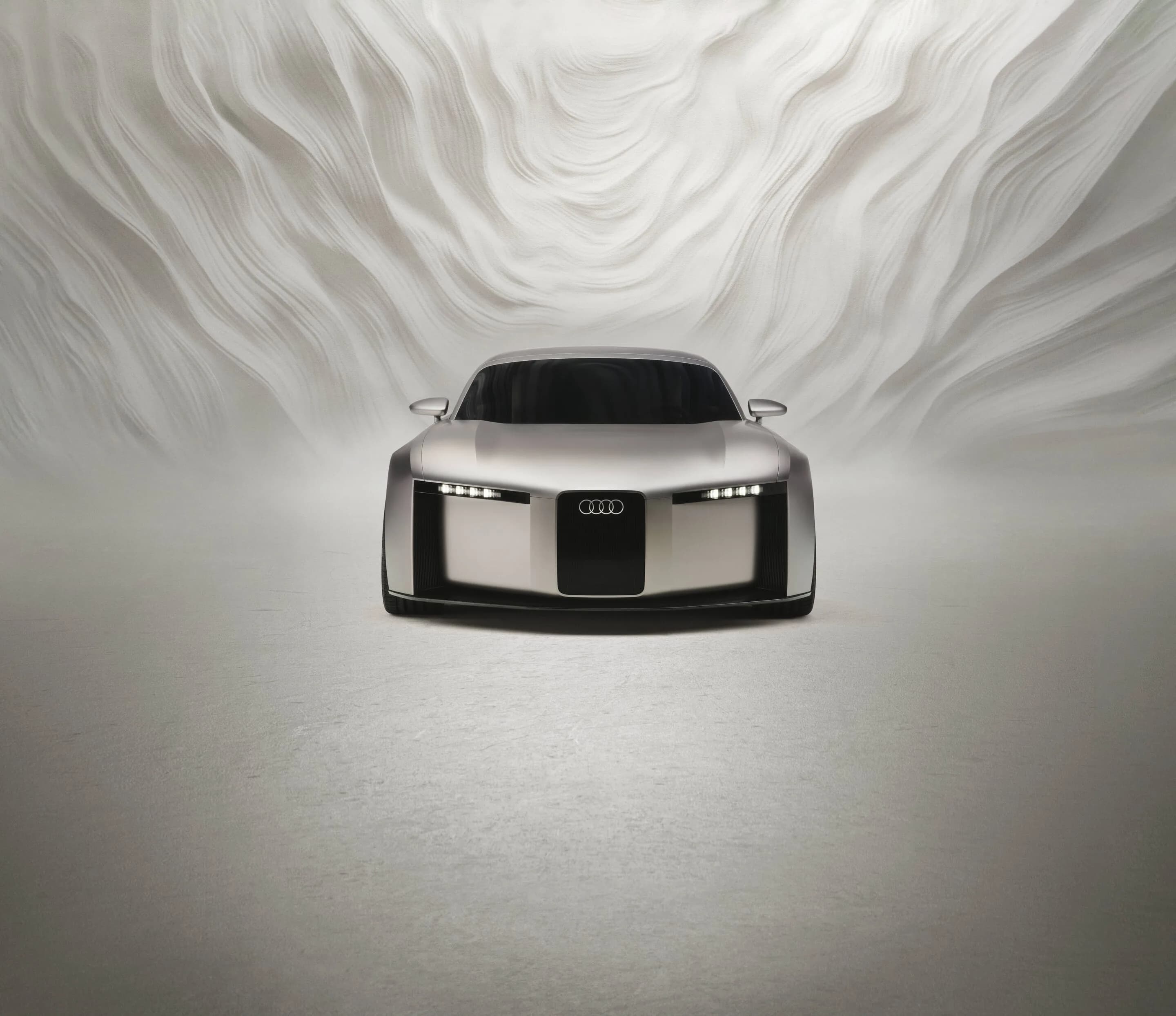
Official Audi press image. The Concept C is a concept vehicle and is not yet a production car.
Audi’s electric TT successor will use Porsche’s 718 platform
Porsche has confirmed that the electric architecture developed for the next-generation 718 Boxster and Cayman will also be supplied to an Audi sports-car programme. In Porsche’s third-quarter 2026 analyst call, finance chief Jochen Breckner named the Audi project “C-Sport” and said the related payment from Audi is expected in 2027.
That statement gives the clearest public link yet between Audi’s Concept C and Porsche’s upcoming electric sports cars. Audi has not confirmed that the production car will be called TT, nor has it released a final specification. The Concept C, shown in Milan in September 2025, is therefore best understood as a design and product preview rather than a technical announcement. Battery capacity, output, range, charging time, pricing and customer deliveries remain undisclosed.
What Porsche actually confirmed
Breckner described the Audi-Porsche relationship as a two-way platform exchange. Porsche uses Audi platforms, modules and technology, particularly for parts of its SUV range. Audi, in return, will pay Porsche for access to the electric sports-car architecture prepared for the next 718 Boxster and Cayman. The Porsche executive said the payment is expected in 2027 and would be lower than Porsche’s own payments to Audi for other technology.
The wording matters because it identifies the architecture as Porsche’s electric 718 platform, while leaving the exact Audi implementation open. Porsche’s 2026 capital-markets presentation describes MMB, or Modularer Mittelmotor Baukasten, as its platform area for two-door sports cars. The presentation also explains that Porsche leads platform development while each brand keeps product differentiation. It does not publish a component-by-component specification for the Audi application.
“C-Sport” is an internal project name, not a confirmed showroom badge. Audi has not said whether the car will revive the TT name, adopt another name, or sit between the former TT and the discontinued R8 in the range. It is also too early to infer that Audi and Porsche will have identical power outputs, battery sizes or driving modes.
The Concept C’s role
Audi presented the Concept C as an all-electric two-seat sports car. Its proportions are linked to a central-battery layout, with the cabin set far back on the body. The study uses an electrically retractable hardtop made of two roof elements. Audi says the system combines the visual character of a coupé with the option of open-air driving.
The front is built around a vertical frame that contains the Audi rings. Audi cites the 1936 Auto Union Type C and the third-generation A6 as historical references for the shape. Four horizontal light elements appear in each headlamp and rear lamp. These details introduce a new visual language, but they do not prove that every part will reach the production car unchanged.
Inside, the concept combines a foldable 10.4-inch central display with physical controls on the steering wheel and centre console. Audi says the approach is intended to keep technology present but less dominant. The show car also uses anodised aluminium and natural materials. The interior layout, screen size and material specification are all subject to change before homologation.
Audi’s official design release calls the Concept C a preview of a future production model. Gernot Döllner also said that the model is backed by a production decision and will be built at Audi’s Böllinger Höfe facility. The available material does not provide a customer launch date. Porsche’s reference to 2027 concerns the timing of the platform programme and the payment from Audi, not an announced market launch for the finished Audi.
Why the shared architecture matters
An electric two-seater is expensive to develop because battery packaging, cooling, software, crash performance and low-volume production have to be engineered for a relatively small number of vehicles. A shared architecture lets the brands distribute those costs across several products. The common elements may include the battery structure, electric motors, power electronics and control systems, while Audi and Porsche tune the suspension, software, seating position and bodywork separately.
Platform sharing does not make the cars interchangeable. A Porsche 718 must deliver the seating position, steering response and mid-engined visual balance expected from that brand. The Concept C has its own roof system, interior controls and design language. Audi may also choose different calibration, equipment and body dimensions. None of those details has been published for C-Sport.
For buyers, the practical point is to avoid treating Porsche’s future 718 figures as Audi specifications. A shared platform can accept different batteries, motors and software. Even the final body style is not fully documented beyond the Concept C’s roadster-like presentation. An Audi production car could retain the retractable roof, but that is an expectation based on the concept, not a confirmed feature list.
The unresolved questions
Audi has not confirmed the TT name, a production date, a European market launch, a price or a final powertrain layout. There is no published range figure, charging rate, kerb mass or number of motors for C-Sport. Audi has also not announced whether the project will be offered in a second body style.
The companies have provided enough information to establish the industrial relationship, but not enough to describe the car as a finished product. The strongest confirmed chain is straightforward: Audi showed a production-oriented electric sports-car concept; Porsche later identified an Audi C-Sport project as a recipient of the electric 718 platform; the platform payment is expected in 2027. Everything beyond that chain needs a new official announcement.