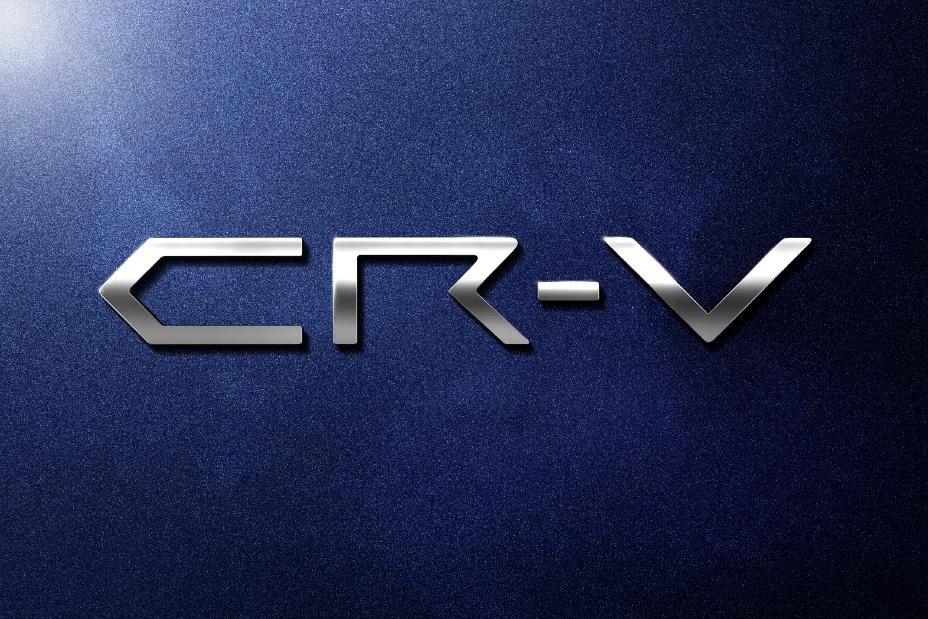
Image: Honda, from the official media gallery for the seventh-generation CR-V announcement.
Honda has confirmed that the seventh-generation CR-V will arrive in North America during 2027 as a 2028 model and will be sold exclusively with a hybrid powertrain. The redesigned SUV will introduce a new platform, the fifth generation of Honda's two-motor hybrid system and a newly developed electric all-wheel-drive unit.
The announcement applies specifically to North America. Honda has not released a European timetable, UK or EU specifications, prices, trim levels, battery capacity or final power figures. The first official image is a teaser showing the CR-V badge rather than the complete vehicle, so any detailed design claims remain premature.
Hybrid becomes the only North American powertrain
The current North American CR-V range includes a turbocharged petrol engine as well as hybrid versions. The 2028 model removes that split: Honda describes the next CR-V as “100% hybrid”, meaning there will be no petrol-only version in the North American line-up.
Honda's sales mix helps explain the decision. Hybrid variants already account for more than half of US CR-V sales, according to the manufacturer, while annual CR-V hybrid volume has grown almost tenfold since its US introduction in 2020. Honda also says the nameplate has exceeded 7.5 million US sales and is on course to pass 400,000 annual units for a third consecutive year.
Those are manufacturer figures for the United States, not a forecast for Europe. They show why Honda can standardise the hybrid system on its highest-volume North American SUV without relying on a niche customer base. They do not establish how the model will be configured or priced in other regions.
What changes in the fifth-generation system
The 2028 CR-V will debut the fifth generation of Honda's two-motor hybrid system. In the current architecture, an electric traction motor usually drives the wheels, while an Atkinson-cycle petrol engine can generate electricity. Under suitable conditions, a clutch can connect the engine directly to the driven axle for efficient cruising.
Honda says it has widened the range in which the combustion engine runs at its most efficient and improved the driving efficiency of the hybrid unit. The company promises higher standard power and better efficiency, but it has not supplied a combined output or a CR-V-specific consumption rating.
Honda's broader development target is to improve fuel economy by more than 10% for its next-generation hybrid models. This is a corporate engineering target, not an EPA result for the 2028 CR-V and not a European WLTP figure. Vehicle mass, aerodynamics, wheel size and drivetrain configuration will all affect the final homologated numbers.
The next CR-V will use a four-cylinder Atkinson-cycle engine. Honda's Anna Engine Plant in Ohio is being retooled to manufacture that engine family, while the new hybrid power unit will come from Honda Transmission Plant-Ohio. Displacement, battery capacity and the exact relationship between front-wheel-drive and all-wheel-drive versions have not been announced.
A new electric AWD unit
Honda also identifies a newly developed e-AWD unit as part of the programme. The company says electric control will permit precise and responsive motor operation. It has not specified motor output, torque distribution, whether the system uses a separate rear motor, or whether all-wheel drive will be standard.
Hybrid-only therefore does not mean every CR-V will have identical mechanical specifications. A range may still contain different drive layouts, outputs and equipment levels. Honda will need to publish those details before buyers can compare the new model accurately with its predecessor or rival hybrid SUVs.
The first model on Honda's new platform
The seventh-generation CR-V will also introduce an all-new Honda platform. Its stated goals are high body rigidity, lower weight and a modular structure that permits greater component commonality across future vehicles. Honda links the architecture to improved handling as well as manufacturing efficiency.
The platform forms part of a wider plan for 15 next-generation Honda Hybrid models globally by the end of the fiscal year ending 31 March 2030, with North America as the primary market. Greater parts sharing is intended to cut development and production costs, but Honda has not promised that retail prices will fall.
North American production will continue at three plants: East Liberty Auto Plant in Ohio, Indiana Auto Plant and Honda of Canada Manufacturing in Alliston, Ontario. Honda says it has built more than seven million CR-Vs in North America since 2006, roughly half of them in the United States.
The new hybrid power unit will be supported by Honda's expansion in Ohio. The company plans to increase hybrid-system production capacity at its Ohio transmission facility by 250% in the coming years. That capacity also serves future compact, midsize and larger hybrid vehicles, so the figure should not be read as CR-V production alone.
What the announcement does not confirm
Honda has not disclosed the complete exterior, cabin, dimensions, cargo capacity, towing limits, performance, fuel economy or pricing. It has not confirmed whether a plug-in hybrid will join the North American range. Calling the model hybrid-only does not imply that it will need routine external charging; the announced two-motor system is a full hybrid.
European availability is another open question. The “2028 model” description follows North American model-year practice, even though sales are due to begin in 2027. Honda Europe may use a different launch date, powertrain selection or specification, and the North American announcement alone cannot establish UK, EU or Romanian availability.
The firm has nevertheless fixed the central facts: the next CR-V starts the nameplate's seventh generation, reaches North America in 2027, drops the petrol-only option there and becomes the first production application of Honda's next platform and fifth-generation two-motor hybrid package. Detailed specifications will follow closer to launch.