
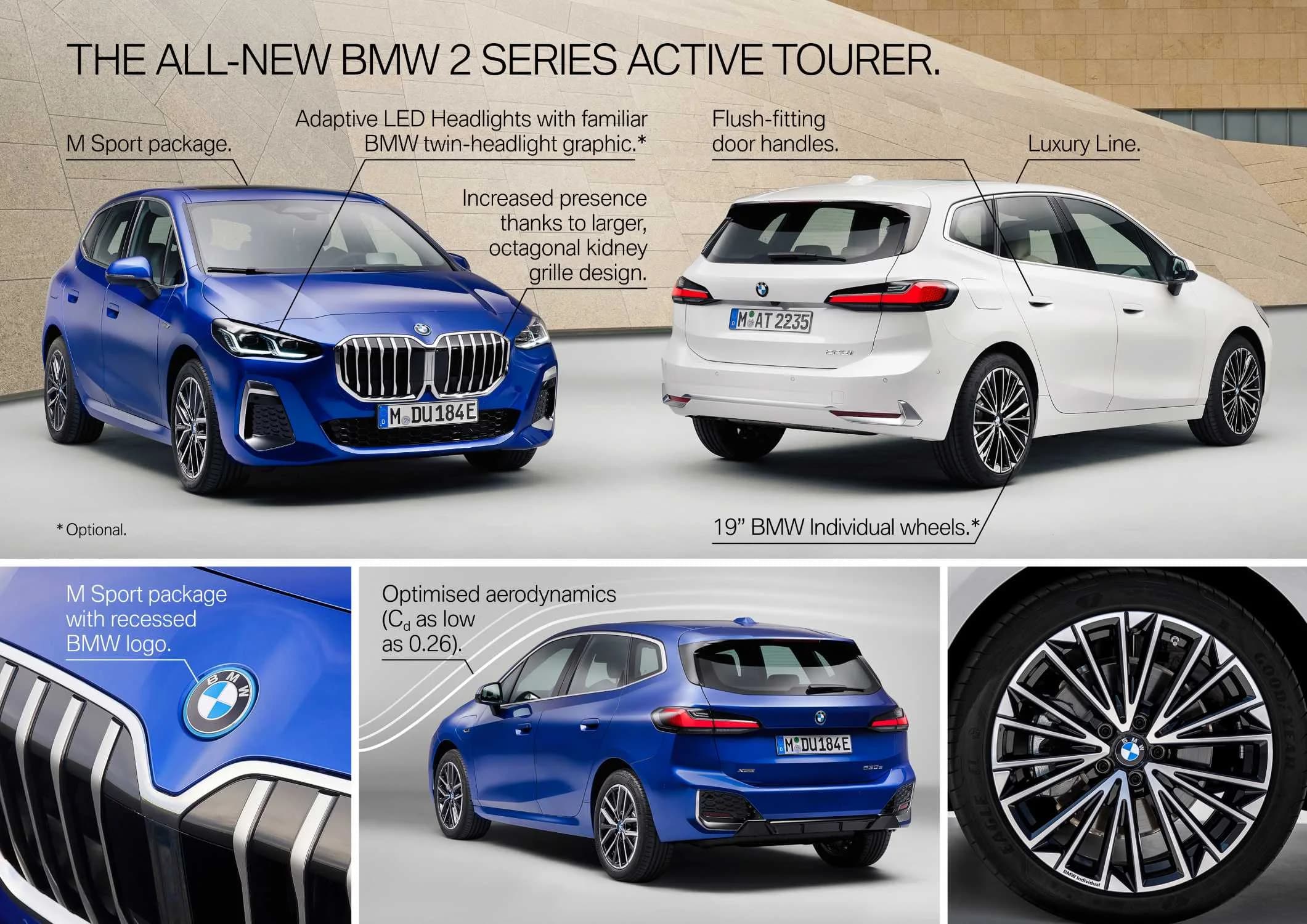
BMW is ending the Active Tourer succession
BMW has confirmed that the current 2 Series Active Tourer will not be followed by a direct successor. The statement was made as part of the company’s 2026 Capital Markets Day, where BMW outlined plans to review and reduce the number of variants across its portfolio. The objective is to improve profitability and simplify the range. The Active Tourer is the named example of a model that will not continue into another generation.
That does not mean production stops immediately. BMW has not announced a final build date, a last order date or a replacement model. The second-generation car remains a current product in the markets where it is sold. The confirmed point is narrower: when this generation reaches the end of its normal life cycle, BMW does not plan to launch a third-generation 2 Series Active Tourer.
A front-wheel-drive BMW with a practical brief
The first 2 Series Active Tourer arrived in 2014. It was BMW’s first production model with front-wheel drive and the brand’s first compact MPV. The concept was unusual for BMW: it offered a taller seating position, a more upright cabin and flexible rear-seat accommodation while remaining smaller than a typical SUV.
BMW built the first generation at Plant Leipzig and later offered the longer 2 Series Gran Tourer, which could carry up to seven occupants. The Gran Tourer has already left the portfolio, leaving the Active Tourer as the remaining BMW model with this particular compact people-carrier format.
BMW launched the second generation in 2021. In the official production announcement, the company said more than 400,000 customers had selected the first generation, with more than 368,000 of those cars built in Leipzig. That history matters because BMW is not cancelling a failed prototype. It is choosing not to invest in a new generation of a model with a clear customer base while the market has moved towards SUVs and crossovers.
What the current car brought to the range
The second-generation Active Tourer was designed for petrol, diesel and electrified powertrains. At launch, the line-up included front-wheel-drive versions ranging from 100 kW/136 hp to 160 kW/218 hp. BMW paired the engines with a seven-speed dual-clutch automatic transmission and later added plug-in hybrid variants.
The 220i and 223i used a 48-volt mild-hybrid system. BMW quoted a 14 kW/19 hp electric motor integrated into the transmission, with total system outputs of 170 hp and 218 hp respectively. These are official manufacturer figures, not Carboratory test results. Consumption and CO2 values also depend on equipment and the WLTP test configuration stated by BMW.
The cabin was a major redesign. A slim dashboard, BMW Curved Display and a floating centre armrest gave the compact MPV an interior layout influenced by the BMW iX. The model was also the first BMW in the compact class to introduce the newer generation of iDrive based on BMW Operating System 8.
Practicality remained the reason to choose the car. The rear bench could slide forward by up to 13 centimetres, while the 40:20:40 split-folding backrest made it possible to carry long items without losing every rear seat. Depending on the powertrain, BMW quoted luggage capacity from 415 to 1,405 litres or from 470 to 1,455 litres. Those figures explain why the Active Tourer appealed to families and urban buyers who wanted flexibility without a large SUV.
Why the formula is being removed
BMW has not attributed the decision to one sales number or one regulatory change. Its public explanation is a portfolio review. The company intends to reduce variants and focus investment on products that provide a stronger commercial return. A model can therefore be useful and technically sound while still being left without a successor if the business case for a new generation is weaker than the alternatives.
The closest BMW alternative is the X1, but it is not an identical replacement. The X1 is a compact SUV with a different body style, seating position and market identity. BMW has not said that the X1 will absorb every Active Tourer customer, nor has it announced an electric MPV that would preserve the same format.
The decision should also not be read as proof that every compact BMW with a combustion engine will disappear. The announcement concerns a review of the portfolio and uses the Active Tourer as an example. More precise information about production timing, ordering windows and market-by-market availability will have to come from BMW or local importers.
What it means for buyers
Customers considering a 2 Series Active Tourer can still evaluate the current model through the local BMW organisation, subject to the market’s available engines and delivery schedules. The absence of a successor does not remove the existing car’s warranty, servicing or parts support. It may, however, matter to buyers who intend to keep the vehicle for many years and want a direct next-generation upgrade later.
There is no official basis for predicting how the news will affect used-car values. Depreciation will depend on the exact engine, equipment, mileage, condition and local demand. The end of a model line can make a practical niche car harder to replace, but it can also limit the pool of future buyers; the effect cannot be assumed in advance.
BMW’s decision is therefore a confirmed end to the model’s succession, not an immediate withdrawal notice. The current 2 Series Active Tourer remains on sale where BMW offers it, while the company has not disclosed the final production date or a direct replacement. For a brand increasingly shaped by SUVs and electrified platforms, the compact Active Tourer will remain a distinctive but temporary chapter in BMW’s product history.
Sources
- BMW Group PressClub — The all-new BMW 2 Series Active Tourer
- BMW Group PressClub — BMW Group Plant Leipzig launches series production
- BMW Group PressClub — Agility, efficiency, AI-based innovations
Image: BMW Group PressClub, official BMW 2 Series Active Tourer media photograph. Local WebP asset: /resources/blog/bmw-2-series-active-tourer-ending-2026.webp. The image is not taken from the Auto Express article.


