BMW Group has added Samsung SDI and LG Energy Solution to the supplier network for its sixth-generation high-voltage batteries. Samsung SDI will provide cells manufactured in Europe, while LG Energy Solution will supply cells made in the United States. Deliveries are due to begin in the late 2020s.
The announcement does not disclose contract values, annual capacity, duration or an exact first-delivery date. It also does not assign either supplier to a named BMW model. Those omissions matter because several external reports attach estimates to the agreements that BMW has not confirmed.
Three European suppliers and another US source
BMW says its future European cell supply will include CATL, EVE Energy and Samsung SDI. LG Energy Solution is being added in the United States. The structure supports BMW's “local for local” purchasing policy: source components in or near the region where batteries and vehicles are assembled whenever practical.
The policy is intended to reduce transport distances and make the production network less dependent on a single company or route. It is not a promise that every region will receive identical cells. BMW designs the Gen6 system, but suppliers can be allocated according to geography, capacity and the requirements validated for each production programme.
BMW has not named the exact Samsung SDI or LG Energy Solution plants in its announcement. It says the companies will use established facilities in their respective regions. Reports identifying individual factories or predicting a particular start year are more specific than the official disclosure and should remain attributed estimates until the parties publish those details.
Cell production is different from battery assembly
Samsung SDI and LG Energy Solution will manufacture cells, not complete BMW vehicle batteries ready to bolt into a car. BMW's regional plants integrate the cells into the high-voltage battery housing, add cooling and electrical connections, install the control hardware and test the finished assembly before it reaches the vehicle plant.
Five Gen6 battery-assembly sites support that system: Irlbach-Straßkirchen in Lower Bavaria, Debrecen in Hungary, Shenyang in China, Woodruff in the United States and San Luis Potosí in Mexico. They sit close to BMW vehicle factories, shortening the final industrial route.
This distinction prevents two common misunderstandings. A cell supplier does not necessarily control the finished pack design, and a BMW battery-assembly plant does not necessarily manufacture the electrochemical cell. BMW keeps responsibility for vehicle integration and its Energy Master controller while purchasing cells from specialist manufacturers.
What BMW's Gen6 technology changes
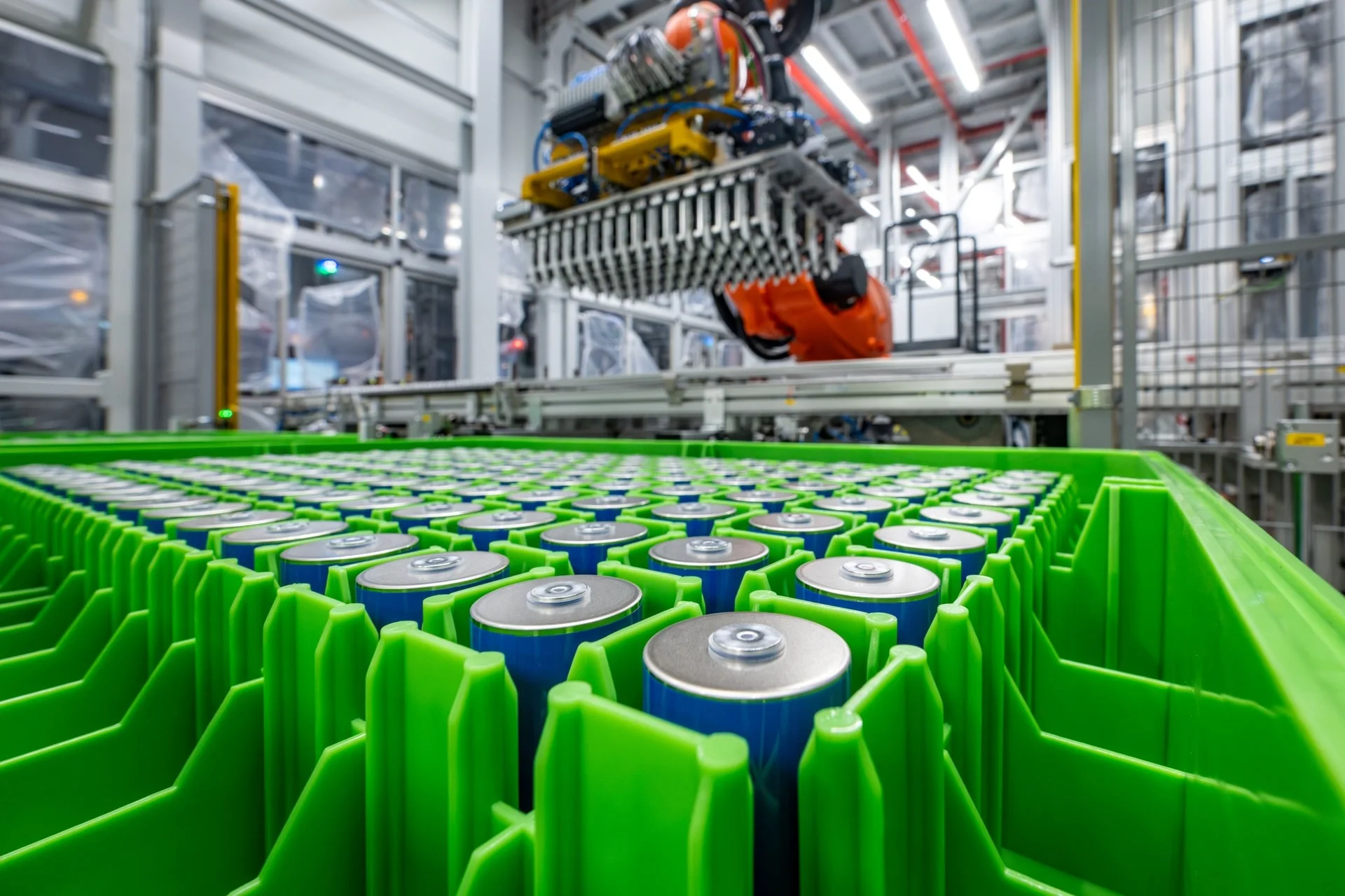
Gen6 replaces the prismatic Gen5 format with cylindrical cells. BMW technical documents describe cells with a standard 46 mm diameter and different heights for vehicle requirements; the iX3 and i3 documentation identifies a 95 mm version. The cells are placed directly into the battery housing through a cell-to-pack design, removing the conventional module layer.
BMW claims more than 20% higher volumetric energy density for the new cylindrical cells compared with its Gen5 prismatic technology. At system and vehicle level, it states that charging speed and range can improve by up to 30%, depending on the model. These are generational BMW figures, not independently measured results for Samsung SDI or LG Energy Solution cells under the new contracts.
The Gen6 electrical architecture operates at 800 volts. In specific models such as the iX3, the system supports up to 400 kW of DC charging. A peak number does not describe the complete charging session: battery temperature, state of charge, charger capability and the vehicle's charging curve determine how long that output is maintained.
BMW's Energy Master is mounted on the battery and consolidates power-supply and battery-management functions. That in-house hardware and software layer helps BMW integrate cells from a broader supplier base without surrendering control of the complete vehicle system.
The solid-state project is a separate programme
Samsung SDI already works with BMW and Solid Power on all-solid-state battery development. Under the 2025 research arrangement, Solid Power supplies sulfide-based solid electrolyte, Samsung SDI develops test cells and BMW evaluates them against agreed requirements for future demonstration vehicles.
The new Gen6 procurement announcement does not say the production cells are solid-state. It does not publish their chemistry at all. Treating the supplier agreement as evidence that BMW is about to sell a solid-state production car would combine two separate programmes and move beyond the available evidence.
The same caution applies to cell dimensions and capacities. BMW has explained the general Gen6 round-cell concept, but it has not released a supplier-by-supplier specification sheet. A performance figure for an iX3 battery cannot be assigned automatically to every future Samsung SDI or LG Energy Solution delivery.
Why BMW is widening the network
Battery cells are a high-value component and a potential production bottleneck. Manufacturing interruptions, raw-material constraints, trade rules or transport problems can affect vehicle output. Multiple validated sources give BMW alternatives, although switching between them still requires engineering work and quality approval.
Nicolai Martin, BMW board member responsible for purchasing and the supplier network, linked diversification to global competitiveness and regional value creation. Hendrik Lang, head of high-voltage-battery purchasing and quality, described the wider network as a way to make cell supply resilient, flexible and competitive.
BMW also retains its own battery expertise. The Battery Cell Competence Centre in Munich explores future cell technologies. The Cell Manufacturing Competence Centre in Parsdorf tests near-series manufacturing, while the recycling centre at Salching recovers materials through BMW's direct-recycling process.
What changes for an EV buyer
The immediate customer effect is indirect. BMW has not announced a price cut, a new range figure or a revised delivery date as a result of these contracts. The objective is to make future Gen6 production less vulnerable and support vehicle manufacturing in several regions from the late 2020s.
Models sharing Gen6 technology can still use different battery capacities, cell heights, charging curves or suppliers. BMW has not published a model-to-supplier map. Buyers should therefore rely on the specification and homologation of the exact car, rather than infer its cell origin from the Neue Klasse label alone.
Official BMW Group press image showing cylindrical battery cells in an industrial handling system. The file supplied through the BMW newsroom was converted to WebP for editorial use. Rights remain with BMW Group.
Sources
- BMW Group: Samsung SDI and LG Energy Solution added to the Gen6 supply network
- BMW Group: Gen6 battery production in Shenyang
- BMW Group: cylindrical-cell technology for Neue Klasse
- BMW Group: solid-state development partnership with Samsung SDI and Solid Power
- BMW Group: 2026 investor presentation and Gen6 production network