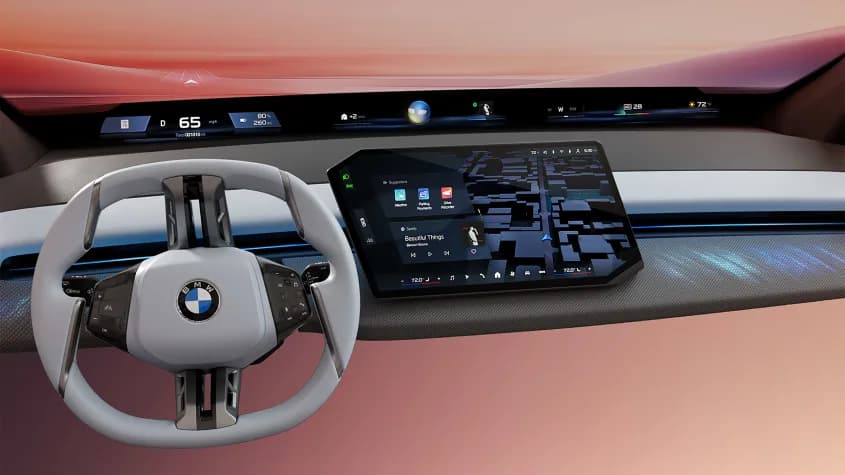
BMW Panoramic iDrive combines the display projected at the base of the windscreen, the central screen, steering-wheel controls and the voice assistant. Photo: BMW
BMW explains why it is dropping more buttons: touch and voice controls are used more often
BMW is reducing the number of physical buttons in its new models because data collected from cars show that drivers increasingly use the touchscreen, steering-wheel controls and the voice assistant. The manufacturer says the change is also linked to the habits of younger customers, not only to the minimalist look of the dashboard.
This direction does not mean future BMWs will have no buttons at all. The company keeps physical controls for functions considered frequent or important while driving, including audio volume, indicators, wipers, mirror adjustment and window demisting.
BMW says the screen and voice have become more familiar
Vikram Pawah, president of BMW Group Australia, told CarExpert that the shift to digital interfaces should be seen in the context of changes outside the car. Phones and digital services have accustomed users to touching a screen and to voice commands.
According to the executive, these methods are adopted faster by customers aged about 45 or younger. The claim describes a trend observed by BMW; it does not mean every young driver prefers screens or that older users refuse the technology.
BMW also bases its decisions on anonymised data collected, with users’ consent, from connected cars. The company can see which functions are accessed and by which method: touchscreen, rotary controller, steering wheel or voice command.
The iDrive rotary controller disappears after almost 25 years
The most visible change is the removal of the iDrive rotary controller from the centre console. The system appeared on the E65-generation 7 Series, launched in 2001, and became one of the characteristic elements of BMW interiors.
Joern Freyer, responsible for user interaction at BMW, previously explained that the data show declining use of the controller. Recent iDrive versions were designed primarily for direct screen touch, and navigating with the wheel sometimes became slower.
Dropping the controller allows BMW to design the interface for fewer parallel operating methods. For users used to navigating menus without touching the screen, however, the change removes a control that could be used with the hand resting on the console.
How the new BMW Panoramic iDrive works
The new BMW Panoramic iDrive architecture, controlled by Operating System X, splits information and controls among four elements:
- BMW Panoramic Vision, a display projected across the full width of the lower windscreen area;
- the central touchscreen;
- the optional 3D display in the driver’s field of view;
- the multifunctional steering wheel with haptic feedback.
Essential information, such as speed and navigation instructions, can be shown close to the line of sight. The central screen remains the main place for menus and personalisation, and certain elements can be transferred to Panoramic Vision with a gesture on the screen.
The BMW Intelligent Personal Assistant can control climate, windows, seats, navigation, the phone and media playback. BMW is betting on natural-language recognition so the driver is not forced to memorise exact phrases.
Which physical buttons BMW keeps
Official BMW documentation for Panoramic iDrive mentions haptic controls for:
- indicators and wipers;
- exterior-mirror adjustment;
- audio volume;
- drive-mode selection;
- demisting and de-icing of windows;
- important functions on the steering wheel.
The steering-wheel buttons have raised surfaces and haptic feedback, so they can be found without the driver looking down. Some symbols are illuminated only when the function is available, a solution BMW calls “shy tech”.
Stephan Durach, BMW’s head of interface development, said data from about 10 million cars convinced the company to keep the rotary volume control. It is used frequently, including for quickly muting the sound.
Climate control and vent direction move to the screen
Not every function used while driving gets a separate control. In interiors with Operating System X, temperature is adjusted from a permanent area of the screen, by voice or with shortcuts. On some new models, even airflow direction can be changed digitally.
This is one of the decisions that may produce the longest familiarisation period. A mechanical air vent can be moved by feel, while a virtual control requires locating the element on the screen or using voice.
BMW argues that placing information at the base of the windscreen and the steering-wheel controls reduce the need to look at the central screen. The effectiveness of the solution depends, however, on each model’s interface and how quickly the system responds.
Physical buttons also matter in Euro NCAP assessments
From 2026 Euro NCAP has introduced stricter criteria for access to main functions. To obtain the maximum score, manufacturers must offer easily reachable physical controls or a permanent, clear screen area for indicators, hazard lights, wipers, headlights and the emergency call.
Euro NCAP rules do not ban touchscreens and are not a legal condition for selling the car. They do, however, influence the safety rating used by buyers and can lead manufacturers to keep certain separate controls.
What to check on a test drive
A preference for buttons or a screen cannot be judged from photographs alone. Before buying a BMW with the new iDrive, the driver should try, while moving, in a safe place, the operations used daily:
- changing temperature and fan speed;
- quickly demisting the windscreen;
- changing the audio source and volume;
- entering a destination;
- temporarily deactivating some assistance systems;
- returning to the main screen from an app such as Apple CarPlay or Android Auto.
A system can look simple in a showroom, but the number of touches and the time needed for a command become obvious only in real use. BMW is not returning fully to dashboards with many keys; its strategy is a combination of screen, voice, projection and a restricted group of physical controls.