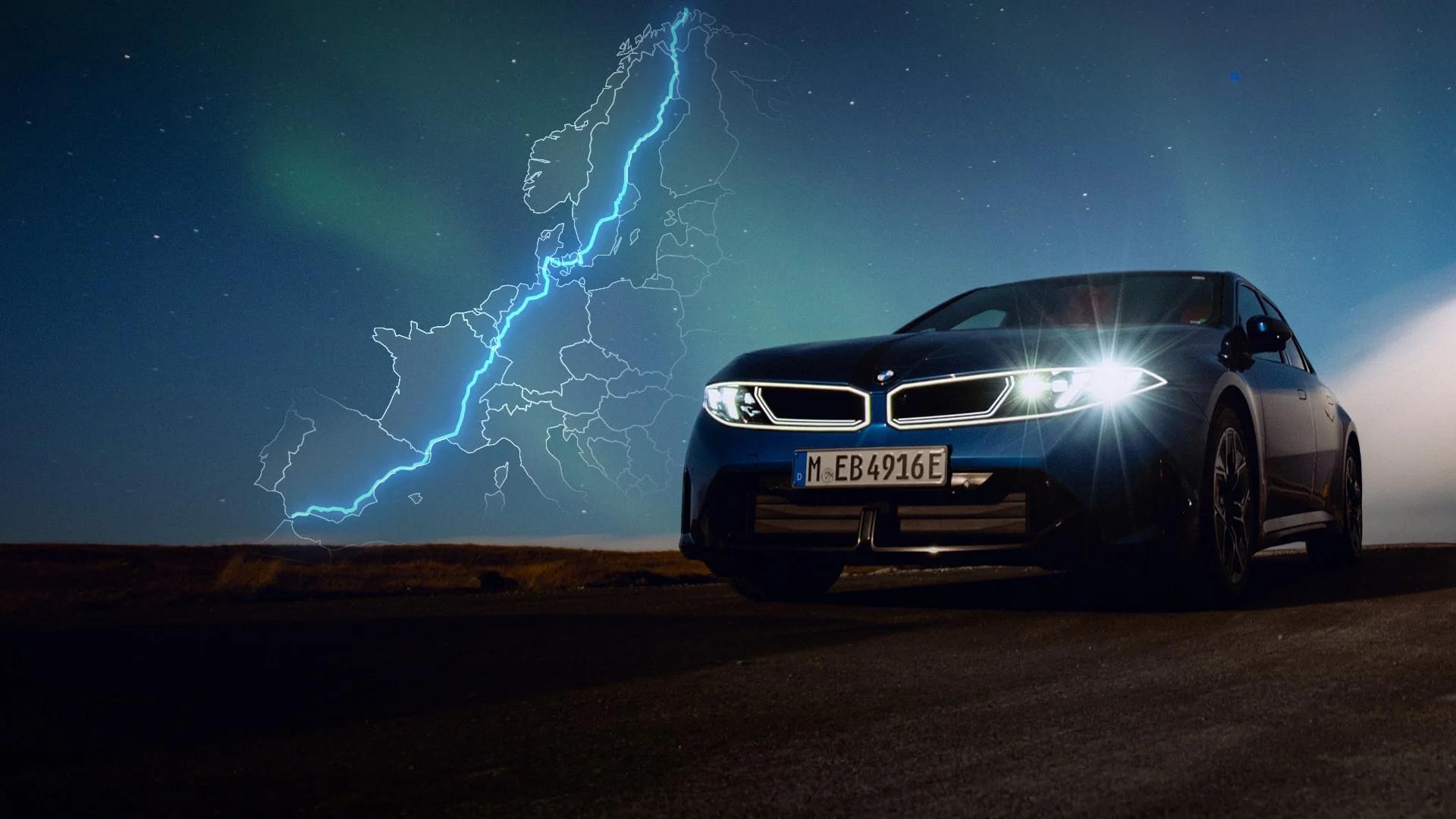
BMW says a production-spec i3 50 xDrive completed the 5,886.7 km Paneuropeana route from Norway's North Cape to Tarifa in southern Spain with a cumulative charging time of 2 hours, 45 minutes and 54 seconds. The manufacturer reports average energy consumption of 12.5 kWh/100 km and an average charging power of 275 kW across the stops.
The 2-hour-46-minute figure is not the duration of the journey. Driving alone took 3 days, 2 hours and 41 minutes, at an average speed of 79.7 km/h. BMW says the car travelled on motorways, rural roads and through towns as a normal road user.
How the Paneuropeana challenge works
The route begins at the North Cape on Norway's Magerøya island and ends in Tarifa, in Spain's Cádiz province. Entrants follow specified checkpoints, but the charging locations are not prescribed. Route planning therefore matters: a car can benefit from choosing high-power sites and avoiding poor availability, while weather and traffic can change the result.
BMW reports that the i3 crossed eight countries and used only publicly accessible chargers in national networks. A single engineer occupied the car at any one time. An identical i3 and a BMW iX3 50 xDrive travelled as support vehicles.
The company says all three cars matched customer-orderable production specification in hardware and software. The run was nevertheless organised and documented by BMW rather than an independent test body. Its release does not provide a stop-by-stop charging log, arrival and departure battery percentages, or a complete record of temperatures and wind conditions.
Why 12.5 kWh/100 km needs context
BMW's measured average of 12.5 kWh/100 km is below the i3 50 xDrive's official combined WLTP interval of 13.4–18 kWh/100 km. Those figures are not directly interchangeable. WLTP is a prescribed laboratory cycle intended for comparison, while the Paneuropeana result comes from one planned road journey with its own speeds, traffic and weather.
An overall average speed of 79.7 km/h is reasonably high for a route that includes cities and secondary roads, but it does not reveal the motorway cruising speed or the share of time spent in each environment. The result should not be treated as a guaranteed owner consumption figure.
The average charging power is arguably the more revealing number. Peak charging power can be achieved only for part of a session, because a battery normally reduces its intake as state of charge rises. Holding an average of 275 kW across the trip suggests that the team arrived at chargers in a favourable part of the battery's charging curve and selected capable infrastructure.
A 108.7 kWh battery and 400 kW DC peak
The i3 50 xDrive has one electric motor on each axle. BMW quotes total output of 345 kW, or 469 PS, and 645 Nm of torque. The official 0–100 km/h time is 4.7 seconds and top speed is 200 km/h.
Its Gen6 battery provides 108.7 kWh of usable energy and uses cylindrical cells. An 800-volt electrical architecture supports DC charging at up to 400 kW. BMW quotes up to 912 km of WLTP range and says ten minutes at a sufficiently powerful charger can add energy corresponding to as much as 423 km of WLTP range.
Those are official maximums, not promises for every stop. Energy added in ten minutes depends on initial battery level, temperature, charger output and battery conditioning. The distance that energy delivers then depends on speed and conditions after the stop. The Paneuropeana result represents a deliberately optimised long-distance operation.
Where BMW says the efficiency comes from
The new i3 has a claimed drag coefficient of 0.21, which BMW describes as its most aerodynamically efficient production car to date. The record car used 19-inch M Aerodynamic Polygon 1061 M wheels. BMW says its tyres have rolling resistance 14 per cent better than the threshold required for the A efficiency label.
According to the manufacturer, energy losses in the Gen6 motors are 40 per cent lower than in Gen5 units. The cylindrical cells deliver 20 per cent greater volumetric energy density than the previous prismatic cells. BMW's Heart of Joy computer coordinates propulsion, braking and recuperation; the company says electric motors can handle more than 95 per cent of braking events and feed energy back into the battery.
These comparisons are manufacturer claims rather than Carboratory measurements. They do, however, identify the main areas behind the road-trip result: reduced aerodynamic and rolling losses, efficient motors, extensive recuperation and a charging curve able to exploit high-power public stations.
What the record does and does not establish
BMW says the previous Paneuropeana charging-time record dated from 2017 and that the new i3 improved it by more than seven hours. Charging networks have changed substantially over that period, so the difference cannot be assigned to the car alone without equivalent route, weather, traffic and infrastructure data.
The most useful conclusion is narrower. A 275 kW average across public charging stops indicates that the i3's Gen6 system can spend relatively little stationary time when high-output chargers are available and the route is planned around them. It does not include detours to chargers, queuing or non-charging rest time, and it does not show performance on corridors dominated by slower or unreliable equipment.
BMW builds the new i3 at its Munich plant, where the body shop, assembly and logistics areas have been modernised over the past four years. The Paneuropeana run provides a detailed manufacturer demonstration of its long-distance capability, but independent journeys will still be needed to establish repeatability in winter, heavy traffic and less favourable charging networks.
Sources
- BMW Group — official BMW i3 Paneuropeana release
- BMW Group — German version and technical details
- Image: BMW Group PressClub, official photograph DI26_000483081