
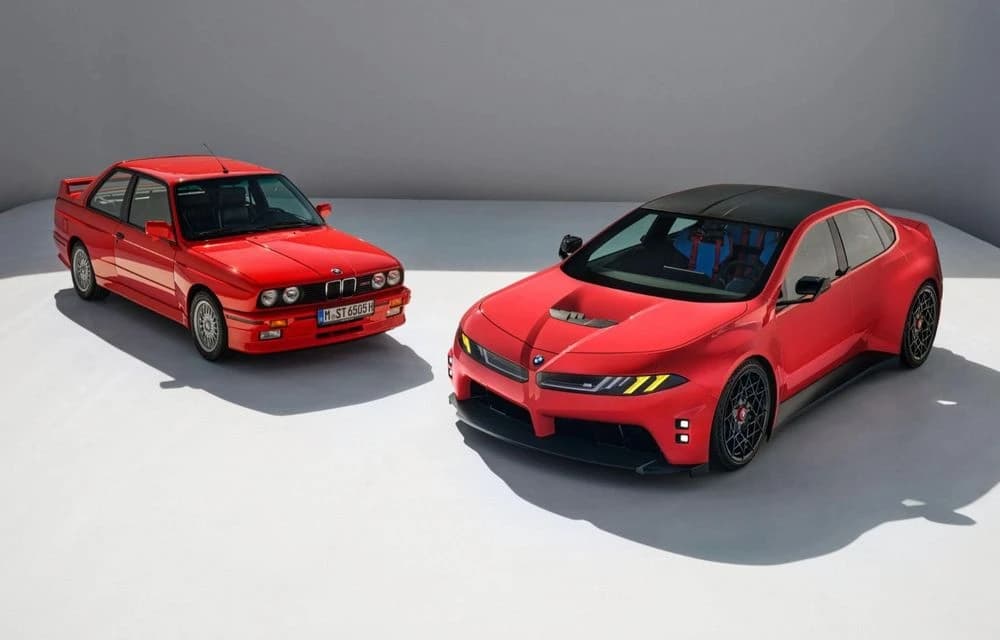
BMW is marking 40 years of the M3 in 2026, four decades after the first-generation car reached the market. The original BMW M3 was shown at the Frankfurt Motor Show in 1985 and launched in 1986. Since then, the name has covered six generations, several engine layouts, sedan, coupé, convertible and Touring body styles, and a long record of competition activity. BMW has also confirmed that the Munich plant will build the first fully electric M3 from 2027.
That future announcement does not amount to a complete reveal. BMW has not published the final electric M3’s power, battery capacity, range, charging time, weight or price. The information available today establishes the production location and the direction of the project, while the current G80 remains the sixth-generation M3 with an inline-six combustion engine.
The E30 started as a homologation car
The first M3 was developed to meet the homologation requirements for touring-car competition. BMW’s historical material lists a 2.3-litre naturally aspirated four-cylinder engine with four-valve technology, producing 147 kW, or 200 hp. The car weighed 1,200 kilograms, accelerated from 0 to 100 km/h in 6.7 seconds and reached 235 km/h.
The initial M3 was a two-door model based on the 3 Series, but it received extensive changes for road and track use. BMW M says that, apart from the doors and roof, the main components were newly developed or adapted by BMW Motorsport. The road car was more successful with customers than the minimum production requirement suggested: BMW cites 16,949 first-generation M3s, including derivatives, compared with the 5,000 cars required for homologation.
The E30 M3 also established the model’s competition identity. BMW lists victories in the German DTM touring-car series, the World Touring Car Championship and the Nürburgring 24 Hours. The company also notes the 1987 Tour de Corse win, making the M3 the only BMW model to win a round of the World Rally Championship.
E36 brought the straight-six
The second generation arrived in 1992 and broadened the M3’s role. The E36 was no longer primarily an homologation car for racing. It was designed as a more mature road-going performance model, first as a two-door coupé and later as a sedan and convertible.
The four-cylinder was replaced by a straight-six. BMW M lists output between 210 and 236 kW, or 286 to 321 hp, depending on version. The engine started at 3.0 litres and grew to 3.2 litres after the facelift. In 1996, BMW offered the Sequential M Gearbox, or SMG, as an option for the M3.
This generation matters because the model’s performance formula was no longer tied to a single racing rulebook. The M3 became easier to use as a road car while keeping a direct connection with motorsport through its engine, chassis work and body design.
E46 and the CSL special edition
The third-generation E46 appeared in 2000 with a 3.2-litre straight-six producing 343 hp. BMW later introduced the M3 CSL, a special edition with weight-saving measures and 360 hp. BMW quotes a 0-100 km/h time of 4.9 seconds for the CSL.
The E46 family also included the M3 GTR, a competition car that won races in the American Le Mans Series and took two victories at the Nürburgring 24 Hours. Those results belong to the racing programme and should not be confused with the specification of the normal road-going M3.
The E46 is also the generation for which BMW’s current historical overview lists total production of 85,139 units. That figure is presented by BMW as the biggest sales total for an M model at the time of its historical comparison, not as the production total of every M3 generation combined.
The only V8-powered M3
The fourth generation launched in 2007 and made one of the most visible technical changes in the model’s history. The E90, E92 and E93 M3 used a naturally aspirated 4.0-litre V8 producing 309 kW, or 420 hp. BMW quotes 4.8 seconds from 0 to 100 km/h for the coupé.
The V8 chapter also overlapped with BMW’s return to the DTM in 2012. Bruno Spengler won the drivers’ title, BMW Team Schnitzer won the teams’ title and BMW took the manufacturers’ championship. The fourth generation was the last to use the M3 name for coupé and convertible versions; those body styles later became the M4.
F80 replaced the V8 with a turbocharged six
The fifth-generation F80 arrived in 2014 as a four-door sedan. Its new straight-six engine used BMW M TwinPower Turbo technology instead of the previous V8’s naturally aspirated layout. The standard car produced 431 hp, while the Competition Package increased output to 450 hp and reduced the claimed 0-100 km/h time to 4.0 seconds.
BMW also used lightweight materials in the F80. Aluminium and carbon-fibre components were applied to parts such as the bonnet, roof, propeller shaft and strut brace. The model continued the performance-sedan formula while the related coupé and convertible carried the M4 badge.
G80 added all-wheel drive and the Touring body
The current sixth generation was introduced in 2020. The G80 kept an inline-six engine and later added two firsts for the M3 range. BMW introduced intelligent M xDrive all-wheel drive in 2021, then launched the M3 Touring estate in 2022.
BMW’s historical figures put the G80’s output between 353 and 405 kW, or 480 to 550 hp, with maximum torque between 550 and 650 Nm. The M3 Competition with M xDrive is listed at 3.5 seconds from 0 to 100 km/h, while the limited M3 CS takes 3.4 seconds. BMW quotes an electronically limited 302 km/h top speed for the CS.
These are manufacturer figures for specific versions. They are not Carboratory test results and should not be applied to every G80 M3 configuration.
The electric M3 is planned for 2027
BMW M has confirmed that the Munich plant will produce the first fully electric M3 from 2027. The announcement is linked to a wider conversion of the factory, which BMW says will build only fully electric vehicles from that year. BMW has invested around €650 million in the transformation of the site.
The company has not yet released the full technical specification of the electric M3. Battery size, motor output, final range, charging performance, mass and pricing remain unknown. It is therefore too early to treat the project as a finished product or to compare it directly with the current petrol-powered M3 on measurable terms.
The change will nevertheless be notable because all six existing generations use combustion engines. BMW says the electric model will use BMW M New Class technology. The open question is how the company will translate the M3’s current priorities—traction, response, repeatable performance and road usability—into a battery-electric car.
Four decades of changing hardware
The M3’s history is not simply a line of increasing power. The E30 was a light four-cylinder homologation car. The E36 made the straight-six and broader road usability central to the formula. The E46 refined the naturally aspirated six-cylinder concept, the E90 introduced the only V8, the F80 returned to a turbocharged six, and the G80 added all-wheel drive and a Touring body.
The electric model announced for 2027 will add a seventh technical chapter without changing the fact that the G80 is the current sixth generation. BMW has not announced an immediate end to all combustion-powered M3 versions. For now, the anniversary marks both a long history and a clear production plan for the next stage.
Sources
- BMW Group PressClub – 40 years of the BMW M3
- BMW M – BMW M3 generations
- BMW M – one-millionth BMW M vehicle and the future electric M3
Image: the photograph explicitly requested from the supplied article, taken from its gallery and converted locally to WebP. Copyright remains with the original rights holder.


