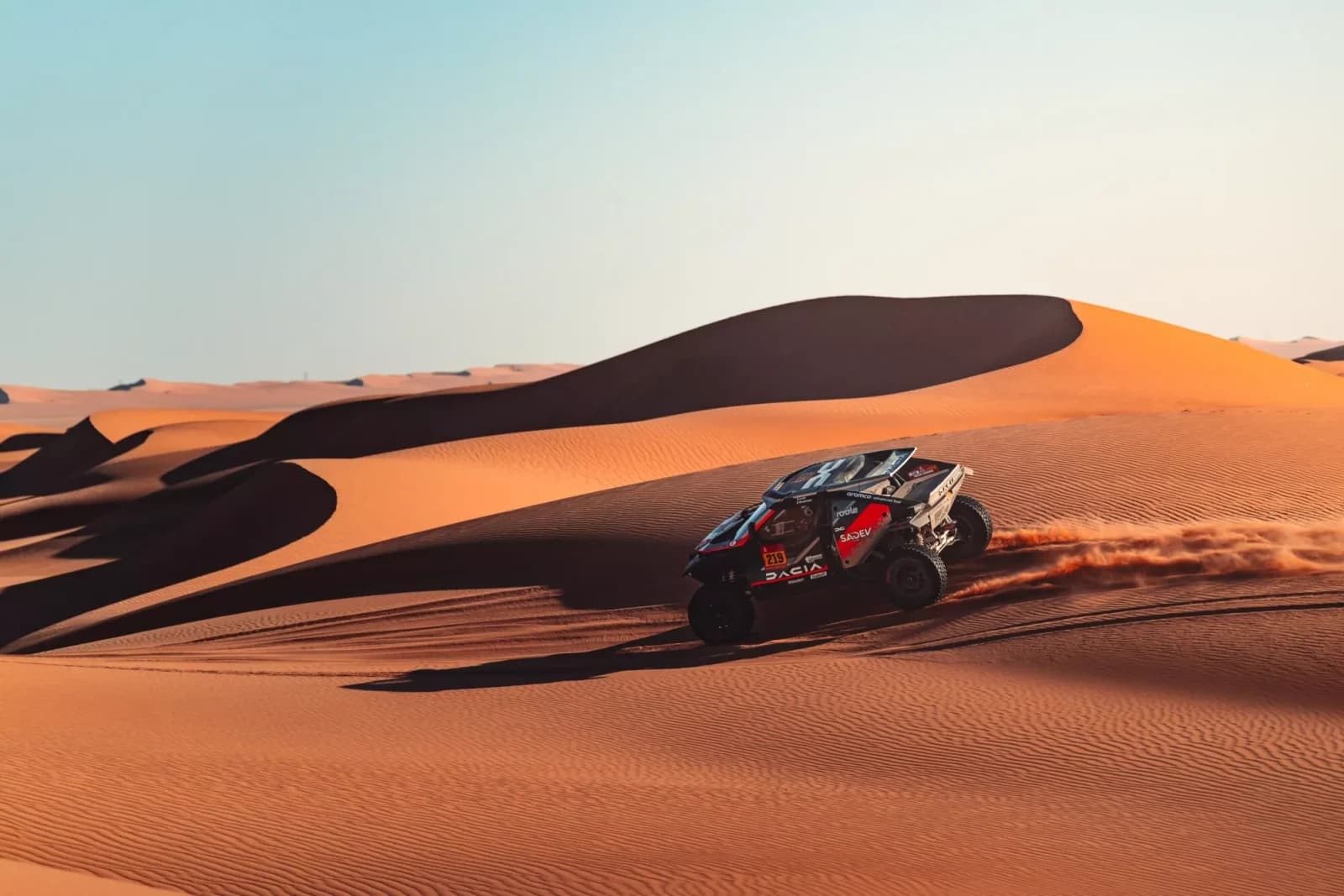
Dacia will field three Sandriders at the 2026 Rallye du Maroc as it defends the lead in the drivers', navigators' and manufacturers' FIA World Rally-Raid Championship standings. Sébastien Loeb and Nasser Al-Attiyah are separated by only three points, making the penultimate round more than a rehearsal for the next Dakar.
Loeb remains with Édouard Boulanger and Al-Attiyah with Fabian Lurquin. The third car brings a new partnership: reigning world champion Lucas Moraes will compete with Pablo Moreno for the first time.
Dacia's three-car Morocco line-up
The official entries are:
- #219 — Sébastien Loeb and Édouard Boulanger, France;
- #299 — Nasser Al-Attiyah, Qatar, and Fabian Lurquin, Belgium;
- #223 — Lucas Moraes, Brazil, and Pablo Moreno, Spain.
Moreno previously navigated for Cristina Gutiérrez and now replaces Dennis Zenz alongside Moraes. Dacia says its relationship with Gutiérrez ended by mutual agreement during the summer. The FIA entry preview lists her in Morocco in a Santana outside the W2RC-registered field.
For Moraes, changing navigator also creates a sporting distinction. The 57 navigators' points earned in the first three rounds remain with Zenz; standings are individual even when a driver continues in the same manufacturer team. Morocco is nonetheless familiar territory for Moraes, who clinched the 2025 drivers' championship there while racing for Toyota.
Three points cover Dacia's title rivals
The FIA standings place Loeb first on 114 points and Al-Attiyah second on 111. Toyota's Seth Quintero is close behind on 101. Boulanger leads the navigators on 114 points, three ahead of Lurquin and 13 ahead of Andrew Short.
Dacia has 315 manufacturers' points, compared with 250 for Toyota Gazoo Racing W2RC and 170 for Ford Racing. Its 65-point advantage follows victories in the opening two rounds: Al-Attiyah and Lurquin won the Dakar Rally, then Loeb and Boulanger took Rally-Raid Portugal.
The third round in Argentina interrupted Dacia's run of victories without removing the team from the podium. Al-Attiyah finished third, 2 minutes 26 seconds behind the winner, and Loeb was fourth at 3 minutes 54 seconds. Moraes lost more than 20 hours and finished 21st. Quintero and Short won that event for Toyota, showing why their 13-point gap to the championship lead remains relevant.
Five stages from Agadir to Zagora
The FIA calendar covers 28 September to 3 October, including the full six-day event programme. Dacia's competitive itinerary starts from Agadir on 29 September and finishes at Zagora on 3 October. Five stages provide 1,575 km of timed competition within a total route of 2,524 km.
Stage one travels east from Agadir to Zagora. The bivouac then remains in the Draa Valley town for the next four days. Stage two runs west of Zagora, while stages three and four head northeast. Friday's fourth stage is the longest against the clock at 384 km. Saturday's finale uses a route south of Zagora.
The FIA reports 104 cars and eight trucks. The Ultimate class contains factory and private entries from Toyota, Ford, Dacia, Mini and other constructors. Twelve Ford Raptors are registered for W2RC points, while Toyota supports Quintero with crews including Henk Lategan and Yazeed Al-Rajhi.
Teams also use Morocco as a Dakar test because of the desert terrain and navigation demands. This edition still carries immediate championship consequences: after Morocco, only the Abu Dhabi Desert Challenge on 22–27 November remains in the five-round 2026 season.
A bid for three Morocco wins in succession
The Sandriders project made its competitive debut at this event in 2024 and won with Al-Attiyah. Loeb and Boulanger repeated the result in 2025. Dacia is therefore unbeaten in Morocco across its first two appearances and has stated that a third consecutive victory is the target.
That record does not make a third win automatic. Loeb recalled that his 2025 success was close and included a late scare after the crew missed a waypoint in the final Power Selective Section. Rally-raid results depend on navigation and reliability as well as stage pace, and the championship margins are small enough for a penalty to change the order.
Team principal Tiphanie Isnard has described protecting all three championship leads as the priority. Internally, however, Loeb and Al-Attiyah are direct rivals for the drivers' title. The points outcome in Morocco will determine whether either arrives in Abu Dhabi with room to manage the finale.
What the Sandrider is
The competition car is not a modified production Duster. Dacia, Renault Group and Prodrive developed the Sandrider as a purpose-built FIA Ultimate T1+ prototype. The original technical sheet specifies a tubular chassis, carbon-fibre bodywork, four-wheel drive and double-wishbone suspension with 350 mm of travel.
Its 3.0-litre twin-turbo direct-injection V6 was rated by Dacia at 265 kW/360 bhp in the global specification, with 539 Nm at 4,250 rpm. It drives through a six-speed sequential gearbox. The vehicle is 4,140 mm long, 2,290 mm wide and 1,810 mm high, with a 3,000 mm wheelbase.
All three Morocco entries use BFGoodrich tyres and fuel supplied by Aramco. Dacia and Aramco describe the fuel as sustainable. The event announcement does not publish an independently measured emissions reduction for these three cars, so that description should be understood as the partners' technical claim rather than a race result.
Image: official Dacia media kit, © MCH Photography S.R.O.