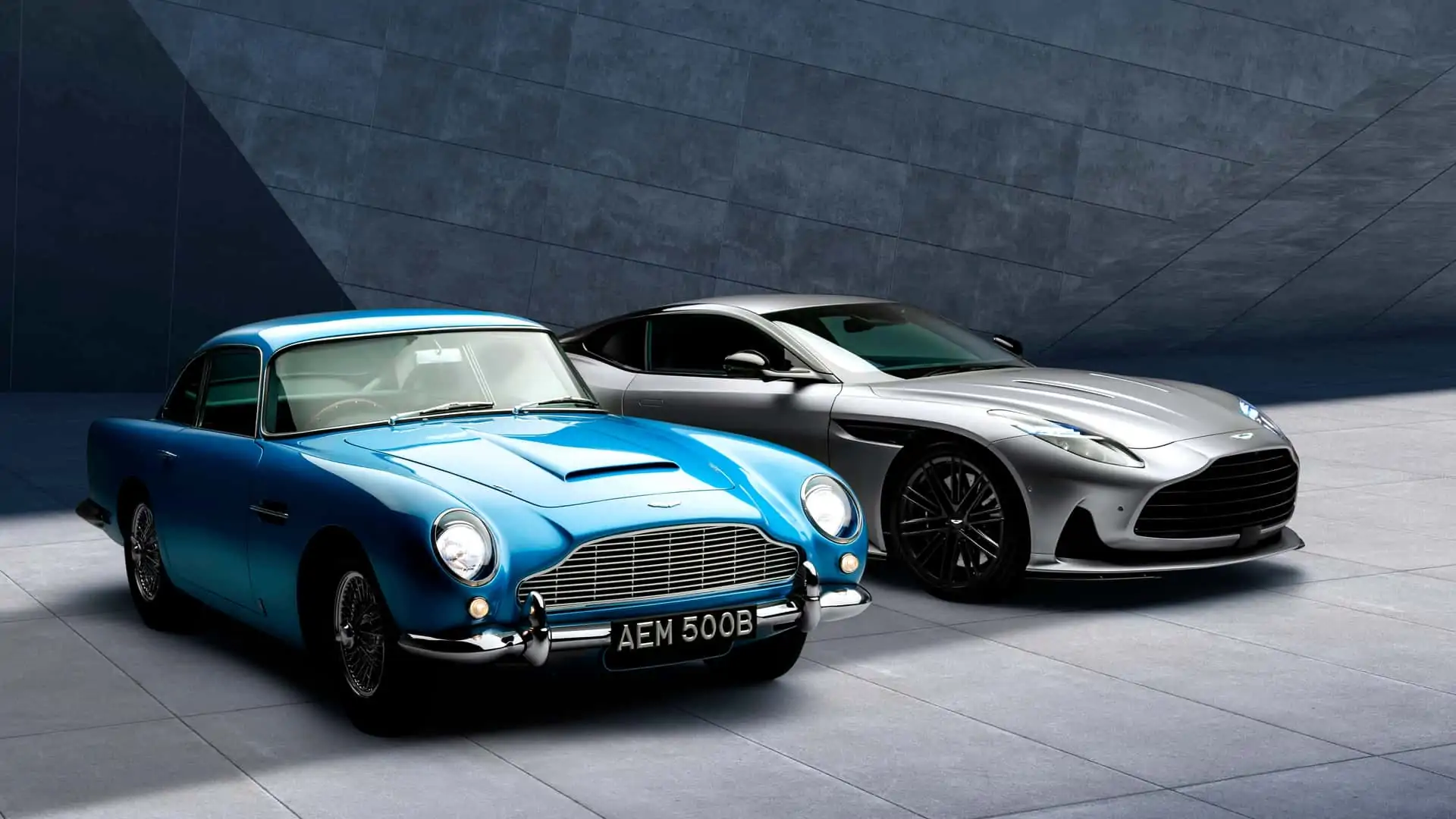
An Aston Martin DB5 alongside a modern model from the British manufacturer. Photo source: Aston Martin
Why does James Bond drive an Aston Martin? The story starts before the famous DB5
The image of James Bond at the wheel of a silver Aston Martin DB5 now seems inevitable. The car with an ejector seat, hidden machine guns and rotating number plates has become almost as recognisable as agent 007. The link did not begin with the DB5, nor was it planned from the start of the series.
In Ian Fleming’s novels, Bond was closer to Bentley. Aston Martin appeared only in the book Goldfinger, published in 1959, and the film-makers turned that one-off choice into one of the best-known pairings of a car and a cinema character.
The Bond of the books preferred Bentley
The literary character drove a 4.5-litre supercharged Bentley, described by Fleming as a coupé painted in a grey close to the colour of warships. It was already an old car for the period in which the books are set, but it fitted the image of a character attached to personal objects and to mechanical performance.
The situation changed temporarily in Goldfinger. For the mission in which he had to follow Auric Goldfinger, Bond was given access to the service car pool and chose an Aston Martin instead of a Jaguar. Fleming called it a DB III, but the model described is considered to be the DB Mark III, not the DB3 competition car.
The DB Mark III already had several special fittings: reinforced bumpers, a receiver for the tracking device, a Colt pistol hidden under the seat and a mechanism that could change the appearance of the rear lights. It was the only Aston Martin explicitly assigned to Bond in Fleming’s original novels.
Why the film Goldfinger used a DB5
When Albert “Cubby” Broccoli and Harry Saltzman prepared the screen adaptation, the DB Mark III was no longer the brand’s current model. Aston Martin had launched the DB5 in 1963, and the producers asked the company for a car for filming.
After negotiations, Aston Martin lent the production a prototype. The official 007 website identifies it by chassis number DP/216/1 and explains that the car was, technically, a DB4 Series 5 used in the development of the DB5. The car received the registration BMT 216A and was converted for its role in Goldfinger. A second DB5 was also used for the Alpine exterior filming.
The choice had a visual logic as well. The DB5 was a new British grand tourer, fast and elegant, but sober enough for the character played by Sean Connery. At the same time, it was too distinctive for an agent who should have gone unnoticed. Bond films were not chasing strict realism: the car had to communicate the character’s status, taste and control to the audience before he said anything.
The gadgets made the difference
A standard DB5 would not have had the same effect. Production designer Ken Adam and effects specialist John Stears took the idea of a specially equipped car from the novel and amplified it for the screen.
The film car received, among other things:
- an ejector seat for the passenger;
- machine guns hidden in the front;
- a bulletproof shield behind the rear window;
- devices for cutting tyres;
- smoke and oil installations;
- extending bumpers;
- a tracking system;
- rotating number plates.
In 1964, the presentation of these functions in Q’s laboratory established the recipe for the Bond car: a high-performance model, memorable design and technologies that were impossible or highly unlikely on a production car. The DB5 was no longer scenery; it took part in the action and helped the character escape situations in which an ordinary car would have been useless.
The DB5 returned after three decades
After Goldfinger, the DB5 appeared again in Thunderball, released in 1965. The series later used many other brands and models, including the Lotus Esprit, Toyota 2000GT, BMW Z3, BMW 750iL and BMW Z8.
The DB5 returned in 1995, in GoldenEye, after an absence of about 30 years. It was also used in Tomorrow Never Dies, Casino Royale, Skyfall, Spectre and No Time to Die. The official 007 list credits it with appearances in eight films of the series.
The returns also changed the car’s role. In more recent productions, the DB5 is no longer only a vehicle issued by Q Branch. It is tied to Bond’s past and identity, especially in the films with Daniel Craig. Its presence works as a link between generations of actors and between the era of mechanical gadgets and modern films.
Bond has driven other Aston Martin models too
The partnership was not limited to the DB5. George Lazenby drove a DBS in On Her Majesty’s Secret Service in 1969. Timothy Dalton received an Aston Martin V8 in The Living Daylights in 1987, equipped for scenes on snow and ice.
Pierce Brosnan used a V12 Vanquish in Die Another Day. Seven cars were supplied for filming, and some stunt examples received all-wheel drive and V8 engines for sequences shot on a frozen lake.
The Daniel Craig era brought the DBS in Casino Royale and Quantum of Solace. For Spectre, Aston Martin built the DB10, a car created specifically for the film, on a technical base derived from the V8 Vantage. No Time to Die brought together four models from the brand: DB5, Aston Martin V8, DBS Superleggera and the Valhalla concept.
Was it the most effective product placement in the car industry?
The DB5 gave Aston Martin exposure that an ordinary campaign could not have reproduced. A concrete example is the Corgi model inspired by the car from Goldfinger: according to Aston Martin, 2.5 million examples were sold in the first year, 1965.
The relationship works in both directions. Aston Martin received the association with a globally known British character, and the films obtained a car that expresses luxury, performance and danger without extra explanation. The DB5 became a visual shortcut for the entire Bond universe.
The manufacturer later used this history through special editions and the DB5 Goldfinger Continuation series. The 25 customer cars were built at Aston Martin Works in Newport Pagnell and reproduced several of the prop mechanisms. They are not modern cars homologated for ordinary use on public roads.
So why does James Bond drive an Aston Martin?
There is no single reason. Ian Fleming introduced the brand in Goldfinger, the film-makers chose the newest Aston Martin available, and the technical team turned the DB5 into a character. The success of the 1964 film did the rest.
Aston Martin fits Bond’s cinematic image because it is British, fast, expensive and less common than other luxury cars. The DB5 adds a contradiction useful to the story: it is unreasonably easy to recognise for a spy, but perfect for a cinema hero who must be recognised at once.
Frequently asked questions
What was the first Aston Martin driven by James Bond?
In the 1959 book Goldfinger, Bond drives an Aston Martin DB Mark III, called a “DB III” by Ian Fleming. In the films, the first was the DB5 from Goldfinger, released in 1964.
Why was the DB Mark III not used in the film?
At the time of filming, the DB5 was the new Aston Martin model. The producers updated the car from the novel and used a prototype, plus a second DB5 for the exterior sequences.
In how many Bond films does the Aston Martin DB5 appear?
The official 007 list indicates eight: Goldfinger, Thunderball, GoldenEye, Tomorrow Never Dies, Casino Royale, Skyfall, Spectre and No Time to Die.
Did James Bond drive only Aston Martin?
No. In the books he was associated especially with Bentley, and the films used numerous other brands, including Lotus, Toyota and BMW.
Sources
- Motor1 — the history of the relationship between James Bond and Aston Martin
- James Bond 007 — official history of the Aston Martin DB5
- James Bond 007 — the film Goldfinger and its cars
- Aston Martin — DB Mark III, the first Aston Martin in the literary Bond universe
- Aston Martin — the DB5 Goldfinger Continuation project