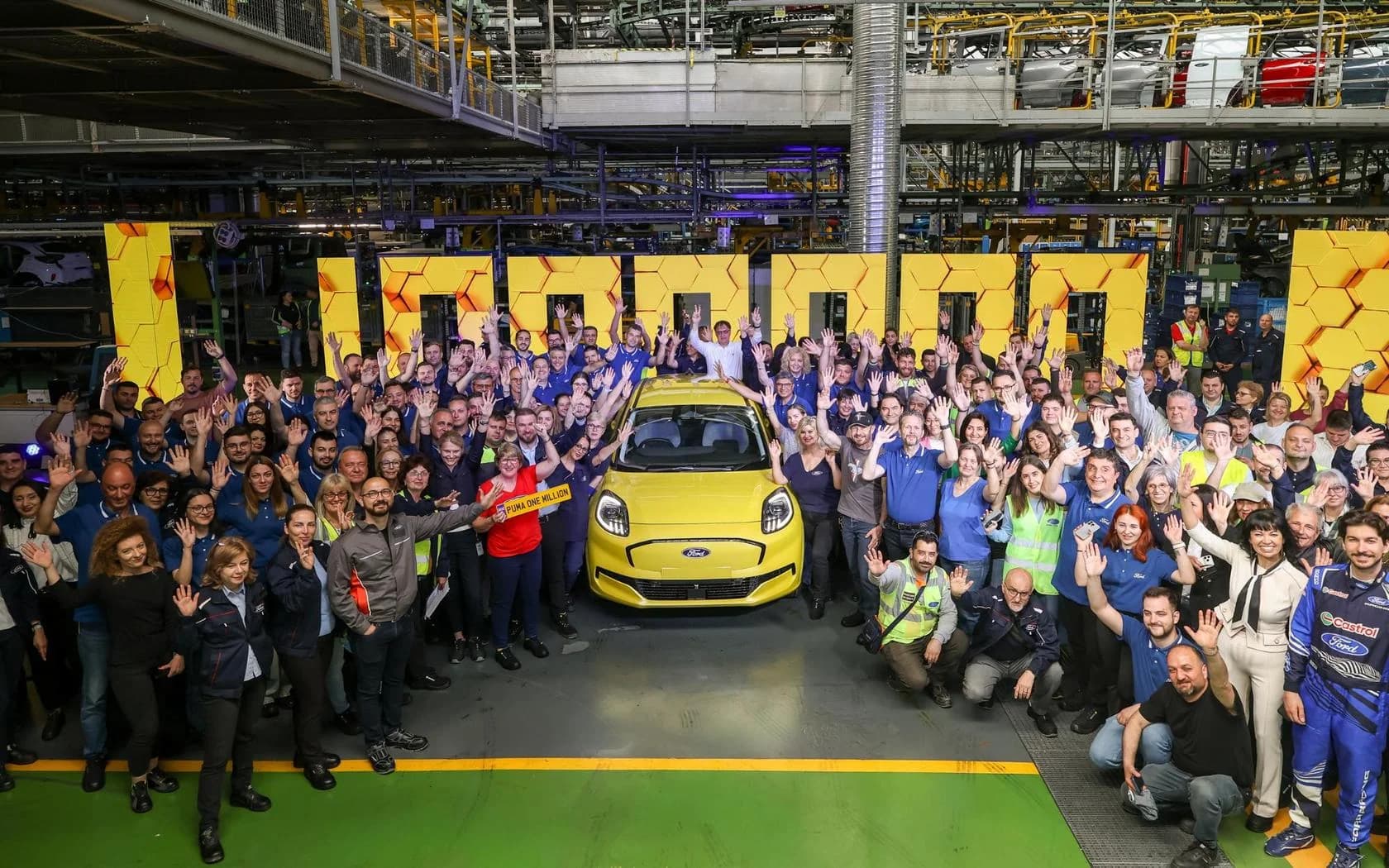
The Ford Otosan plant in Craiova, at the one-million-car production milestone. The photograph illustrates manufacturing in Romania; the J.D. Power data cited in the article come from the US market. Photo: Ford Otosan.
Ford is catching manufacturing defects earlier. First results show up in warranty costs
Ford says it is starting to identify quality problems before they reach a large number of customers. The manufacturer has tied engineering, purchasing and production teams more closely together, extended durability tests and uses data generated by cars to locate a fault and the affected batch more quickly.
Results are beginning to show in short-term indicators. In the US J.D. Power Initial Quality Study 2026, Ford ranked first among volume brands, with 152 problems reported per 100 vehicles in the first 90 days of use. The volume-brand average was 177 problems per 100 vehicles.
That is a significant improvement on Ford’s 15th place among volume brands in 2023. It does not mean that all of the manufacturer’s problems have been solved. The study measures the initial quality of new cars in the United States, not reliability after five or ten years, and not the quality of every model sold in Europe.
What Ford changed in plants and in vehicle development
The central change is the shift from reacting after complaints appear to detecting issues early. Ford teams hold daily sessions in which they track open problems until the cause is established and a solution is applied. Engineering, suppliers and production are involved together, so that a component defect is not treated separately from the process by which the part was designed, purchased and fitted.
The manufacturer has also extended durability tests for some programmes. Vehicles and components are subjected to cycles equivalent to up to 15 years and about 362,000 km of use before launch. The aim is for wear that would appear late in service to be observed while the project can still be corrected.
One example comes from the Essex engine plant in Canada. According to Road & Track, Ford selects an engine from the line every day, tests it and dismantles it to look for deviations that are not visible in a normal inspection. The company also uses computer models to identify engines with a higher risk, so that checks are concentrated where the probability of a problem is higher.
Vehicle data can quickly narrow the affected batch
Connected cars supply information on errors, operating parameters and workshop interventions. In its 2026 integrated report, Ford explains that these data are used for anomaly detection, root-cause analysis and tracking investigations through to a possible recall.
The practical advantage is a more precise delimitation of the vehicles affected. If engineers can link an error to a supplier, a production period or a specific configuration, the company no longer has to include preventively in a campaign all cars built over a very wide interval.
| Measure introduced or extended | What it tries to prevent |
|---|---|
| Daily problem reviews | Delayed decisions between departments |
| Longer durability tests | Defects that appear after many kilometres |
| Periodic dismantling of tested components | Hidden manufacturing deviations |
| Data transmitted by connected vehicles | Slow identification of a fault pattern |
| Exact delimitation of VIN series | Recalls wider than necessary |
Warranty costs are falling, but recalls have inertia
Jim Farley, Ford’s chief executive, said the quality recovery took about four years. Ford says the cumulative reductions in material and warranty costs in 2025 exceeded by 50% the internal target set for that year. The manufacturer expects further falls in warranty spending in 2026. The trend matters financially: every repair paid under warranty hits the margin directly, and a problem found after hundreds of thousands of cars have been delivered is far more expensive than one corrected before series production.
The large number of recalls associated with Ford in recent years will not fall at the same pace. A campaign announced today may concern cars built several years ago, before the new procedures. In addition, better detection can temporarily produce more campaigns, because the company finds and declares problems that would previously have been noticed later.
That is why three indicators must be kept separate:
- initial quality, measured in the first 90 days;
- warranty costs, which include faults appearing over a longer period;
- safety recalls, which can cover older generations and model years.
What the J.D. Power study shows, and what it does not
J.D. Power surveyed 78,514 buyers and lease users of new vehicles after the first 90 days of ownership. The score includes both technical defects and dissatisfaction related to use, software, connectivity and controls. The lower the PP100 number, the better the result.
Ford scored 152 PP100 and finished ahead of Nissan, at 156, and Buick, at 162. F-150, Mustang and Super Duty won their segments. Across the whole market, including premium brands, Porsche had the best score, 138 PP100.
The ranking confirms that the new Ford cars analysed in the US generated fewer complaints at the start of use. It cannot by itself predict maintenance costs at high mileages and it does not include the experience of owners in Romania.
What it means for Ford customers in Romania
Ford builds the Puma, Puma Gen-E and Transit Courier models in Craiova through Ford Otosan. The Romanian plant has its own processes, suppliers and controls, and the US J.D. Power study does not publish a separate score for cars built there.
For a buyer in Romania, Ford’s improvement is a favourable company-level signal, not a guarantee for every car. Checking a specific model remains more useful than the brand’s overall score: the history of technical campaigns, the powertrain, the year of manufacture and the warranty terms can substantially change the operating risk.
Owners can check the VIN in the recalls section of the Ford Romania website or at an authorised workshop. A recall campaign is carried out at no cost to the customer, whether the car was bought new or used, as long as the chassis number is included.
Frequently asked questions
Is Ford now the most reliable car brand?
That conclusion cannot be drawn. Ford is the volume brand with the best result in the 2026 US J.D. Power study of initial quality. The study covers the first 90 days, not long-term reliability.
Why can recalls continue if manufacturing has improved?
Recalls announced now may concern cars produced before the new controls were introduced. Faster detection can also lead to the identification of problems that would otherwise have gone unnoticed for longer.
Are Ford cars built in Craiova included in the study?
The 2026 J.D. Power study cited here analyses the US market. It does not provide a separate assessment for the Craiova plant or for Ford’s European range.
How do I find out if my Ford has an active recall?
The check is done by VIN on the Ford Romania website or through an authorised dealer. If the vehicle is included in a campaign, the remedy indicated by the manufacturer is free of charge.