
Fabrizio Giugiaro has returned to his Gallardo design work with HOMMAGE 26, a CAVËN Atelier commission developed by GFG Style. Unveiled at the Concours at Wynn Las Vegas on 31 October 2026, the project is planned as 25 numbered cars, each built around an existing donor vehicle rather than a newly manufactured Lamborghini Gallardo.
The familiar proportions remain, but the execution changes substantially. Carbon-fibre body surfaces, concealed pop-down headlights and active rear aerodynamic elements accompany a reworked naturally aspirated 5.0-litre V10. GFG’s official specification quotes 540 PS for the GT and 560 PS for the Performance, with a manual gearbox in both descriptions.
Photo: CAVËN Atelier.
A designer revisiting an earlier study
CAVËN calls this the opening chapter of its Designer Series. The stated principle is to bring a car’s designer back to earlier work with access to materials, engineering and manufacturing methods unavailable during its original development. Giugiaro identifies his 1998 design as the reference for this commission, working through GFG Style’s Moncalieri design centre.
That should be understood as the project’s creative premise, rather than a claim that the original production Gallardo emerged without further development. HOMMAGE 26 is a contemporary CAVËN and GFG conversion programme. It is not an announcement that Lamborghini is restarting Gallardo production or introducing a new factory trim carrying this name.
GFG’s release makes the donor requirement explicit. The 25 numbered examples are a planned series, not a count of completed customer deliveries. The announcement does not establish how many places remain available, and it gives no individual delivery date for a particular owner’s vehicle.
The front returns to an unfinished lighting idea
Giugiaro says the front preserves cues from his earlier work while developing a concealed lighting concept that could not be executed in the same way at the time. The new pop-down arrangement connects the visual treatment of the lights and air openings. This is one of the clearest examples of the project revisiting a design intention rather than simply copying an old panel.
The side view retains the low roof and compact cabin proportions, while the surrounding surfaces have been reworked in carbon fibre. The official photographs show the new treatment of the side intake and lower body. Carbon construction alone does not establish a particular weight saving: GFG has not supplied a final vehicle mass or a before-and-after measurement for this conversion.

Orange HOMMAGE 26 in side profile. Photo: CAVËN Atelier.
At the rear, GFG describes a continuous visual connection between roof and tail. A rear spoiler and two active side flaps are integrated into that composition, with redesigned rear styling. The release does not publish downforce or drag figures, so the hardware cannot be assigned a measured aerodynamic advantage in numbers.
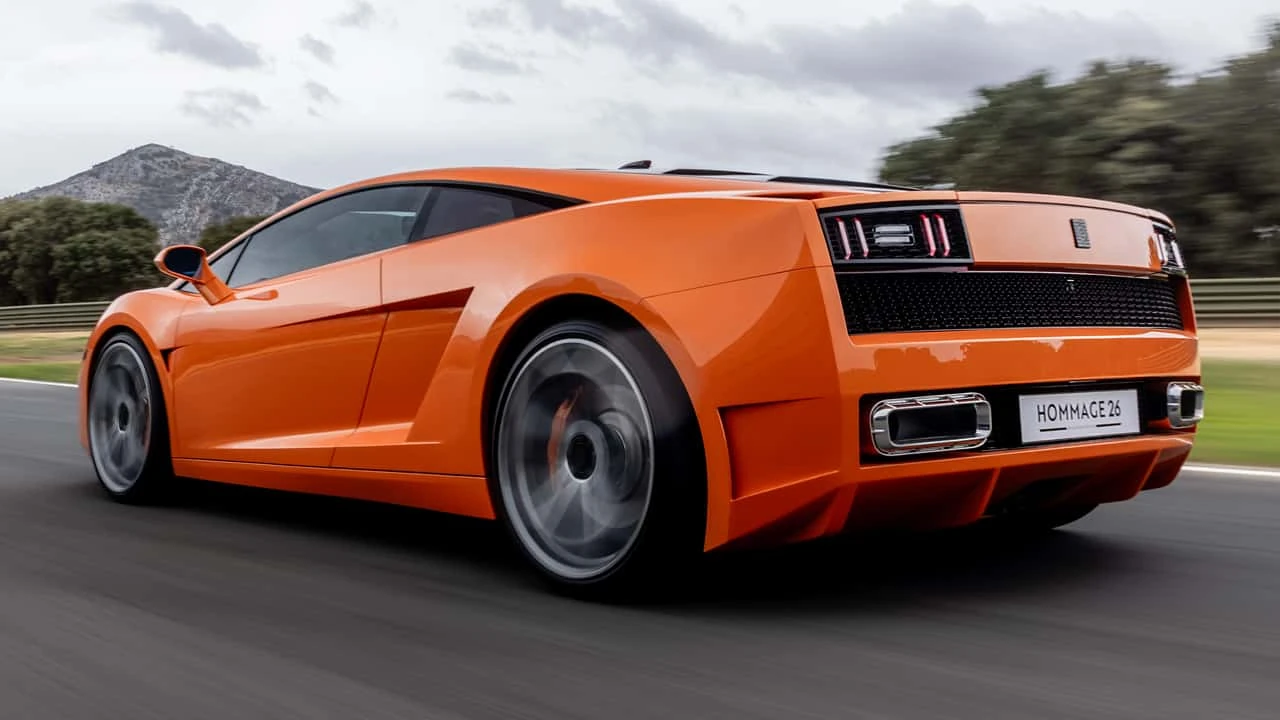
HOMMAGE 26 driving, rear three-quarter view. Photo: CAVËN Atelier.
The engine remains a 5.0-litre V10
Italtecnica has reworked the naturally aspirated engine to reach 8,500 rpm. The published GT and Performance ratings differ by 20 PS. These are metric horsepower figures from the creator’s specification, not Carboratory dynamometer results. They should also not be confused with differently expressed British or US horsepower numbers in other reporting.
GFG confirms a manual transmission, keeping the driver involved in selecting gears. It does not give an official acceleration time or maximum speed for HOMMAGE 26. A power rating alone cannot establish either result without the completed car’s mass, gearing and other relevant specifications.
The donor-engine distinction is important. Lamborghini’s own historical press material places the Gallardo’s move to a 5.2-litre V10 with the 2008 facelift and LP 560-4 designation. HOMMAGE 26 is explicitly described with the earlier 5.0-litre engine. The later production model’s performance figures should not be carried across to this conversion simply because the Gallardo name is shared.
Inside, the manual gate remains visible
The interior has new graphics and redesigned seats. Giugiaro describes improved comfort and ergonomics as objectives, which remain designer statements rather than findings from a Carboratory road test. The supplied interior photograph shows the exposed metal gear gate, instruments ahead of the driver and physical controls retained on the centre console.
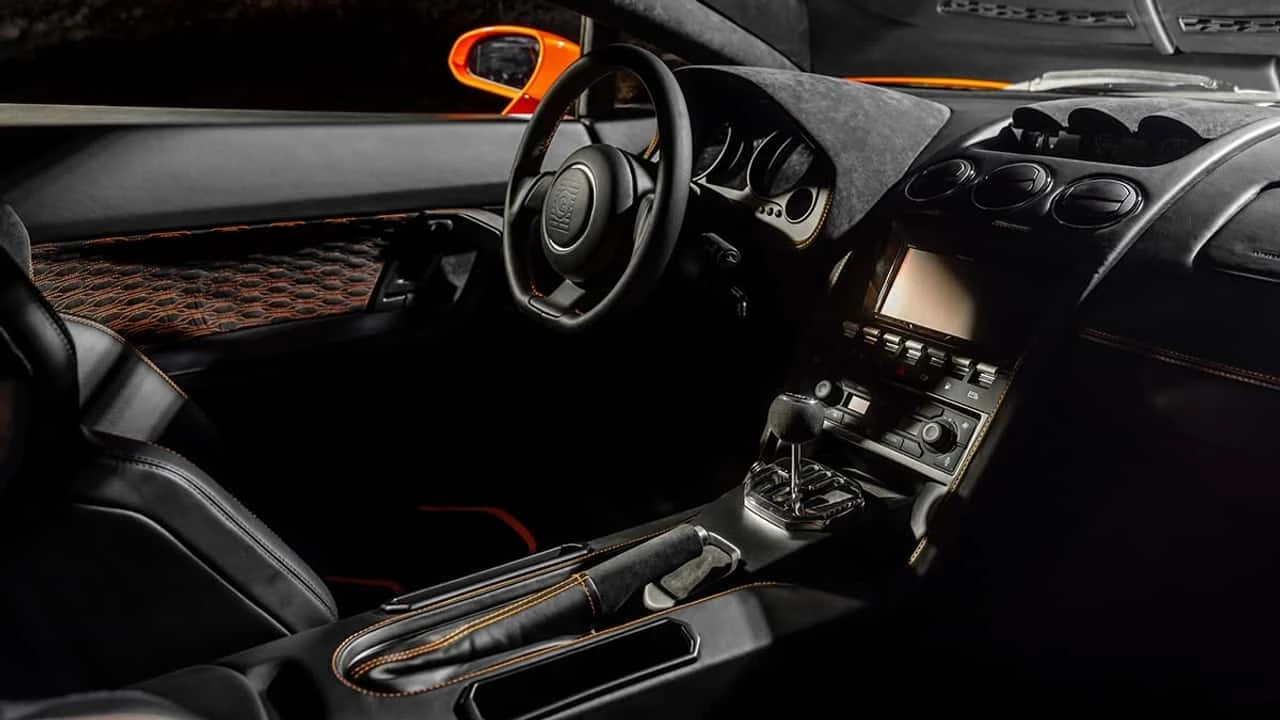
HOMMAGE 26 interior with exposed metal manual gear gate. Photo: CAVËN Atelier.
An opening rear window sits between the passenger compartment and engine bay. GFG says its purpose is to let more of the V10’s sound reach the cabin directly. No sound-pressure measurement accompanies that explanation, and the photograph is not a complete specification of every option available across the planned 25-car series.
The chassis package includes electronically controlled suspension with Comfort and Sport modes, upgraded brakes and wheels designed for the project. GFG does not publish brake dimensions or stopping distances in the release. Those omissions limit numerical comparisons with a donor Gallardo, even though the nature of the mechanical changes is clear.
The quoted price excludes a crucial component
Motor1 reports a starting price of €900,000 before taxes and excluding the donor car. Top Gear separately reports €900,000 with the donor excluded. GFG’s technical release does not provide an individual commercial quotation, so the reported starting amount should not be treated as the final cost of a complete car delivered to a particular country.
CAVËN’s published terms say sales and modification commissions are confirmed individually in writing. They also call for case-by-case assessment of technical and legal feasibility, noting that non-original modifications may affect approval and warranty. An owner therefore needs an agreed donor specification, scope of work and local registration basis, rather than relying on the launch photographs or the announced series size alone.