
Hyundai is reportedly preparing two more Ioniq electric vehicles for Europe. Auto Express says the company is working on a smaller SUV expected to be called Ioniq 4 and a larger family model commonly referred to as Ioniq 7. Hyundai has not officially confirmed either name, the launch schedule, the prices or the technical specifications.
Two gaps in the electric range
The report points to launches within the next 12 to 18 months. One vehicle would sit between the Ioniq 3 and the Kona Electric, while the other would be positioned between the Ioniq 5 and the Ioniq 9. These are product-positioning expectations, not a published Hyundai model announcement.
Hyundai’s confirmed European line-up already provides some useful context. The company introduced the Ioniq 3 as a compact all-electric hatchback designed around European requirements. Its April 2026 release also identified the car as the first European Hyundai model to receive Pleos Connect, the company’s new infotainment platform. Hyundai says the Ioniq 3 is due to launch in 2026 and has stated a goal of making all models sold in Europe electrified by 2027.
A compact electric SUV would give the brand a different body style in the space below the Ioniq 5. Buyers looking for a higher seating position, easier access or a more adaptable luggage area would not have to choose between a hatchback and a larger SUV. Hyundai has not published dimensions or boot figures for a vehicle called Ioniq 4.
What is expected from the Ioniq 4
Auto Express describes the smaller vehicle as a B-segment SUV and expects production could start in 2027. The publication quotes Hyundai Europe product vice-president Chris McKinnon responding to the importance of this segment with “Watch this space”. That comment indicates interest in the category, but it does not confirm a name or a production date.
The report expects a more upright, conventional SUV shape rather than a tall hatchback. It also suggests that the cabin could share some of the Ioniq 3’s approach, including a lounge-like interior and Pleos Connect software. None of that has been presented by Hyundai as a specification for the future SUV. The two cars may share technology, but the platform, dimensions, motors and battery options remain unknown.
Auto Express has estimated battery capacities of roughly 42 kWh and 61 kWh, together with a single front-mounted motor. Those details are media predictions rather than Hyundai data. A dual-motor version has also been discussed as a possibility, but there is no official confirmation of one.
Battery capacity alone would not establish the car’s real-world range. Weight, aerodynamics, wheel size, temperature, speed and climate-control use all affect consumption. Even an official range figure would need to be read alongside its test cycle and configuration. Until Hyundai releases a technical sheet, the predicted figures should not be used as purchase specifications.
A family SUV between the Ioniq 5 and Ioniq 9
The larger vehicle is expected to be sold under the Ioniq 7 name, although that name is not confirmed in Hyundai’s official material. Auto Express places it between the Ioniq 5 and Ioniq 9, which would give the brand a family-oriented electric SUV that is smaller than its current flagship.
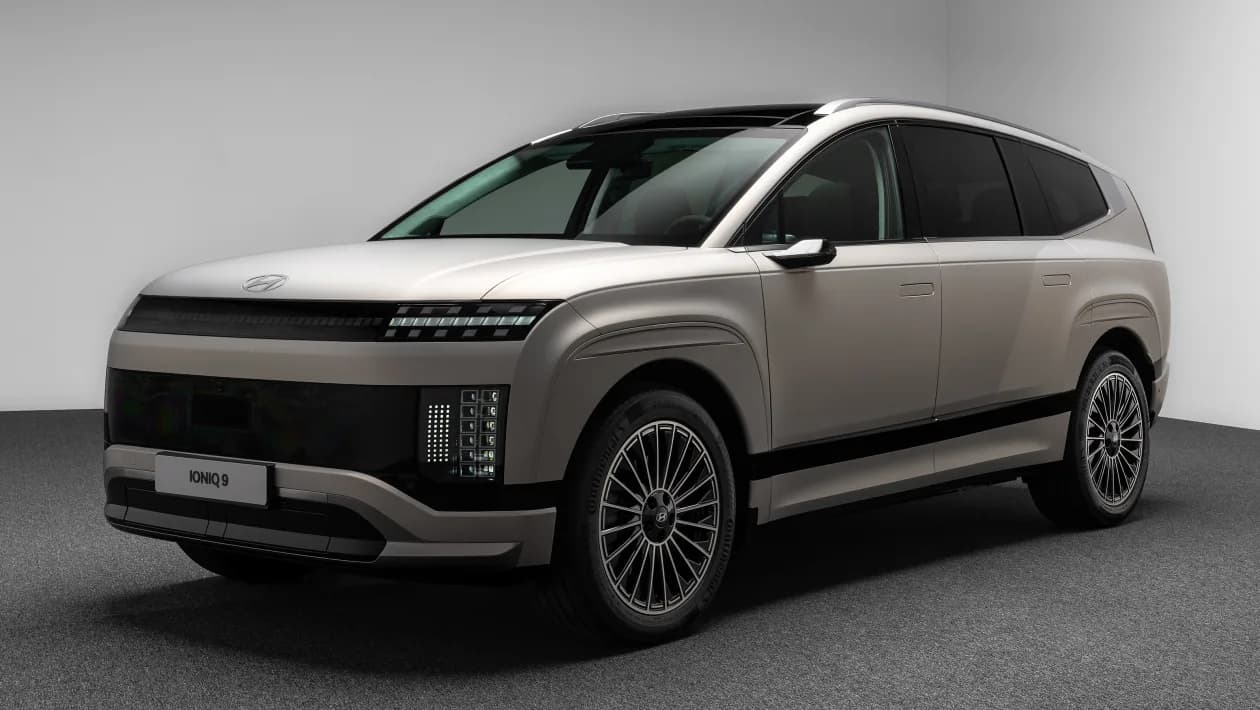
Hyundai’s official Ioniq 9 material provides the clearest reference point. The Ioniq 9 is described as the first three-row SUV in the Ioniq family and as a large electric vehicle designed around passengers and space. A model between it and the Ioniq 5 could use a less bulky body while retaining a practical cabin. That is an inference from the reported positioning, not a confirmed design brief.
The British publication has speculated about a choice of single- or dual-motor powertrains and an 800-volt charging system for the possible Ioniq 7. Hyundai has not confirmed those features for a vehicle with that name. The same applies to proposed range targets, seating layouts and pricing. There is no verified Romanian-market price or availability date yet.
The confirmed software direction
Hyundai Motor Group presented Pleos Connect in April 2026 as a next-generation infotainment system based on Android Automotive OS. Its announced elements include a wide central display, a slim driver display, over-the-air updates and an application marketplace. The Ioniq 3 is the first European Hyundai model officially linked to the system.
That does not prove that the expected Ioniq 4 and Ioniq 7 will use an identical interface. It does show the direction of the company’s new electric products. Software updates, applications and the interaction between the driver and the car are being developed as part of the vehicle’s ownership experience. Details for the two future SUVs will have to wait for a Hyundai announcement.
Several practical questions remain open. Hyundai has not said when either vehicle will be shown, where it will be built, whether Europe will receive both models at the same time or which batteries will be available. It has also not confirmed whether the Ioniq 7 name will be used at all.
About the image
The image used here shows the Hyundai IONIQ 9, an officially presented production model. It is illustrative and does not show the unconfirmed Ioniq 4 or Ioniq 7. Until Hyundai publishes official images, renderings and prototype photographs should not be treated as evidence of the final design.
For now, the two vehicles should be described as expected additions to Hyundai’s electric range rather than confirmed launches. The reported placement of a smaller SUV below the Ioniq 5 and a family SUV below the Ioniq 9 would address clear gaps, but the names, motors, batteries, range, prices and timing still require confirmation from the manufacturer.


