
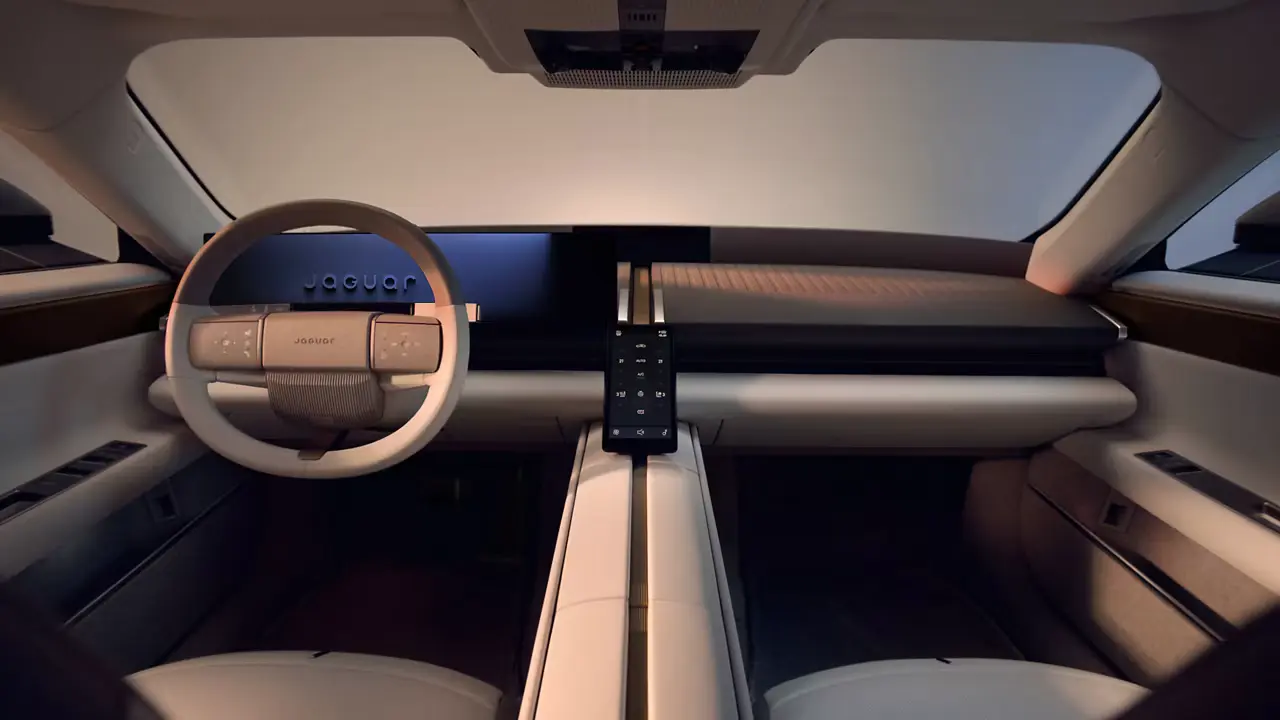
Jaguar will reveal the Type 01 in New York on 6 October 2026. The new model is a four-door luxury GT and the first production vehicle developed under Jaguar’s new creative philosophy. Ahead of the world reveal, the company has shown the interior and confirmed part of the electric powertrain. The car is positioned as the production continuation of the Type 00 design vision, but it is not yet available to order.
Jaguar says the Type 01 will use three electric motors producing more than 1,000 PS and more than 1,300 Nm of torque. Battery capacity, range, charging performance, acceleration, top speed, dimensions and price have not been released. The power figures establish the car’s performance positioning, but they are not a complete technical specification.
Why it is called Type 01
Jaguar explains the name through three references. “Type” connects the car to historic Jaguar names such as the C-type, E-type and F-TYPE. The zero represents electric propulsion and zero tailpipe emissions. The one identifies the vehicle as the first Jaguar of a new generation.
The name is displayed on the brand’s Strikethrough motif, where the bonnet meets the base of the windscreen. Jaguar uses the strong linear graphic as a signature of its new identity. It is intended to connect the exterior bodywork with the cabin and to make the car recognisable without relying on conventional styling cues.
Jaguar says Type 01 is designed, developed and built in the United Kingdom. The vehicle therefore has to combine a new electric architecture with the low driving position, long-distance comfort and performance character associated with the brand’s GT cars. Jaguar has not yet announced production volumes, the manufacturing plant, customer orders or the market launch sequence.
A cabin divided by a central spine
The official interior images show a central spine running from the front of the cabin to the rear. Jaguar says this creates four individual spaces rather than a conventional cabin organised around a broad horizontal dashboard. The layout presented is therefore clearly a four-seat interpretation, with the console separating front and rear occupants.
The driver sits low in a position Jaguar describes as confidence-inspiring and appropriate for a GT. The slim dashboard visually extends the bonnet and helps merge the exterior and interior forms. Brass-inspired finishes appear on the central spine and along the upper sections of the doors. The colour palette is influenced by travertine stone and by the texture of artisan materials.
The Jaguar Leaper is integrated into the interior detailing. Storage compartments are concealed, and some technologies are designed to appear only when needed. Jaguar has not yet published a full material specification or described the final audio, climate-control and storage systems. The images show the design direction, but they do not replace the equipment list for customer cars.
Screens and rear visibility
Jaguar treats the infotainment system as part of the interior architecture rather than as a separate tablet attached to the dashboard. The company describes digital interfaces for control on demand and a ClearSight digital rear-view display. This display is positioned centrally at the base of the windscreen, at the same height as the exterior mirrors, with the aim of helping the driver keep attention on the road.
The manufacturer has not yet stated the screen sizes, software functions, connectivity services or the availability of the digital rear-view system across markets. It is also not clear which equipment will be standard and which will be optional. Jaguar’s own website warns that pre-production images and features may change before launch, and that specifications can vary by market.
A three-motor electric GT
The announced output of more than 1,000 PS and 1,300 Nm places Type 01 at the high-performance end of the electric GT market. Jaguar has not explained how the motors are distributed between the axles or whether the system will use individual torque control at each wheel. Battery chemistry, cooling, inverter hardware and the expected kerb weight are also still unknown.
For a luxury GT, usable range and charging time will matter as much as peak output. A tri-motor system can provide strong traction and precise control, but it can also add weight and complexity. Until Jaguar publishes an energy-consumption figure, WLTP range and charging data, it is not possible to judge the balance between performance and long-distance usability.
The company has also not released braking, suspension or tyre specifications. These components will determine how the car manages its high torque and how comfortable it is on public roads. The official reveal should clarify whether Type 01 is intended primarily as a long-distance grand tourer, a performance flagship, or a combination of both.
From Monaco to the New York reveal
Jaguar first showed the Type 01 name and silhouette in Monaco, where a prototype wearing an artistic camouflage wrap drove on the street circuit. The prototype later appeared at the Goodwood Festival of Speed and during Monterey Car Week and Pebble Beach events. These appearances showed the vehicle’s proportions and dynamic presence before the full presentation.
The New York reveal on 6 October will establish the final design and provide the next set of technical details. For now, Type 01 remains an announced future production car. Jaguar has not published a European price, a customer delivery date, a final range figure or a complete equipment list. The brand says that customer-car specifications and features may change before launch.
What is confirmed is a four-door electric GT, a tri-motor layout, more than 1,000 PS, more than 1,300 Nm and an interior dominated by a full-length central spine. The reveal will show whether the production model retains these design and architecture decisions in full and how Jaguar plans to turn its new visual language into a road car.


