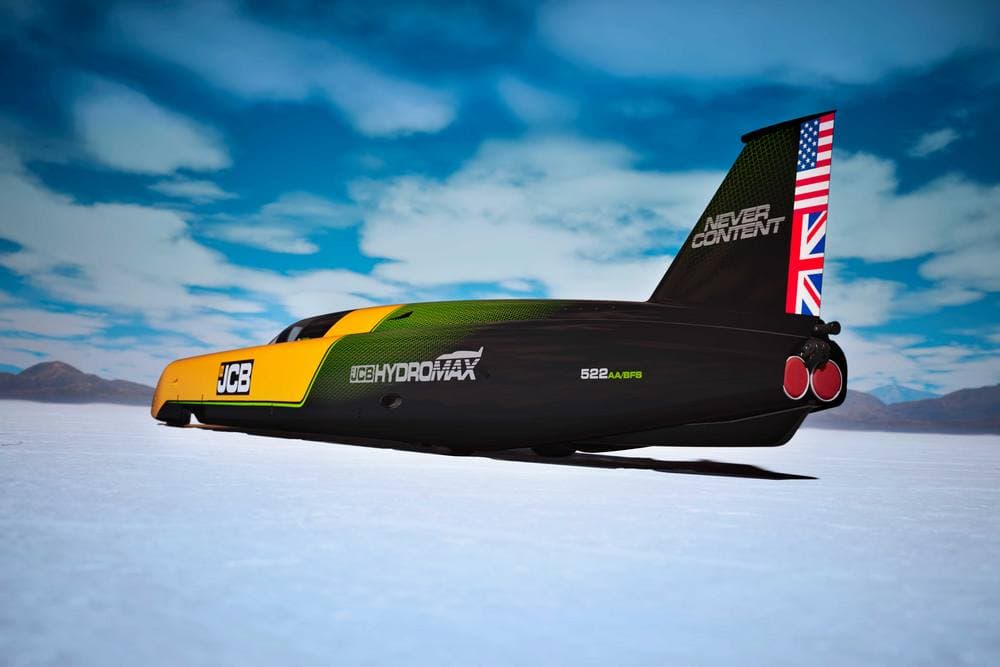
JCB Hydromax at the Bonneville Salt Flats. Photo: JCB
JCB Hydromax set a hydrogen speed record: 653.909 km/h
The JCB Hydromax prototype covered the flying kilometre and mile at the Bonneville Salt Flats at an average speed of 653.909 km/h, setting a provisional FIA world record for a vehicle with an internal-combustion engine fuelled by hydrogen.
The attempt took place on 11 August 2026, in the US state of Utah. At the wheel was Andy Green, a former Royal Air Force pilot and the holder of the absolute land-speed record of 1,227.985 km/h, set in 1997 with ThrustSSC.
The Hydromax result is not the peak speed reached in a single pass. FIA rules require two runs in opposite directions, and the record is their average. The prototype recorded 644.740 km/h on the first pass and 663.267 km/h on the second. The calculated average was 653.909 km/h.
Two JCB engines, 1,600 hp in total
Hydromax is about 9.75 metres long and uses two internal-combustion engines fuelled by gaseous hydrogen. One drives the front axle, the other the rear. Combined power reaches about 1,600 hp.
The engines start from the JCB unit developed for construction machinery, but the record configuration is heavily modified. The British engineering company Ricardo raised one engine’s output from about 74 hp to 800 hp and cut its mass by 100 kg. To lower the centre of gravity and the vehicle’s profile, the two engines run mounted on their sides.
Ricardo built six units by hand for testing and for the record attempt. Prodrive handled vehicle integration and operations at Bonneville, and development of the whole project lasted a little over 15 months.
The previous record dated from 2004
The FIA cites as the previous benchmark for a hydrogen combustion engine the speed of 298.5 km/h, set in 2004 by the BMW H2R prototype. Hydromax also surpassed JCB’s Dieselmax record from 2006, of 563.4 km/h, set on the same course and also with Andy Green at the wheel.
The FIA supervised the technical inspection, safety procedures and timing together with the Automobile Competition Committee of the United States. The result is presented as a provisional world record, pending ratification by the FIA Land Speed Records Commission.
Hydromax did not chase the absolute record. That remains with ThrustSSC, a vehicle powered by two turbojet engines, which exceeded the speed of sound in Nevada’s Black Rock Desert.
It is not a fuel-cell car
The phrase “hydrogen car” can describe two different technologies. Models such as the Toyota Mirai or Hyundai Nexo use a fuel cell to turn hydrogen into electricity, then drive the wheels with an electric motor.
JCB Hydromax burns hydrogen directly in the cylinders. The basic principle remains that of an internal-combustion engine: air and fuel are introduced into the chamber, the mixture is ignited, and the resulting pressure moves the pistons.
This approach retains part of the architecture and industrial experience built up for thermal engines. At the same time, it needs high-pressure tanks, specialised fuel-delivery systems and careful control of combustion.
What the record proves and what it does not
The result shows that a hydrogen-fuelled engine can run at extreme load and sustain the power needed for a speed record. The data gathered matter first of all for JCB’s programme for heavy machinery, where short refuelling times and long running hours count more than they do in a passenger car used for commuting.
The record does not, however, solve the problems that limit hydrogen’s spread in road transport: fuel production, the energy needed for compression or liquefaction, transport, tank cost and the small number of stations.
Nor should the phrase “zero emissions” be extended automatically to the whole system. Burning hydrogen does not produce carbon dioxide from the fuel, but high temperatures can lead to the formation of nitrogen oxides. The total climate impact also depends on how the hydrogen was produced. If the electricity used comes from high-emission sources, the balance is not the same as for hydrogen obtained using renewable energy.
For passenger cars in Romania, Hydromax does not change the available offering or the refuelling infrastructure. It is a speed laboratory built for a very specific FIA category, not a prototype for a production car. Its technical value lies in the engines and storage system working under extreme conditions, not in a demonstration that hydrogen has already become a practical alternative for ordinary drivers.
Frequently asked questions
What is the JCB Hydromax record?
The official provisional average is 653.909 km/h, calculated from two runs in opposite directions at the Bonneville Salt Flats.
Is Hydromax electric?
No. It uses two internal-combustion engines that burn gaseous hydrogen, with a combined output of about 1,600 hp.
Is the record already definitive?
The FIA presents it as a provisional world record, subject to ratification by the commission responsible for land-speed records.
Can the technology be used on production cars?
Technically, hydrogen can fuel internal-combustion engines, but Hydromax is a specialised prototype. JCB is mainly pursuing applications for heavy machinery and has not announced a passenger car derived from the project.