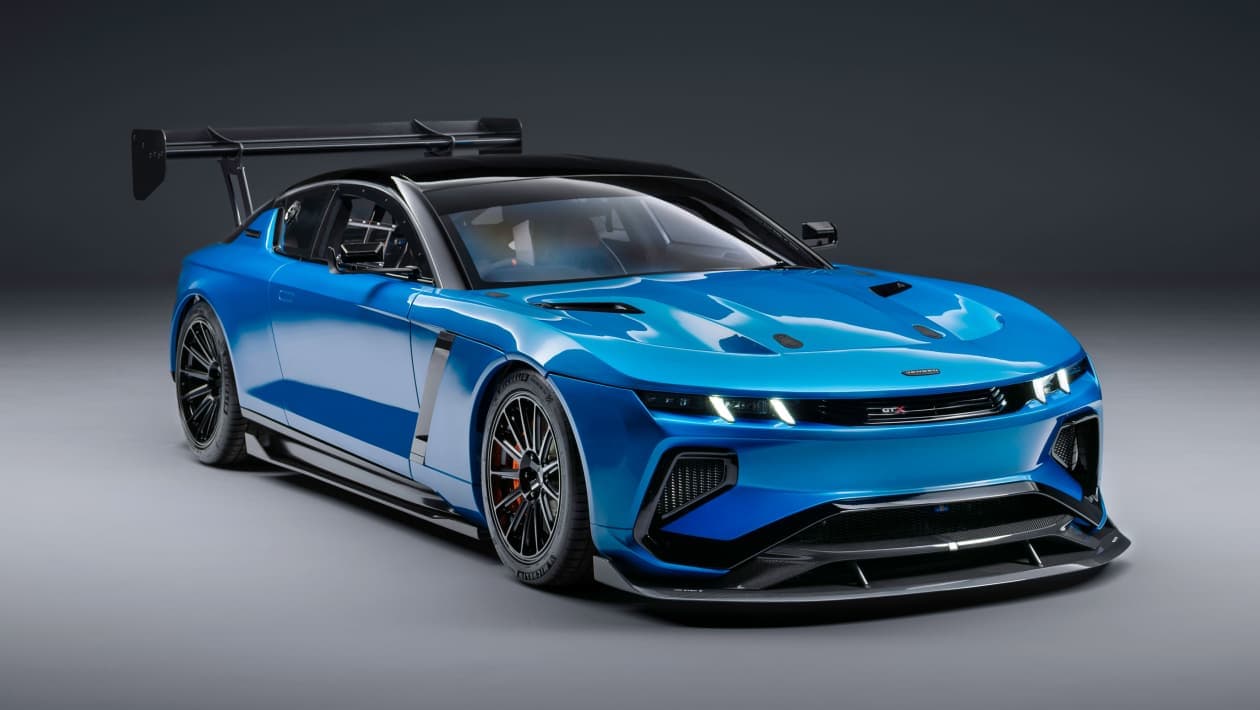
The Interceptor GTX is an entirely new construction, inspired by the proportions of the Jensen model from the 1960s and 1970s. Photo source: Jensen International Automotive
The Jensen Interceptor GTX returns with a 973 hp V8. For now it is a track prototype
The Jensen Interceptor name returns on an entirely new car, 50 years after production of the classic model ended. The Interceptor GTX is a running prototype intended for the track, with a supercharged V8, 973 hp, rear-wheel drive and aerodynamics dominated by a huge carbon-fibre rear wing.
The car was developed by Jensen International Automotive (JIA), the British company that until now specialised in restoring and updating Interceptor examples. The GTX does not, however, use the chassis of an old car and is not a restomod. The project starts from scratch and serves as a development platform for future road-going Jensen Interceptors.
6.8-litre supercharged V8
Under the long bonnet is a 6.8-litre V8 with dry-sump lubrication and a mechanical supercharger of about 2.7 litres. The engine starts from the GM LT architecture, but has been extensively modified by the American company Late Model Engines. According to JIA, fewer than 20% of the components remain those of the base unit.
The changes include CNC-machined cylinder heads, titanium valves and revised systems for variable valve timing and direct injection. Maximum engine speed is 7,000 rpm. The power announced in the GTX specification is 960 bhp, equivalent to about 973 hp in metric terms. The manufacturer says the assembly has technical headroom of up to about 1,217 hp, but that is not the output of the car presented.
| Characteristic | Jensen Interceptor GTX |
|---|---|
| Engine | 6.8-litre V8, mechanical supercharger |
| Power | 973 hp |
| Maximum engine speed | 7,000 rpm |
| Drive | rear |
| Gearbox | sequential, 6 speeds |
| Mass with fluids | 1,660 kg |
| Mass distribution | 49:51, front/rear |
Sequential gearbox and an engine set well behind the front axle
The engine is mounted behind the front-axle line, and power reaches the rear-mounted transmission through a carbon-fibre propshaft. The six-speed sequential gearbox is supplied by Samsonas Motorsport and uses straight-cut gears. The driver can change gears from paddles or from the lever on the centre tunnel.
This layout helps achieve a near-equal mass distribution. The Wavetrac differential, traction control and adjustable ABS are there to make the 973 hp usable on track, though JIA still describes the experience as predominantly mechanical and analogue.
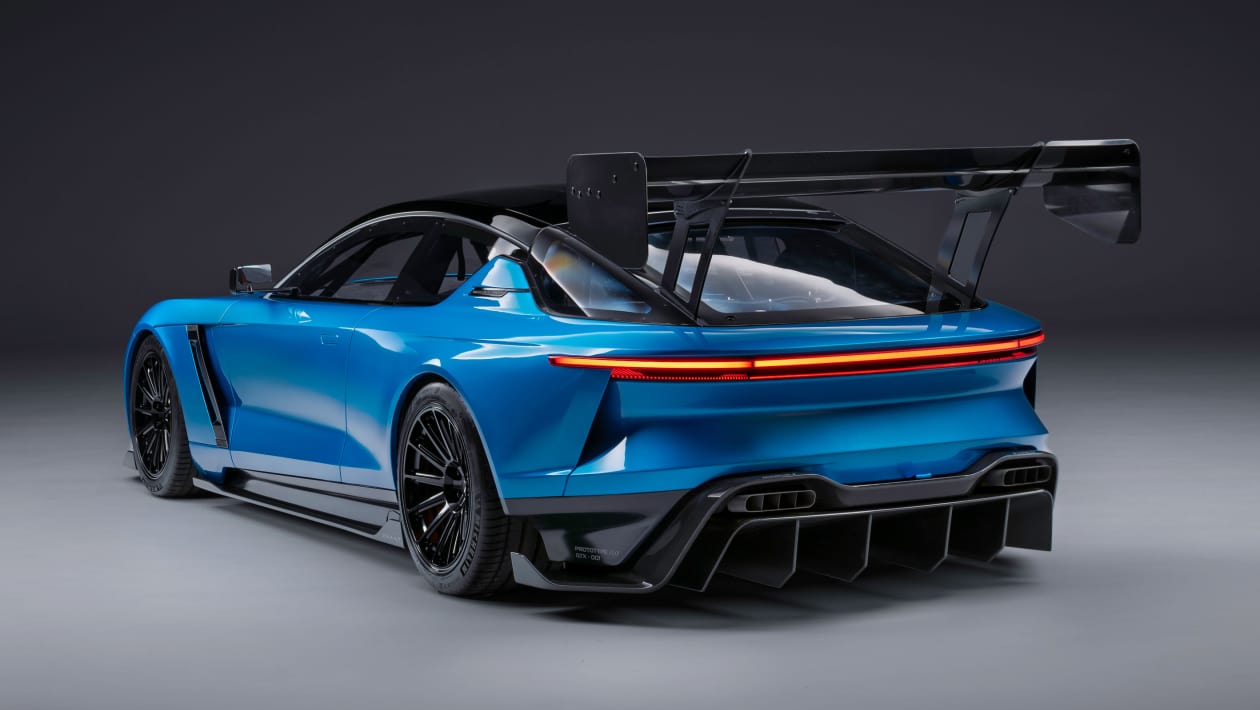
The adjustable wing can generate more than 350 kg of downforce on its own, according to the company. Photo source: Jensen International Automotive
Aluminium chassis and body
The structure is a bonded and riveted aluminium monocoque. The body, also aluminium, is hand-formed by British specialists at Coventry Metalcraft, and the design was produced with Avant Design. Carbon fibre is reserved mainly for aerodynamic elements.
The suspension uses double aluminium wishbones at both axles and Nitron dampers with three-way manual adjustment. Steering has hydraulic assistance, a solution chosen for feedback rather than electric assistance. AP Racing brakes work with steel discs, considered more consistent and easier to exploit than some carbon-ceramic solutions in a track-day context.
Forged Vossen wheels have a diameter of about 51 cm and are fitted with Michelin Pilot Sport 4S tyres. JIA preferred road-homologated tyres over slicks so that the grip limit would be more progressive for drivers without competition experience.
Functional aerodynamics, not just decoration
The GTX keeps the long bonnet and large rear screen that recall the original Interceptor, but the rest of the shape is dictated by cooling and downforce. The front has a large splitter, the floor is profiled, and the rear diffuser occupies almost the full width of the car.
The adjustable wing produces, on its own, more than 350 kg of downforce, according to JIA data. The exhausts sit above the diffuser, and openings behind the front wheels extract hot air from the brake area.
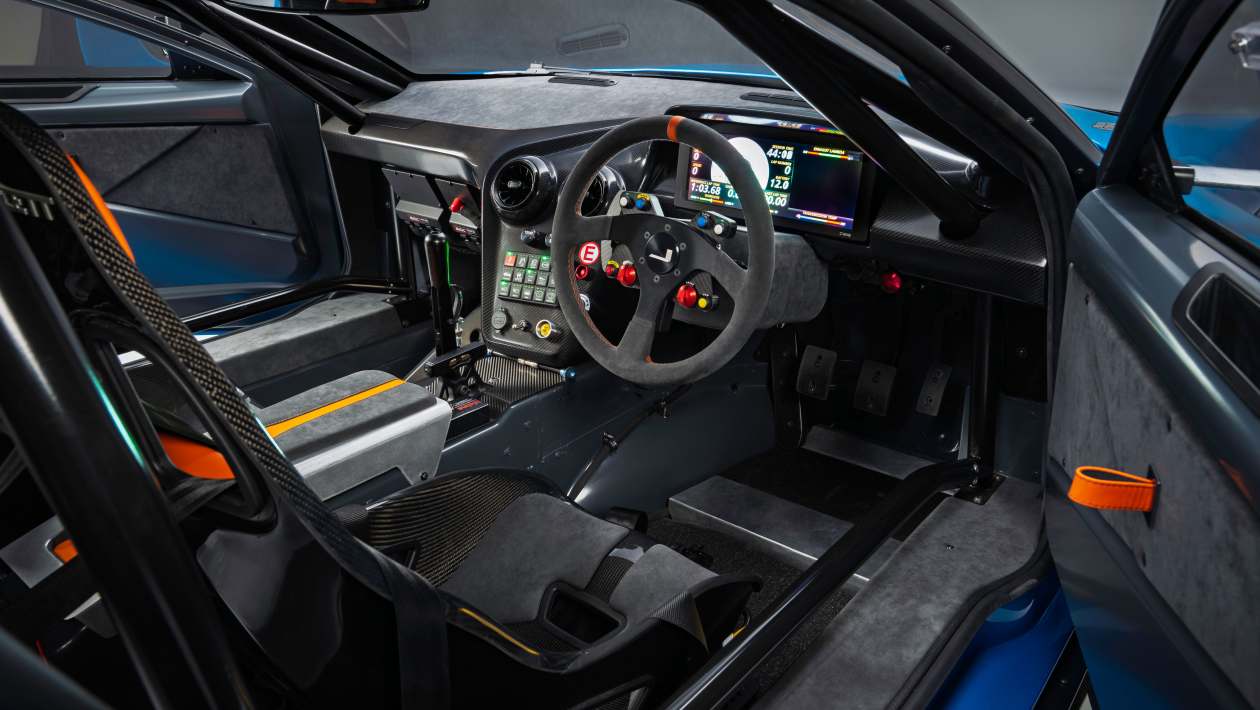
The cabin has an FIA-homologated roll cage, carbon-fibre seats and MoTeC instrumentation, but the GTX is not homologated for a competition class. Photo source: Jensen International Automotive
It is a track car, but not a homologated race car
The cabin has two Tillett carbon-fibre seats, six-point harnesses, a fire-suppression system and an FIA-homologated safety structure. Instrumentation is supplied by MoTeC, and the centre console concentrates the technical controls. Alcantara-trimmed surfaces still keep a visual link with a grand tourer.
The Interceptor GTX is not legal for public roads and was not built to the regulations of an FIA class such as GT2, GT3 or GT4. It is a demonstrator intended for private track sessions and for validating components that could reach later models. JIA has not communicated an official price or a production volume for the GTX.
Next come the Interceptor GT and GTR for the road
The company is preparing two versions legal for public roads. The Interceptor GTR is due to keep some of the GTX’s character and aerodynamics, while the Interceptor GT will be a four-seat grand tourer with a cleaner body and a cabin oriented towards long journeys.
A classic manual gearbox and an automatic are being examined for those cars. Specifications, prices and launch dates are not yet final. The space left in front of the engine would even allow later integration of an electric motor, if regulations or customer demand impose a hybrid system.
The GTX should therefore be seen as a technical statement about the direction of the new Jensen range. The brand’s actual return to the road will depend on turning this prototype into a homologated, produced car, a stage for which the company has not yet announced a firm timetable.