Kia Australia’s chief ride and handling engineer, Graeme Gambold, believes car makers are overlooking people who still value the experience of driving. In an interview published by carsales on 2 November 2026, he expressed frustration with finding a car that combines satisfying road manners, the desired equipment and an absence of electronic interventions he finds intrusive.
His comments concern the priorities behind vehicle development, particularly tuning for Australian conditions. They do not announce a new Kia sports car. Nor does one engineer’s assessment establish a measured decline across the entire market. The useful detail is how Kia’s local work on steering and suspension fits alongside its existing electric performance cars and its more experimental concept designs.
Steering is central to the Australian programme
Gambold told the publication that around half of Kia’s local tuning work focuses on steering, with Volkswagen products among the reference vehicles. That proportion describes the Australian team’s work. It is not a share of Kia’s worldwide engineering budget, or a numerical score proving one manufacturer’s steering is better than another’s.
There is separate manufacturer confirmation that local tuning reaches ordinary production models. Kia’s Australian K4 page states that the car underwent a ride and handling programme for the country’s road conditions, as much of the range does. It presents the K4 in hatchback and sedan forms, rather than reserving the explanation for a dedicated high-performance model.
The geographical qualification matters. An Australian development programme does not establish that a European K4 has identical calibration. Likewise, a discussion about steering feel cannot be reduced to the power figure beside a GT badge. Kia’s own product description places local road behaviour within the development of a regular model, independently of any announcement about a future sports car.
EV6 GT is the production example
Kia already has a documented electric performance model in the EV6 GT. Its European announcement of 11 December 2024 described the model-year 2025 update with an 84 kWh battery and up to 478 kW, or 650 metric horsepower, when Launch Control is activated. The same document listed 448 kW, equivalent to 609 metric horsepower, in GT mode.
Those figures have different operating conditions. Presenting the larger number without its Launch Control qualification would obscure how Kia described the car. The announcement also quoted 0–100 km/h in 3.5 seconds and a 260 km/h maximum speed. These are manufacturer figures, not results from a Carboratory road test, and the original European release labelled its specifications preliminary.
Kia’s current UK specification page separately lists an 84 kWh battery, electronically controlled suspension and an electronic limited-slip differential. It also includes Virtual Gear Shift. The equipment confirms that software is part of the production GT’s approach to driving involvement. It does not establish identical standard equipment in every market or on every car carrying an EV6 badge.
That distinction helps frame Gambold’s complaint. Electronic intervention is not one indivisible feature: chassis control and a simulated gearshift have different roles from a driver-assistance alert or correction. The interview does not supply a comparative test of those functions, or show that a specific GT system resolves the concerns he raises about modern cars.
Virtual shifts have a defined mechanism
Kia’s official owner documentation describes Virtual Gear Shift as a way of recreating a combustion car’s shifting experience in an electric vehicle with a motor and reducer. Motor response and simulated sound are coordinated, while the paddles let the driver select virtual ratios. This is not the installation of a conventional manual gearbox in the electric car.
The documentation describes automatic and manual operation, a display showing the virtual gear, and sound linked to the simulated engine behaviour. These are specific interactions, rather than an unspecified promise that additional power will make the vehicle more engaging. Whether an individual driver enjoys them remains a judgement to make behind the wheel, rather than a result established by the feature list.
The manual also sets operating limits. Virtual Gear Shift is unavailable in Eco and Snow modes, and smart cruise control can suspend it temporarily. Battery charge conditions and activation of traction or stability control can limit its operation. A performance-oriented interface therefore still operates within defined software conditions; the simulated gear display does not remove them.
Vision Meta Turismo explores a different cockpit
Kia’s Vision Meta Turismo takes the digital theme into concept-car territory. The official presentation identifies a distinct driver cockpit and passenger zone, alongside a modular interface called Add-Gear. Kia describes that interface as bringing together functions including game controllers, audio and smart displays. These are elements of a design exploration, not equipment confirmed for a customer delivery.
The concept page presents Speedster, Dreamer and Gamer experiences and an augmented-reality head-up display. Its gaming scenario belongs to the period when the vehicle is stationary. That context should stay attached to descriptions of the entertainment functions, rather than suggesting that every activity shown is intended for use while driving on public roads.
The official materials reviewed do not give a firm retail launch timetable for Vision Meta Turismo. Gambold’s comments should consequently not be treated as confirmation of a returning Stinger or an affordable rear-wheel-drive sports car. The three pieces of evidence answer different questions: the engineer describes his dissatisfaction, EV6 GT documents a production approach, and Vision Meta Turismo shows a concept that Kia is exploring.
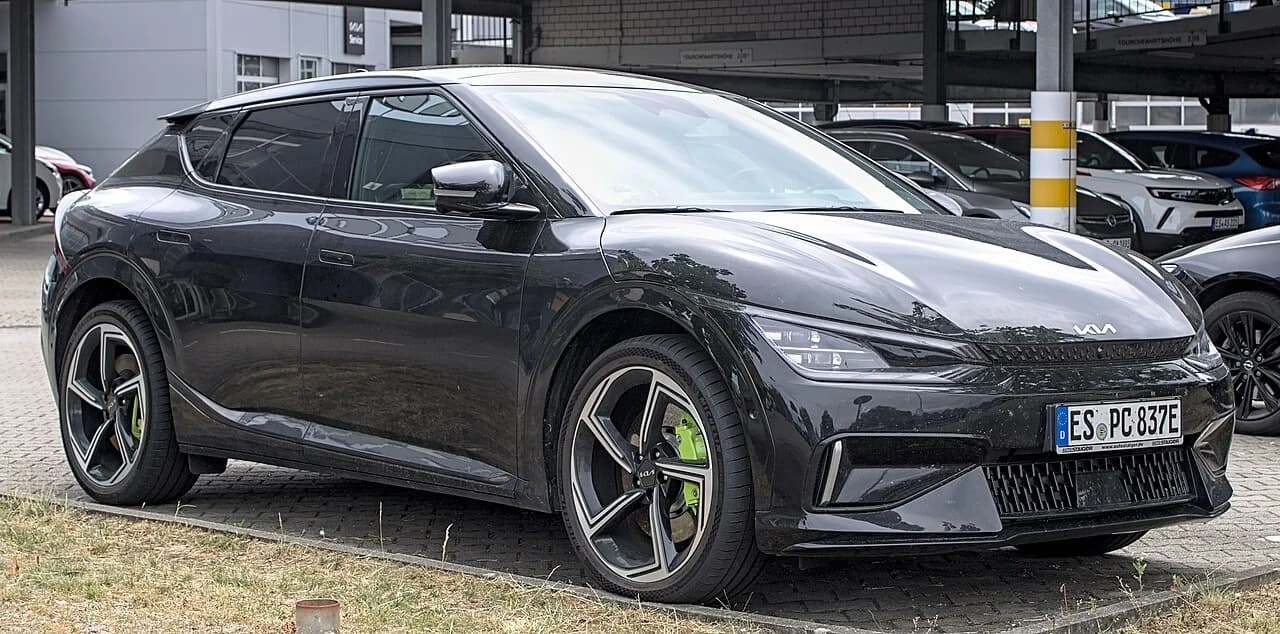
Archive photograph: Kia EV6 GT in 2023, before the model-year 2025 update discussed here. Alexander-93 / Wikimedia Commons, CC BY-SA 4.0. Resized and converted to WebP; adapted image under the same licence.
Sources
- carsales — original Graeme Gambold interview, 2 November 2026
- Kia Australia — K4 local ride and handling programme
- Kia Europe — model-year 2025 EV6 GT initial announcement
- Kia UK — current EV6 GT equipment and specifications
- Kia — official Virtual Gear Shift owner documentation
- Kia — official Vision Meta Turismo concept presentation