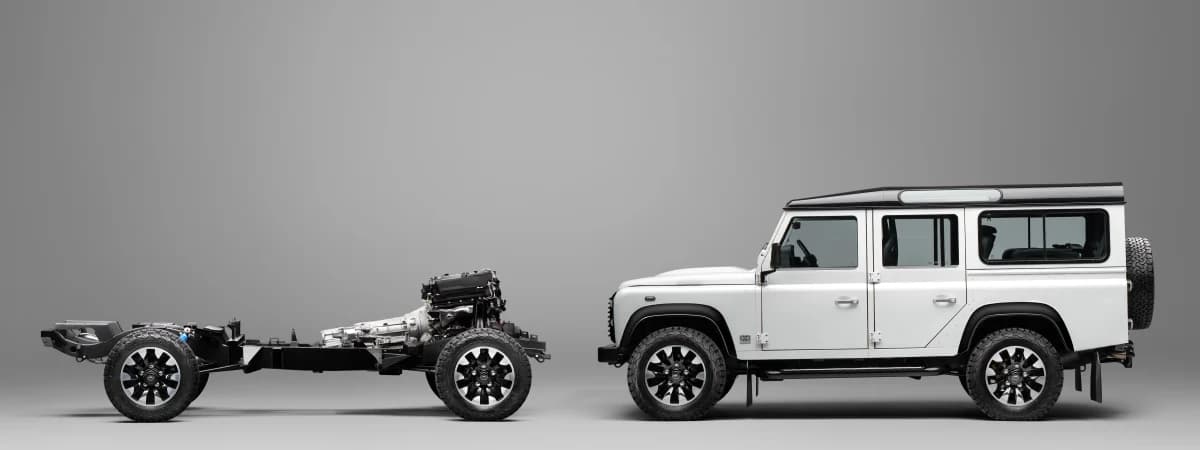
Official Defender Works V8 Conversion press image. Credit: JLR Media; used editorially under the JLR newsroom user licence.
Defender’s Classic division has opened an official Works V8 Conversion programme for eligible Defender 90 and 110 vehicles built from 2012 to 2016. Announced on 23 September 2026, the service lets an owner send in an existing L316-generation Defender rather than buy a different donor vehicle rebuilt by JLR Classic.
The conversion installs a naturally aspirated 5.0-litre petrol V8 rated at 405 PS and 515 Nm, paired with an eight-speed ZF automatic transmission. It also replaces the chassis and adds suspension, brake, driveline-control and cabin changes required to integrate the powertrain. JLR has not published a fixed conversion price, a standard completion time or a complete market list.
More than an engine swap
The Works V8 package addresses the extra performance as a complete-vehicle project. Bilstein dampers are combined with Eibach coil springs, anti-roll bars, revised links and bushes. The Alcon braking system uses four-piston callipers at both axles, with 335 mm ventilated front discs and 300 mm rear discs.
A new transmission tunnel and gear selector accommodate the automatic gearbox. Works V8 badges identify the conversion, while 16-inch steel wheels are standard. Owners may specify 18-inch alloy wheels and other genuine accessories after their vehicle has been assessed.
No acceleration, top-speed or fuel-consumption figure accompanies the September announcement. Figures quoted for the 2018 Works V8 or later Works Bespoke commissions therefore cannot automatically be applied to a converted customer car. Age, prior specification and condition can all affect the completed project, and JLR says the final specification is set only after inspection.
How it differs from a Works Bespoke Defender
The new programme fills a different role from the Classic Defender V8 by Works Bespoke introduced in 2024. For Works Bespoke, JLR specialists source a 2012–2016 donor, remaster it and sell the finished vehicle to the client. The current starting price displayed by JLR Classic for that product is £228,000, before relevant costs.
With the Works V8 Conversion, the client supplies the Defender. That is central to the proposition: a long-owned working vehicle or family car can retain its history and identity while undergoing an extensive factory-backed rebuild. The scope remains substantial, because JLR explicitly includes a new chassis rather than describing the job as a bolt-in engine package.
The £228,000 Works Bespoke figure is not a price for the conversion. JLR says conversion pricing, timing and specification are subject to assessment and approval by its representative. Any quote must also be understood in its market context, including tax, transport and registration work.
A wider upgrade menu for 2007–2016 Puma diesels
The V8 service heads a broader Classic Defender upgrade programme. Wheel, brake, suspension, dynamic and performance packages are offered for eligible L316 Defender 90 and 110 models made between 2007 and 2016 with the Land Rover Puma diesel engine.
The diesel performance package combines the chassis upgrades with a dedicated ECU calibration, raising the manufacturer-stated output to 155 PS and 400 Nm. JLR’s UK page lists a starting price of £17,118, excluding tax and fitting. That is a UK reference, not a universal retail price.
The dynamic package groups wheels, Alcon brakes and Bilstein/Eibach suspension. Owners can also select the brake or suspension upgrades separately. Wheel choices listed by JLR include 16-inch Wolf steel wheels, 18-inch Sawtooth alloys, and several 18-inch Bowler designs.
Cosmetic and dynamic packages can be purchased through the Classic Parts channel for self-fitment or ordered via an authorised retailer. JLR also offers fitting at its Classic Works facilities in Coventry, UK, and Essen, Germany. More involved performance work is directed to those specialist operations.
Inspection determines eligibility
A matching build year and body style do not guarantee acceptance. JLR says eligibility depends on age, model, condition, existing specification and market availability. Every prospective V8 car undergoes a comprehensive assessment before the company confirms the work.
The same caveat applies across the upgrade range. Market-specific road rules can affect whether a modification is legal, and JLR advises owners to tell their insurer so that cover is not inadvertently affected. It does not claim that approval in one market ensures registration in another.
According to the official FAQ, the packages were validated on road, off road, in sand dunes, on proving grounds and through long-term durability testing. Brake parts and wheels have TÜV certification following independent tests covering impact resistance, durability, corrosion, structural strength, salt spray, air leakage and hot-pressure endurance. These are JLR’s stated validation details, not Carboratory test results.
JLR’s standard parts and accessories warranty applies to the components, with regional terms to be confirmed through a local retailer. The announcement does not state one global warranty period for the complete converted vehicle.
What an owner needs to establish first
The initial check is the vehicle’s exact production year and specification. A 2007–2011 Puma-diesel Defender may qualify for the wheel, brake, suspension or diesel-performance packages, but it is outside the stated window for the Works V8 Conversion. The V8 service is limited to eligible 2012–2016 Defender 90 and 110 vehicles.
The next questions concern logistics and registration. An owner outside the UK or Germany needs confirmation that the vehicle can be accepted by a Classic Works facility, which documents accompany a new chassis and powertrain, and what the national authority requires when cylinder capacity, fuel type, output and transmission change.
That makes the September launch an invitation to assessment rather than an off-the-shelf product with a single price. JLR has published the hardware and eligibility outline; the cost, programme timing, completed specification and local road approval remain vehicle- and market-specific.