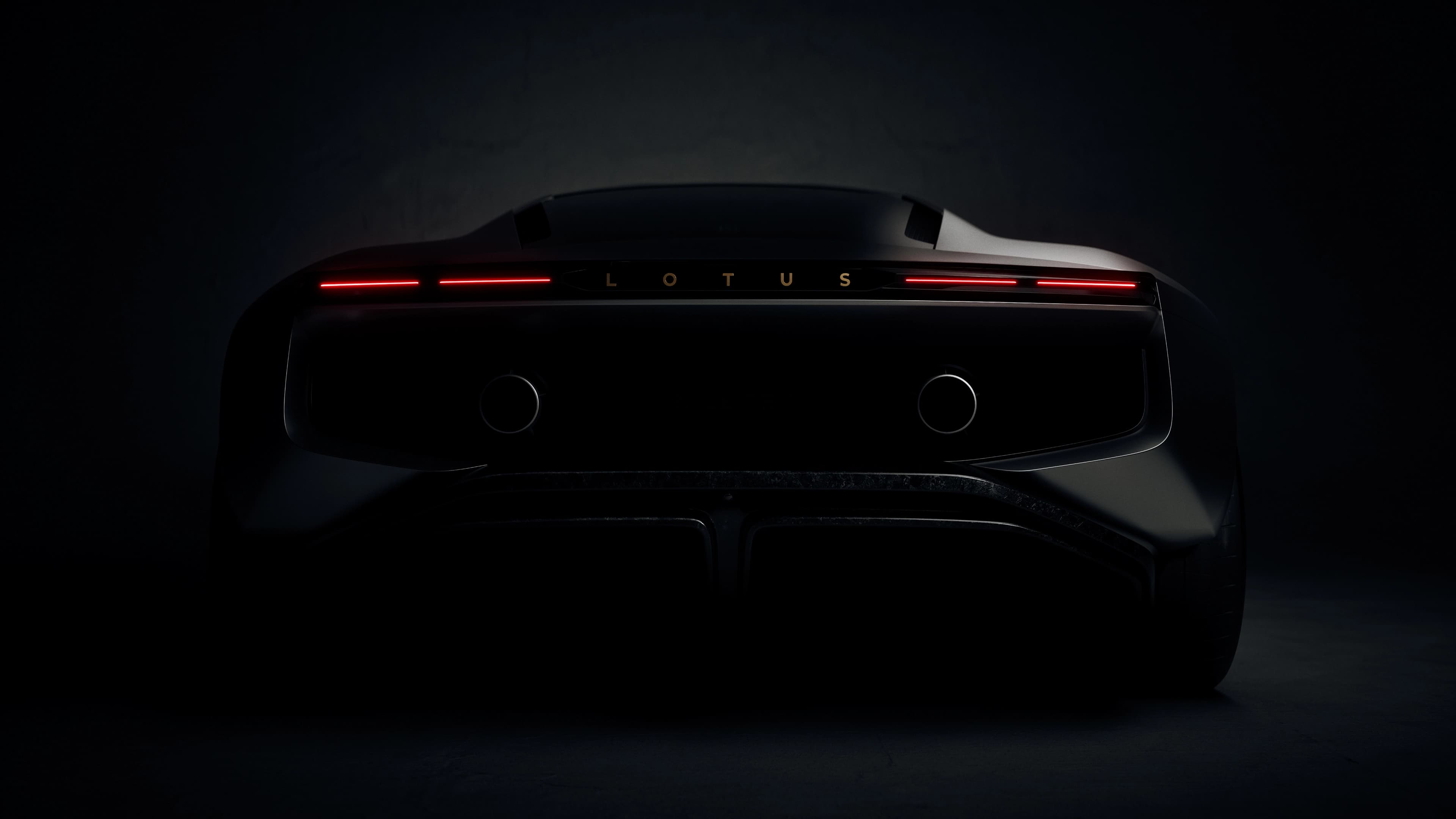
Lotus has so far published only partial images of the future Type 135. Photo: Lotus
Lotus Type 135 will have a hybrid V8 and more than 1,000 hp. Launch is scheduled for 2028
Lotus has confirmed that its future supercar, known in the development phase under the Type 135 designation, will use a hybrid powertrain with a V8 engine and will exceed 1,000 hp. First deliveries are planned for 2028, and production is expected to take place in Europe.
The project represents a major change from the plan announced in 2021. At that time, Type 135 was presented as a fully electric sports car, scheduled for 2026. Lotus has since revised the strategy and keeps electric propulsion for Eletre, Emeya and Evija, but brings the combustion engine back at the top of the range through a hybrid system.
A mid-mounted V8 after 22 years
Lotus Technology chief executive Feng Qingfeng said in the 27 August 2026 investor conference that Type 135 will mark the return of a Lotus model with a mid-mounted V8 engine after 22 years. The reference is the Lotus Esprit V8, whose production ended in 2004.
That link does not mean the new car will be called Esprit. Lotus has not announced the commercial name, and Type 135 and Vision X are identifiers used for the project. Until the company confirms it, the Esprit name remains a possibility discussed in the motoring press, not official information.
Power of more than 1,000 hp will be obtained by combining the V8 with one or more electric motors. Lotus has not published the displacement, the number of turbochargers, battery capacity or the exact split of power between the combustion engine and the electric side.
The mass target is about 1,500 kg
Lotus says it is aiming for a total mass of about 1,500 kg. The objective is difficult for a car that must include a V8, a battery, electric motors and the electronics of a high-voltage system.
Feng Qingfeng explained that Type 135 will use an 800 V electrical architecture and compact electric motors. According to data presented to investors, a 150 kW electric motor developed for the project should weigh about 20 kg, compared with 75-95 kg for a comparable conventional unit. The company associated the solution with technology from Formula 1, but has not yet published a detailed technical sheet.
The stated mass is, for now, a development target. It does not represent the weight of a type-approved production model and may be changed by 2028.
All-wheel drive and technology developed with Geely’s support
Lotus has previously indicated that the future supercar will have all-wheel drive, needed to put the hybrid system’s power to the ground. The exact configuration is not known, but electric motors can allow separate torque control of axles or wheels.
Development benefits from the resources of Geely, Lotus’s majority shareholder. Company management says the partnership gives access to components, suppliers and production volumes that Lotus could not sustain alone at the same cost.
Lotus retains responsibility for the areas traditionally associated with the brand: mass reduction, aerodynamics, chassis tuning and circuit behaviour. Type 135 is also being prepared as a basis for future participation in GT3 competition, according to management’s presentation to investors.
Where Type 135 will sit in the Lotus range
The new model will occupy the space between Emira, the brand’s entry-level sports car, and Evija, the limited-series electric hypercar. Lotus describes it as its future performance flagship and expects it to contribute to the company’s profitability.
The positioning will bring it into the territory of mid-engined hybrid models such as the Ferrari 296 GTB, McLaren Artura and Lamborghini Temerario. An exact comparison cannot yet be made, because Lotus has not communicated dimensions, performance, electric range or price.
The company is also analysing a V6-engined variant, according to statements made in the August financial conference. The V8 version with more than 1,000 hp is, however, the one included explicitly in the official Focus 2030 strategy and the only one for which Lotus has confirmed a launch calendar.
Why Lotus dropped the all-electric plan
Type 135 was initially conceived as an electric successor to classic Lotus sports cars. The strategy changed against the background of demand for performance models with combustion engines and the difficulty of keeping mass low with a battery large enough for an electric supercar.
Lotus is not abandoning electric cars. Eletre and Emeya remain in production, and Evija continues to be the brand’s most powerful electric model. In parallel, X-Hybrid technology is being extended to Eletre X and the future Type 135.
This architecture allows the company to keep an internal-combustion engine in the range even after emissions rules are updated, but the result depends on type approval and the rules in force on the markets where the car will be sold in 2028.
Price and presentation date have not been announced
Lotus confirms deliveries from 2028, but does not specify the presentation month, the start of production or the number of examples planned. The price is not known, and the company has not opened reservations.
For buyers in Romania there is not yet information on allocations, authorised service for the hybrid system or warranty conditions. Those details can be assessed only after the production version is presented and documentation for the European market is published.
Frequently asked questions
What is Lotus Type 135?
Type 135 is the development designation of a future Lotus supercar with a hybrid V8, scheduled for 2028.
What power will it have?
Lotus confirms total power of more than 1,000 hp, but has not yet published the final figure.
Will it be electric or hybrid?
The model will be hybrid. The original plan provided for a fully electric car, but Lotus changed the project architecture.
Will it be called Lotus Esprit?
The Esprit name has not been confirmed. Lotus currently uses the Type 135 and Vision X designations.
How much will it weigh?
The development target is about 1,500 kg. The final type-approved mass is not yet available.
When will it be launched?
Lotus schedules first deliveries for 2028, without an exact date announced.