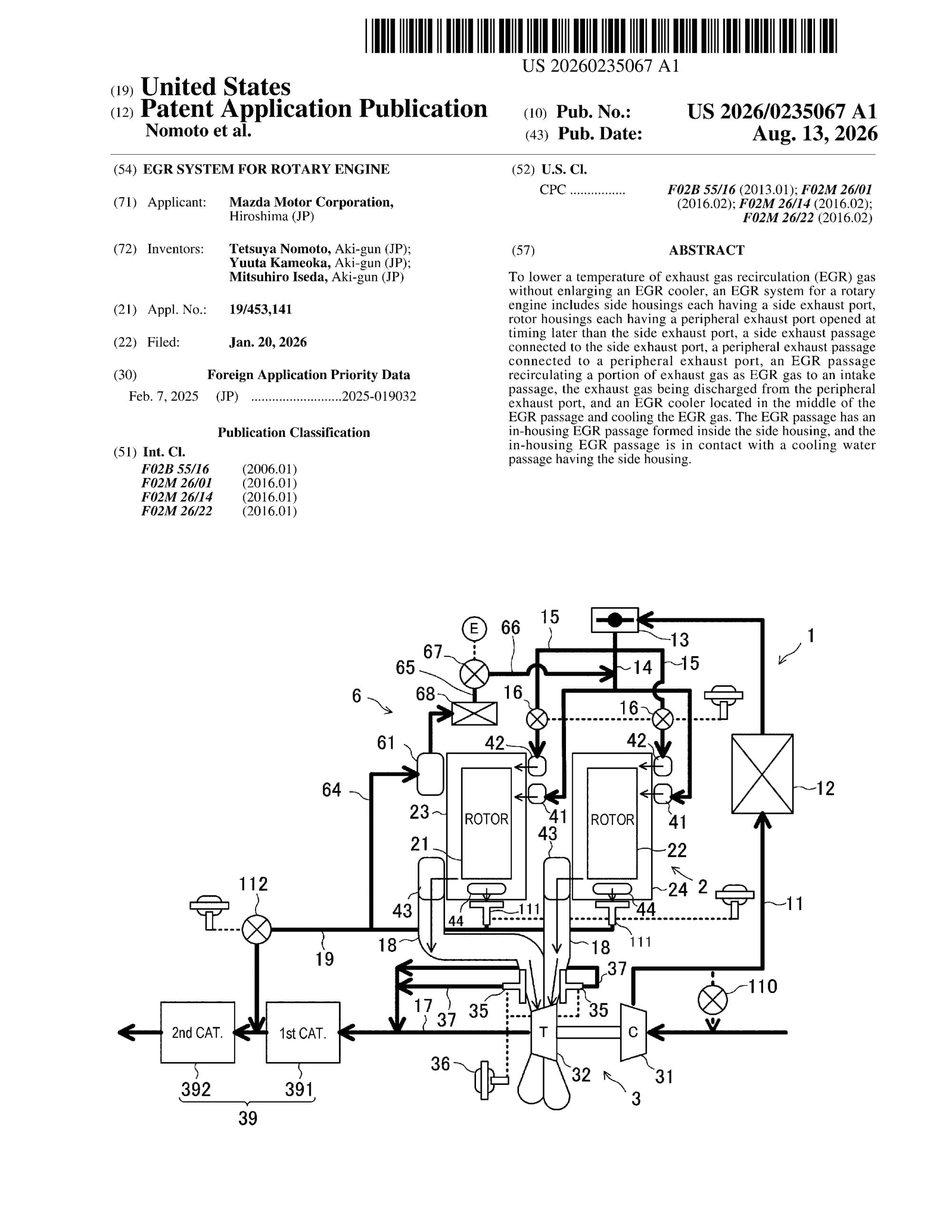
First page of application US 2026/0235067 A1, with the EGR-system diagram. Source: USPTO / Mazda Motor Corporation
Mazda has published an EGR patent application for the rotary engine
The United States Patent and Trademark Office (USPTO) published on 13 August 2026 application US 2026/0235067 A1, titled EGR system for rotary engine. The applicant is Mazda Motor Corporation (Hiroshima). The inventors named are Tetsuya Nomoto, Yuuta Kameoka and Mitsuhiro Iseda. The US filing is from 20 January 2026, with Japanese priority of 7 February 2025 (JP 2025-019032).
A published application is not a type-approved model and does not confirm production. Mazda has not announced a new rotary sports car on the basis of this text. The document describes an exhaust-gas recirculation (EGR) architecture for a rotary engine with a turbocharger and two types of exhaust ports.
What the application proposes
EGR sends some of the burned gases back into the intake. It lowers combustion temperature and, on petrol engines, helps the three-way catalyst when the mixture is held near the stoichiometric ratio (λ = 1).
In the application’s background, Mazda notes a known rotary limit: at high load, the mixture is often enriched to cool the gases and exhaust parts, which worsens emissions. A large quantity of cooled EGR would allow λ = 1 even at high load, but a large conventional EGR cooler is hard to package next to a rotary.
The solution described combines three ideas:
- A side exhaust port, which opens first and discharges hotter gases, directed to the turbocharger turbine.
- A peripheral exhaust port, which opens later and discharges cooler gases; EGR gas is taken from this one.
- An EGR passage cast in the side housing (in-housing EGR passage), in contact with the engine coolant circuit, so the gas is also cooled in the engine wall, not only in an external cooler.
Mazda writes that, because the peripheral gas temperature is already lower, the EGR cooler can be smaller. When EGR is not needed, the flow can be sent to a second catalyst. The application drawings show a two-rotor engine, intercooler, EGR valve and two stages of catalysis.
These are statements from the invention document, not WLTP type-approval results and not a power sheet.
What already exists in series: the 8C in the MX-30 R-EV
The current production rotary engine is the 8C, used as a generator on the MX-30 e-Skyactiv R-EV, not as an engine that drives the wheels. Mazda resumed production of rotary vehicles on 22 June 2023, at Ujina Plant No. 1 in Hiroshima, 11 years after RX-8 production stopped (June 2012). Until then, the brand announced more than 1.99 million rotary vehicles built; in October 2023 it passed two million.
According to Mazda Technical Review 2023, the 8C has 830 cm³, a single rotor, direct injection, a higher compression ratio than the 13B and already Cooled EGR. Mazda says the unit can run λ = 1 across the whole range, cut unit consumption by up to 25% versus the 13B and meets Euro 6d. As a generator, the Europe table indicates 53 kW at 4,500 rpm. The 8C exhaust is side, two ports — so it is not the side + peripheral + turbo architecture in the 2026 application.
On the MX-30 R-EV, Mazda’s release announces a 17.8 kWh battery, 50 l tank and 85 km WLTP electric range in EV mode. Motion is always electric; the rotary feeds the generator.
Tetsuya Nomoto, one of the inventors on the US application, also appears as an author of the technical paper on 8C combustion. Continuation of the research is documented; a new model is not.
Brief history, without an announced sports car
Mazda launched the Cosmo Sport (110S) in May 1967, the first series sports car with a rotary engine, after the technical agreement with NSU/Wankel in 1961. Iconic SP, presented in October 2023, is a concept with a two-rotor rotary system used again for generation, on fuel described as carbon-neutral. Mazda has not linked application US 2026/0235067 to Iconic SP or to a launch calendar.
What it means for Romania
The only Mazda with a rotary that can be ordered remains the MX-30 R-EV, a plug-in in which the Wankel is a generator. The patent application does not change the price list and does not add a rotary coupé to the configurator.
The MX-30 R-EV is produced in Japan. Rabla 2026 funds vehicles manufactured in the EU, EEA, United Kingdom, Switzerland, Turkey or Morocco; Japanese origin excludes eligibility by country of manufacture, independently of the fact that it is a PHEV.
On the used market, Mazda MX-30 listings must be read by type approval: the electric variant has no rotary; the R-EV has it as a generator. An RX-8 remains a model stopped in 2012, with different exhaust technology and without this EGR.
Frequently asked questions
Has Mazda type-approved a new rotary engine?
No. It has published a patent application. Publication at the USPTO is not equivalent to type approval, a price or a production date.
What is different from the MX-30 R-EV?
The 8C in the MX-30 is a single-rotor rotary, without a turbo in the published sheet, with conventional cooled EGR and side exhaust. The 2026 application describes a two-rotor rotary, turbo and side plus peripheral exhaust.
Does the patent announce an RX-7 or RX-8 successor?
No. Mazda has not made that link. Iconic SP remains a concept.
What does EGR mean here?
Exhaust-gas recirculation. The stated aim is to keep combustion temperature lower and allow a stoichiometric mixture at high load, with a smaller cooler.
Sources
- USPTO — US 2026/0235067 A1, EGR system for rotary engine (PDF)
- Mazda Newsroom — MX-30 e-Skyactiv R-EV, 13 January 2023
- Mazda Newsroom — MX-30 R-EV production start, 22 June 2023
- Mazda Technical Review 2023 — 8C engine combustion technology
- Mazda Newsroom — more than two million rotary vehicles, Cosmo Sport 1967
- Mazda Newsroom — Iconic SP concept
- CarBuzz — identification of the USPTO application
- Ministry of the Environment — Rabla 2026 eligibility by country of manufacture