
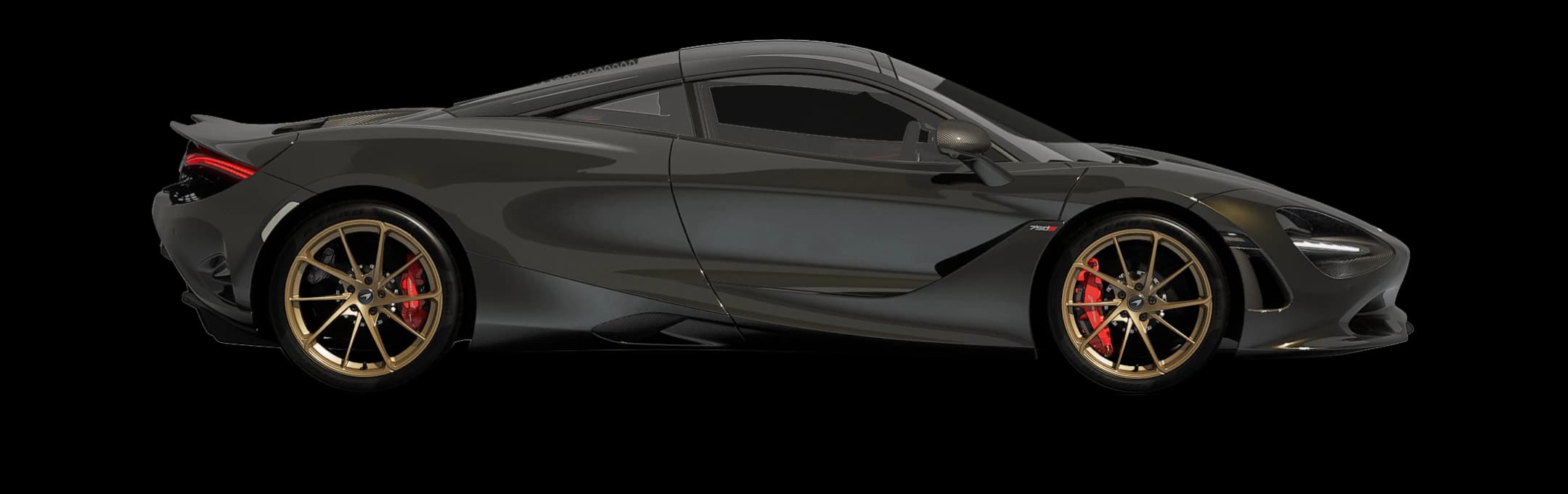
McLaren 750S production will end in 2027, after the British manufacturer confirmed that it is taking final orders for the V8-powered supercar. The model arrived in 2023 as the successor to the 720S and is one of the last series-production McLarens to use an exclusively combustion-powered drivetrain.
The information was reported by Autocar, which quoted McLaren’s confirmation and comments from chief commercial officer Henrik Wilhelmsmeyer. The report does not give a specific final assembly date. The accurate reading is therefore that production is scheduled to end next year, rather than that every remaining car will be built on one fixed day.
The 720S successor
McLaren revealed the 750S in April 2023, with customer deliveries beginning later that year. It took the 720S’s position in the Super Series range while retaining the main architecture and changing the engine, suspension, steering, transmission and aerodynamic package. In a financial report, McLaren described the car as having roughly 30% new or changed components compared with the 720S.
The formula remains familiar: a mid-mounted 4.0-litre twin-turbocharged V8, a seven-speed transmission and rear-wheel drive. McLaren’s official product page lists 750 PS and 800 Nm. The claimed 0-100 km/h time is 2.8 seconds, 0-200 km/h takes 7.2 seconds and top speed is 332 km/h.
Those are manufacturer figures, not independent test results. Tyres, temperature, surface and specification can affect real-world performance. They do, however, explain the 750S’s position in the range: a lightweight combustion supercar without electric motor assistance.
Engineering for low mass
McLaren lists a minimum dry weight of 1,277 kg for the Coupe, depending on specification. Dry weight is not the same as the mass of a fuelled, road-ready car, and options can change the result. The company says the 750S is 30 kg lighter than the 720S.
The Carbon Fibre Monocage II structure, carbon-fibre-shelled seats and lightweight alloy wheels are part of that programme. The front track is 6 mm wider, the steering rack is quicker and the suspension uses twin-valve dampers with McLaren’s Proactive Chassis Control III hydraulic system. The final drive is 15% shorter, which changes the car’s response under acceleration.
McLaren also retained hydraulic steering. The system is less common on modern road cars, but it provides a direct mechanical connection between the steering wheel and the front axle. That does not replace independent testing: braking, stability, ride comfort, durability and everyday usability still need to be judged on the road.
Coupe and Spider
The 750S is offered as a Coupe and a Spider. The Spider uses a retractable hardtop and keeps the 4.0-litre V8. McLaren lists a 2.8-second 0-100 km/h time and a 332 km/h top speed for the open model as well, while weight and intermediate acceleration can vary with equipment.
Both versions have two seats, a mid-mounted engine and a seven-speed transmission. McLaren’s European specification lists 150 litres of front luggage space and 210 litres at the rear. That can cover a short trip, but it does not make the 750S a family car. The published combined WLTP figure is 12.2 litres per 100 km, with 276 g/km of CO2.
The 788HS and McLaren’s next range
In 2026, McLaren introduced the 788HS, a limited derivative from the same technical family. Autocar describes it as the final limited-volume version to be built on the platform, with McLaren Special Operations set to produce 200 highly customised examples. It is not a normal-volume successor; it closes the development cycle of this architecture.
Autocar also reports that McLaren is preparing a new line-up that could include an SUV. The publication links the change to a wider company reorganisation and says the 750S, Artura and GTS are due to retire over the coming years. McLaren has not yet published all the official details for the future production range, so the SUV should be treated as a reported plan rather than a launched model.
For anyone seeking a new 750S, final-order status means availability will depend on remaining factory slots and the market in which the order is placed. Ending production does not automatically guarantee stronger used-car values. Future prices will depend on mileage, service history, specification, condition and real demand.
What the 750S leaves behind
McLaren has not officially called the 750S its final V8 road car. Its production end nevertheless arrives as the company prepares a different model mix. The manufacturer still lists the 750S and 750S Spider among its current cars, but customer orders are now in the final phase.
The next challenge will be to preserve the low weight and mechanical response associated with the 750S while expanding into other vehicle types and potentially different powertrains. The confirmed point is straightforward: final orders are open, and McLaren 750S production is scheduled to end in 2027.


