The future electric E-Class is expected to drop the rounded shape of the current EQE. Image: Auto Express rendering based on camouflaged prototypes.
Mercedes is preparing an electric E-Class for 2027. The new model will replace the EQE
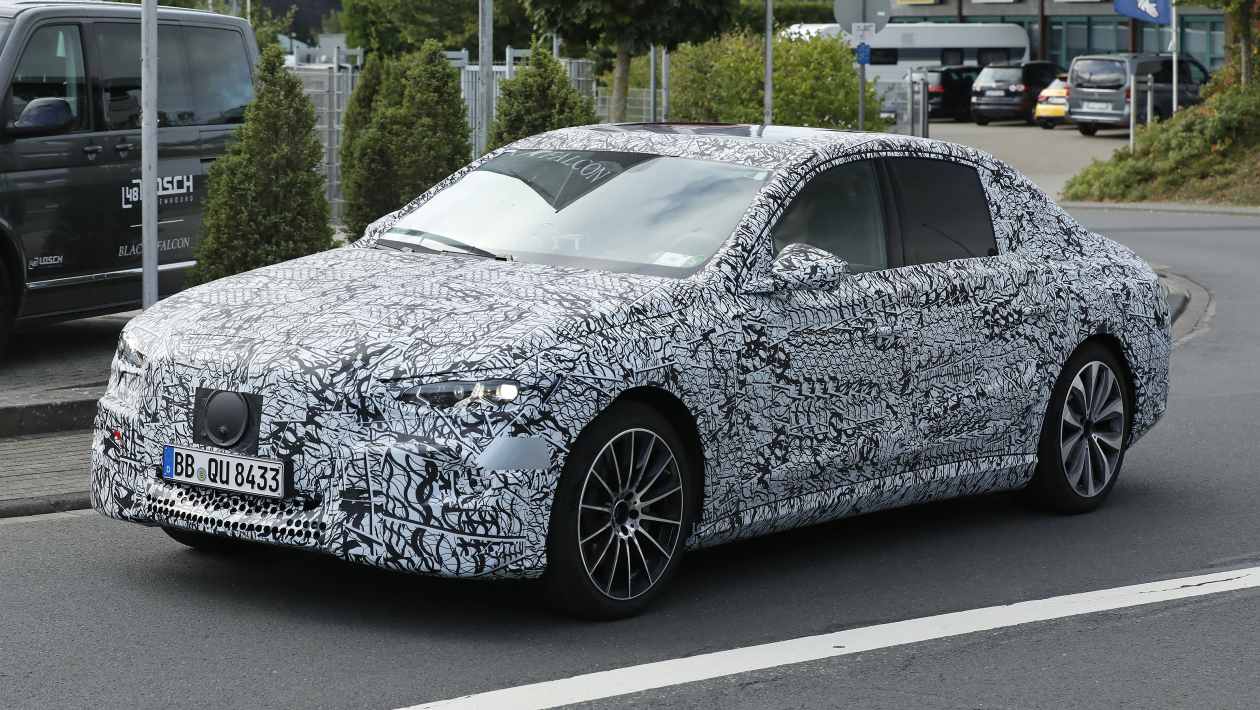
Mercedes-Benz is testing a new large electric saloon, scheduled for presentation in 2027. The model will take the place of the current EQE, but will be visually close to the E-Class with combustion and hybrid engines. The first prototypes indicate a return to a conventional silhouette, with a clearly defined bonnet, a cabin set further back and a separate boot.
The change is broader than a facelift for the EQE. The future car will use a platform dedicated to electric propulsion, while the current combustion E-Class will go through its own mid-cycle update. The two versions will have different architectures, but Mercedes wants the design and user experience to be much closer.
The commercial name has not been announced. Mercedes already uses the formula “with EQ Technology” for its new electric models, so the future saloon could be presented as an E-Class with EQ technology. Until the name is confirmed, it is more accurate to describe it as the electric successor to the EQE.
A three-box saloon, not the arched shape of the EQE
The current Mercedes EQE was drawn around aerodynamic efficiency, with the windscreen pushed forward and the roof continuing in a broad curve towards the rear. The prototype of the new model uses proportions closer to the E-Class: the bonnet appears longer, the driver’s position is set further back, and the boot has a well-defined lid.
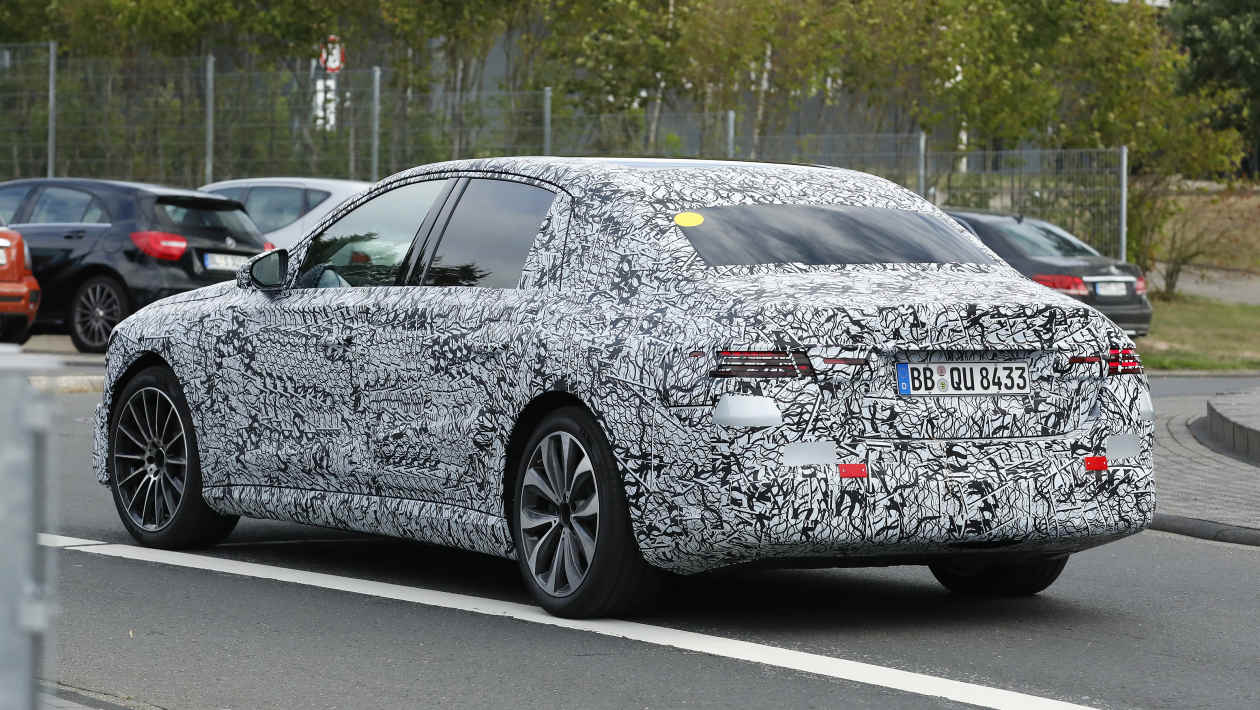
The rear could receive horizontal tail lights and a boot more clearly defined than on the EQE. Image: Auto Express rendering based on camouflaged prototypes.
At the rear, narrow light units appear, arranged horizontally. Prototype images are still insufficient to establish the final graphic, and some elements may be provisional. Auto Express notes that the horizontal lines could refer to the striated tail lights Mercedes used in the 1970s and 1980s, but that interpretation has not been confirmed by the manufacturer.
A more upright roof and a less raked rear window should offer more headroom on the rear bench. The electric platform also allows an almost flat floor, without the bulky centre tunnel found on cars built for several types of propulsion.
Illuminated grille and star-shaped light signatures
The electric version will have its own front end, even if the profile will resemble that of the classic E-Class. The renderings show an illuminated grille, inspired by the new electric GLC and the electric C-Class. Prototypes caught on test also have double star-shaped light elements inside the headlamps.
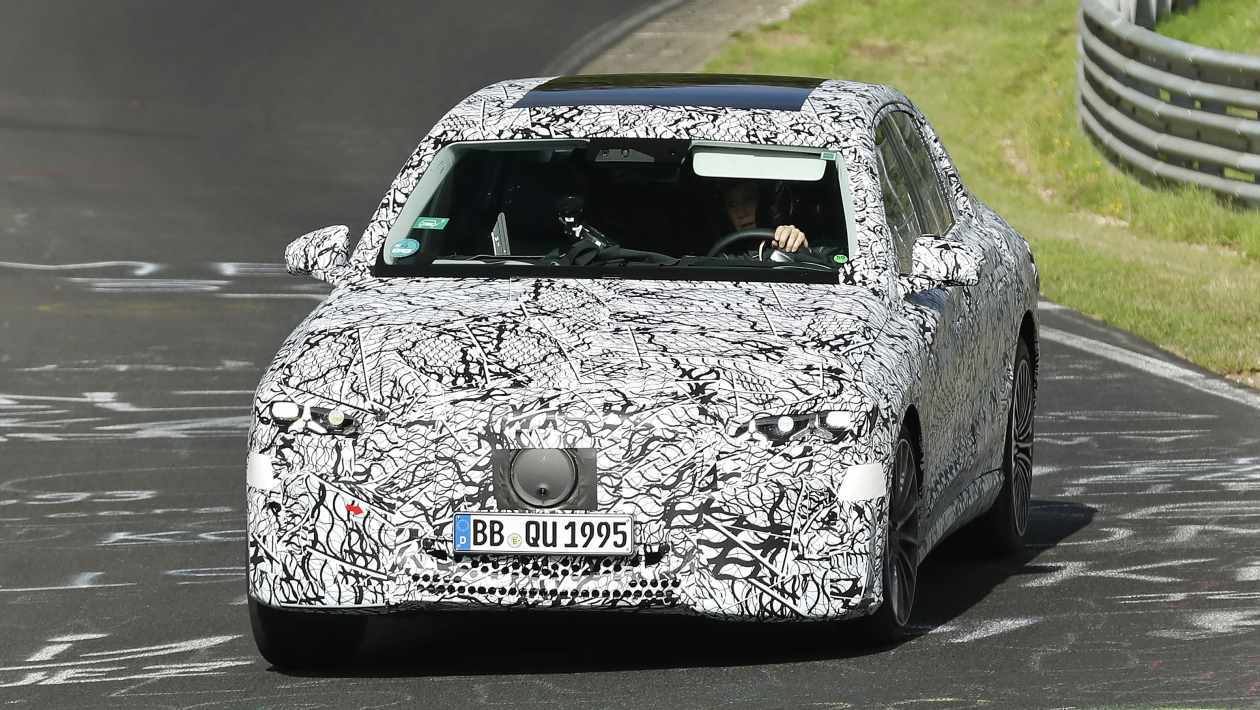
The illuminated grille and headlamp graphic follow the direction introduced by Mercedes’ new electric models. Image: Auto Express rendering based on camouflaged prototypes.
Mercedes has already started to bring the style of its electric cars closer to that of its combustion models. Mathias Geisen, a member of the Mercedes-Benz Group board of management, explained in 2026 that the brand wants to offer the same identity and a similar level of technology regardless of the propulsion system. The future E-Class will be one of the first projects conceived entirely after this direction.
The 805 km range is still an estimate
Mercedes has not published the battery capacity, motor power, charging speed or range of the future electric E-Class. Auto Express estimates WLTP range of between about 724 and 805 km, but those figures do not come from an official specification sheet.
To reach the upper threshold, the publication anticipates a 110–120 kWh battery, larger than the 94 kWh pack mentioned for the electric C-Class. Large capacity alone does not guarantee range: mass, drag coefficient, motor efficiency and thermal management will have a direct influence.
An 800 V electrical architecture is likely, because it already appears on Mercedes’ new electric models and allows high-power rapid charging. The manufacturer has not, however, confirmed the installation parameters for the E-Class.
The range is expected to include single-motor, rear-wheel-drive versions as well as dual-motor, all-wheel-drive configurations. A Mercedes-AMG variant is possible, but power figures circulated in the press are speculative and should not be treated as production data.
What happens to the current Mercedes EQE
Mercedes presented the EQE in 2021, and the model reached the market as the electric alternative to the E-Class. The new strategy gradually drops the pronounced visual separation between the EQ range and the brand’s classic cars.
Available information indicates that the EQE saloon will be replaced by the new electric E-Class. There is not the same confirmation for the EQE SUV, which may continue separately. Mercedes has not yet announced the date on which production of the current EQE will stop.
For the European market, the main rivals will be the BMW i5 and Audi A6 e-tron. The advantage Mercedes is pursuing is a platform created exclusively for electric propulsion, combined with proportions and a visual identity familiar to E-Class buyers.
When it will be presented
Auto Express indicates 2027 for the debut. Until then, the prototypes will pass through several stages, and the headlamps, bumpers and bodywork elements may change. The images in this article are renderings produced on the basis of camouflaged cars and are not official photographs of the production model.
In parallel, the E-Class with combustion engines and plug-in hybrid will receive a facelift. The two cars will be sold in the same family, offering customers a choice of propulsion without two completely different design languages.
Frequently asked questions
Will the new Mercedes electric E-Class replace the EQE?
Yes, published information indicates replacement of the EQE saloon. Mercedes has not yet communicated the production end date or the situation of the EQE SUV.
What range will it have?
There is no official figure. Current estimates speak of 724–805 km in the WLTP cycle, but the number will have to be confirmed after the car is presented.
Will it look the same as the current E-Class?
The two versions will have similar proportions and design elements, but the front of the electric model will be different, with an illuminated grille and a specific light signature.
When will it reach the market?
The presentation is expected in 2027. The order and delivery timetable for Romania has not been announced.