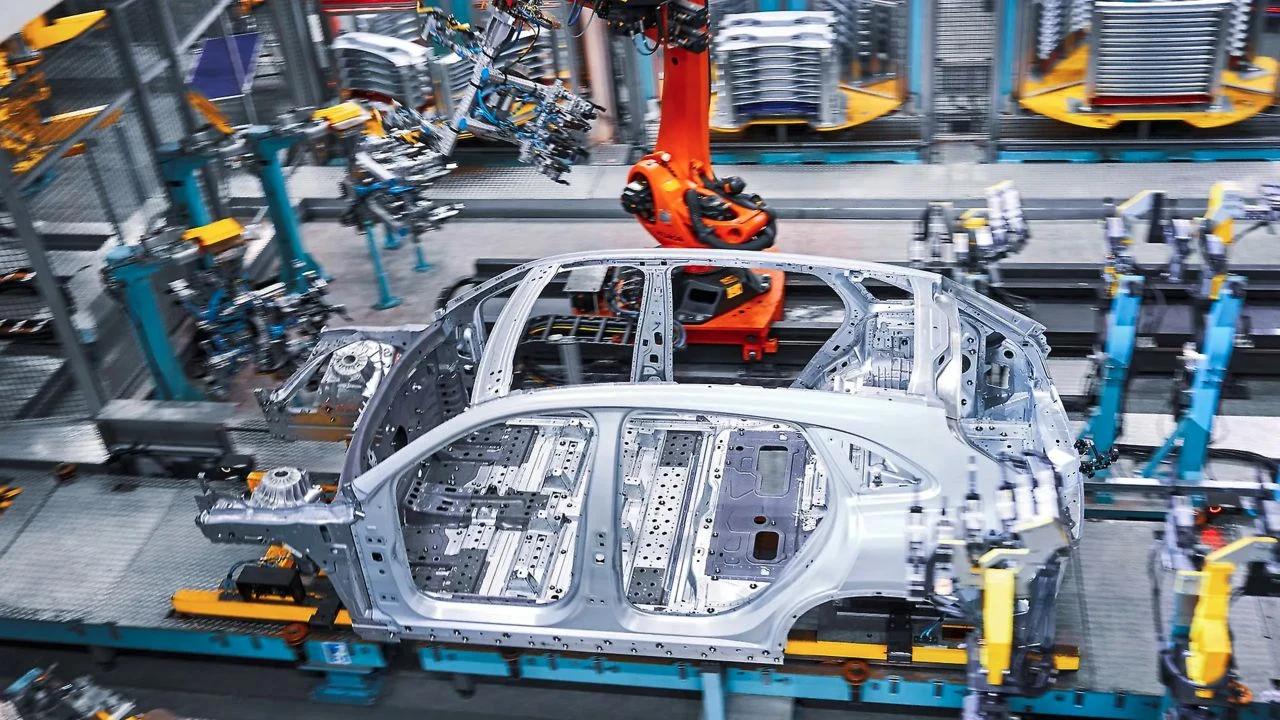
Image: Mercedes-Benz Group. The official photograph shows body production at the Bremen plant. It illustrates German manufacturing and does not identify a factory selected for closure; Mercedes-Benz has named no such site.
Mercedes-Benz has halted all further investment at its German sites while management, the General Works Council and IG Metall remain divided over labour-cost reductions. The company is now examining factory closures in more detail, but it has not approved a closure, named a plant or stopped current production. The distinction matters for employees and suppliers: this is a sharp escalation in negotiations, not a final industrial map.
Production chief Michael Schiebe said in an internal interview that the management board had jointly decided to stop additional investment because it could not see a route to agreement under today's German cost structure. Human-resources board member Britta Seeger said the company wants to avoid closures “at all costs” but must consider which locations it can continue to afford.
What the investment freeze does — and does not — mean
The announcement covers future investment at German locations. Mercedes has not published the affected projects, their value or the treatment of contracts already committed. It does not mean that Sindelfingen, Bremen or Rastatt assembly lines have gone idle, and it does not establish that every previously approved programme has been cancelled.
Investment allocation nevertheless determines a plant's future workload. A new model requires tooling, robots, digital systems, logistics and worker training. A powertrain plant needs capital to move from combustion components into electric motors, batteries or axles. If the next product goes elsewhere, today's output can continue while the site's medium-term utilisation deteriorates.
That makes the freeze a negotiating instrument as well as a capital decision. Management connects new German investment to lower costs. The General Works Council and IG Metall say they will discuss sustainable solutions but reject closures and want binding product and investment commitments rather than an ultimatum.
Two plant categories are at risk, but no locations are named
Schiebe warned in September that failure to cut costs could lead to the closure of one German vehicle-assembly plant and one German powertrain plant. The November message says the option will now be explored more concretely. It still does not identify either facility.
Mercedes' official network illustrates why guessing would be irresponsible. German vehicle plants include Bremen, Rastatt and Sindelfingen. Powertrain and component operations include Affalterbach, Berlin, Hamburg, Kamenz and Untertürkheim, with MDC Power facilities at Kölleda and Arnstadt. Van production includes Düsseldorf and Ludwigsfelde. The company has not said which operation from each category is under the most pressure.
The sites also have different roles. Bremen builds the GLC, including the electric version, on flexible lines alongside combustion and hybrid models. Sindelfingen concentrates upper and luxury vehicles and includes Factory 56. Rastatt produces compact cars. Component sites make engines, electric drive units, axles, batteries and other systems. None can be labelled a confirmed closure candidate from the available evidence.
The dispute over hours and employee payments
Management wants a rapid productivity increase and has discussed moving from a 35-hour to a 40-hour week without proportional additional pay. Other subjects include profit sharing, voluntary benefits and collectively agreed holiday and Christmas payments. IG Metall treats the 35-hour week as a central achievement and opposes using closure threats to obtain concessions.
Schiebe says a production hour in Germany can cost as much as five times the equivalent at some Eastern European plants. That is a management claim. The internal message described publicly does not provide a plant-by-plant breakdown of wages, social contributions, energy, utilisation or output per hour that would let outsiders reproduce the comparison.
Separate collective bargaining is also under way in Germany's metal and electrical industry, where IG Metall is seeking a 5% pay rise. Seeger argues that such an increase would add to costs that are already internationally uncompetitive. The sector-wide pay negotiation and Mercedes' internal productivity programme overlap, but they are not the same agreement.
The financial pressure in Mercedes' own figures
Mercedes remains profitable, though its car division is operating at a much thinner margin. Third-quarter group revenue was €30.7 billion, down from €32.1 billion a year earlier. Reported group EBIT was €1.77 billion and net profit €1.52 billion. Adjusted group EBIT fell 15% to €1.78 billion.
Mercedes-Benz Cars reported an adjusted return on sales of 2.5%. Global car sales fell 8% to 407,232 units, with the company attributing much of the decline to difficult conditions and intense competition in China. Performance was not uniformly weak: sales outside China grew, including a 5% increase in Europe, a 13% rise in Germany and 6% growth in the United States.
The company says combined spending on property, plant, equipment and research and development at Mercedes-Benz Cars fell 11% in the first nine months, following the 2025 launch-programme peak. Fixed costs have been reduced by about 25% since 2019, and a voluntary severance programme for indirect German functions is due to reopen in December 2026.
Cost reductions were already in the industrial plan
Mercedes' February strategy set German production capacity at about 900,000 cars, while Kecskemét in Hungary would be able to build up to 400,000. Global capacity is being adjusted to about 2.2 million units by 2028. Those figures describe capacity, not guaranteed output.
The target is to lower production cost per vehicle by 10% from 2027 compared with 2024 through better equipment utilisation, automation, artificial intelligence, lower energy costs and optimised logistics. Capital expenditure and R&D had already been expected to decline from their 2025 peak. The new German freeze is more specific and directly connected to the labour negotiations.
Employment protection does not allocate products
The General Works Council's report says the “Zukunftssicherung 2035” agreement excludes compulsory redundancies for operational reasons until the end of 2034. That protection matters, but it does not automatically assign a new model or investment to each plant, nor does it guarantee an unchanged factory network.
Closing a site would require negotiations over transfers, voluntary exits, retraining and social plans. Mercedes has not explained publicly how its closure scenario would interact with the employment agreement. No reliable national job-loss total can therefore be calculated from the announcement.
IG Metall and the works council responded on 13 November by demanding clear site prospects. General Works Council chair Ergun Lümali accused management of threatening to move activity to Eastern Europe instead of investing in innovation, AI, robotics and products in Germany. The union says closures are unacceptable but presents itself as willing to negotiate.
The link to Romania and other suppliers
Mercedes' European electric-powertrain chain crosses national borders. The Sebeș plant in Romania makes electric drive units for the electric GLC assembled in Bremen; Kamenz supplies batteries, while Hamburg makes electric-axle components. A decision about German assembly can therefore affect demand beyond Germany.
The freeze does not announce a new Romanian investment or a transfer to Sebeș or Cugir. It also does not prove that current component orders will fall. Those consequences would depend on which models, volumes and plants are eventually selected. For now, the confirmed change is the suspension of future German-site investment while negotiations continue.
Sources
- Mercedes-Benz Group: third-quarter 2026 results
- Mercedes-Benz Group: production capacity and cost strategy
- Mercedes-Benz Group: global production network
- Mercedes-Benz Group: electric GLC production at Bremen
- IG Metall Baden-Württemberg: statement of 13 November 2026
- Mercedes-Benz General Works Council: 2025 activity report