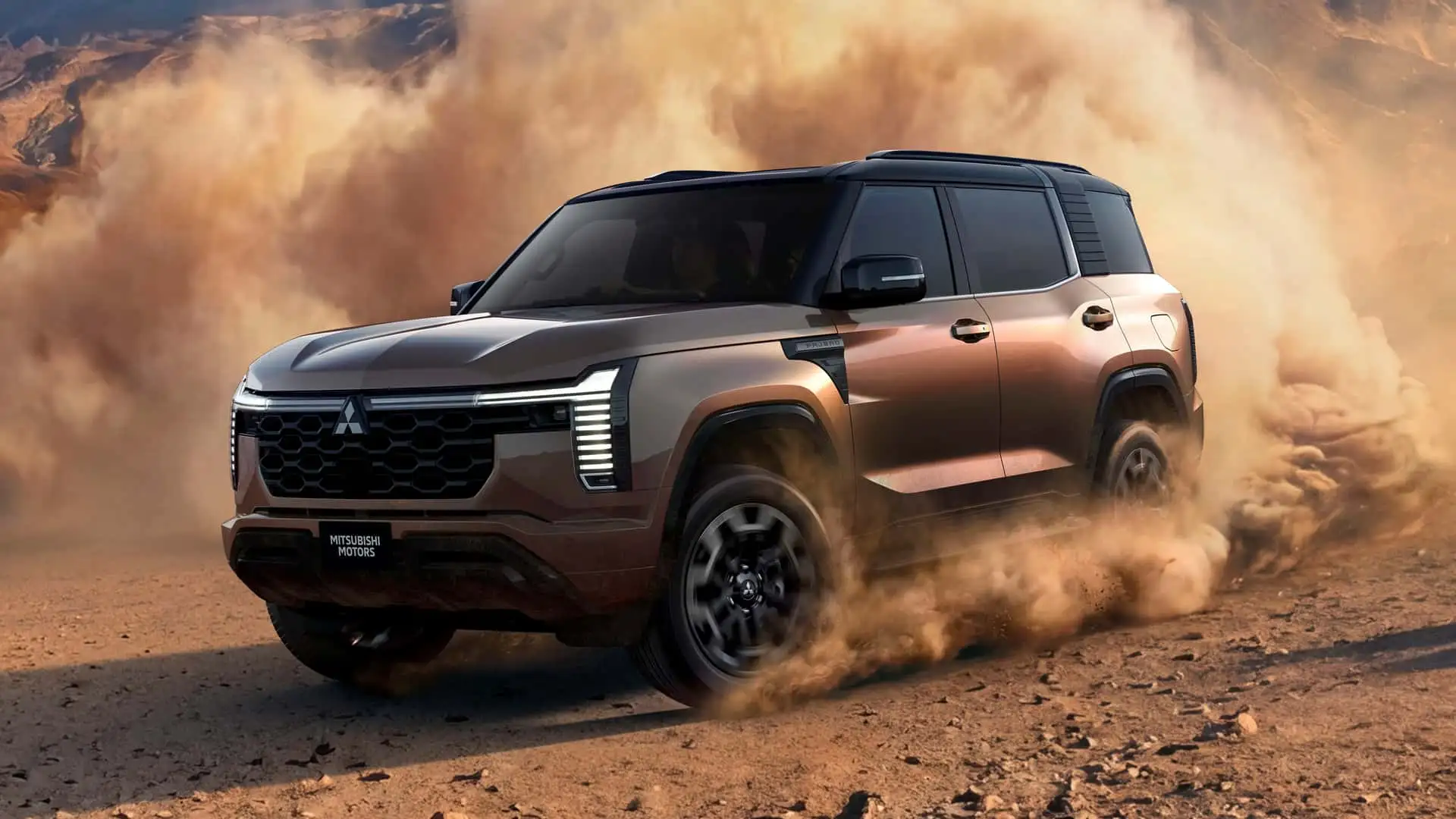
Mitsubishi has confirmed that the new Pajero is built on a separate chassis derived from the Triton pick-up. Photo: Mitsubishi Motors
The new Mitsubishi Pajero returns with a 204 hp diesel, low range and 230 mm of ground clearance
On 2 September 2026 Mitsubishi presented the fifth-generation Pajero, bringing back a name withdrawn globally in 2021. The new model is a body-on-frame SUV with seven seats, a 2.4-litre diesel engine and an all-wheel-drive system with low range.
Pajero uses the technical base of the Triton/L200 pick-up, but has a shortened wheelbase, its own rear suspension and a separately developed cabin. Mitsubishi positions it as its new flagship, not as a simple roofed version of the pick-up.
Almost five metres long and seven seats
The new Mitsubishi Pajero measures 4,920 mm long, 1,925 mm wide and 1,910 mm high. The minimum turning radius is 5.8 metres, a relevant figure for a vehicle that clearly exceeds the dimensions of a mid-size European SUV.
The body has straight forms, a high bonnet and large glazed surfaces. Mitsubishi has dropped the spare wheel mounted on the tailgate, an element associated with earlier generations, but has kept the vertical proportions and solid grab handles in the cabin.
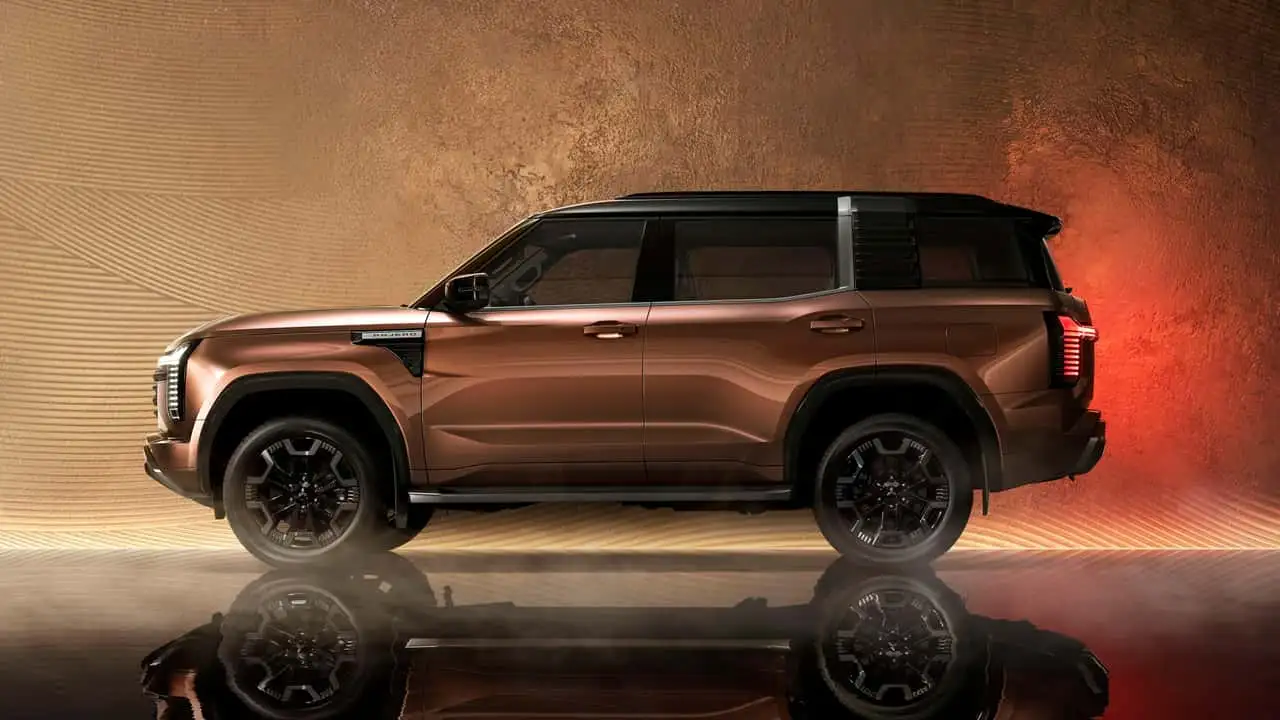
For now only the long body is announced, with three rows and seven seats. The second-row bench can slide over a distance of 150 mm. The manufacturer has not yet published boot volume with all seats raised, nor towing capacity.
2.4-litre diesel, 204 hp and an eight-speed automatic
The engine coded 4N16 is a 2.4-litre turbo diesel, related to the unit used by Triton. In the Pajero it develops 150 kW, equivalent to 204 hp, at 3,500 rpm and 480 Nm between 1,750 and 2,500 rpm. Some configurations will have 470 Nm.
The transmission is an eight-speed automatic. Mitsubishi has not announced a petrol, hybrid or plug-in hybrid powertrain for launch and has not yet communicated consumption and emissions figures.
That detail may limit the vehicle’s presence in the European Union, where emissions rules and taxation increasingly favour electrified systems. The company has not confirmed that the diesel version presented for Japan and other markets will be homologated in Europe.
S-AWC, lockable centre differential and low range
Pajero combines for the first time the S-AWC dynamic control system with the Super Select 4WD II all-wheel-drive transmission. The driver can select four main configurations:
- 2H, rear-wheel drive;
- 4H, permanent all-wheel drive;
- 4HLc, with the centre differential locked;
- 4LLc, with the centre differential locked and a reduction ratio for difficult terrain.
The system includes modes for gravel, mud, rocks and snow, depending on the selected configuration. S-AWC coordinates torque distribution, individual wheel braking, stability control and the Active Yaw Control function to influence the vehicle’s trajectory.
Ground clearance is 230 mm for the version with 20-inch wheels. The approach angle reaches 30.4 degrees, the breakover angle 22.6 degrees and the departure angle 25.8 degrees. These figures describe a layout conceived for difficult terrain, not merely a visual SUV package.
Own suspension and a chassis derived from Triton
The ladder-type structure starts from the current Triton’s chassis, but is adapted to the wheelbase and mass of an SUV. At the front there is a double-wishbone suspension, and the rigid rear axle uses five links, in a configuration developed for Pajero.
Mitsubishi says the mounting points between body and chassis have been calibrated to reduce vibrations transmitted to passengers. This solution tries to reconcile the strength needed off-road with comfort closer to that of a road SUV.
Figures for kerb weight, payload and suspension travel have not been published. Without them, a full technical comparison with Toyota Land Cruiser, Ford Everest or other body-on-frame SUVs cannot yet be made.
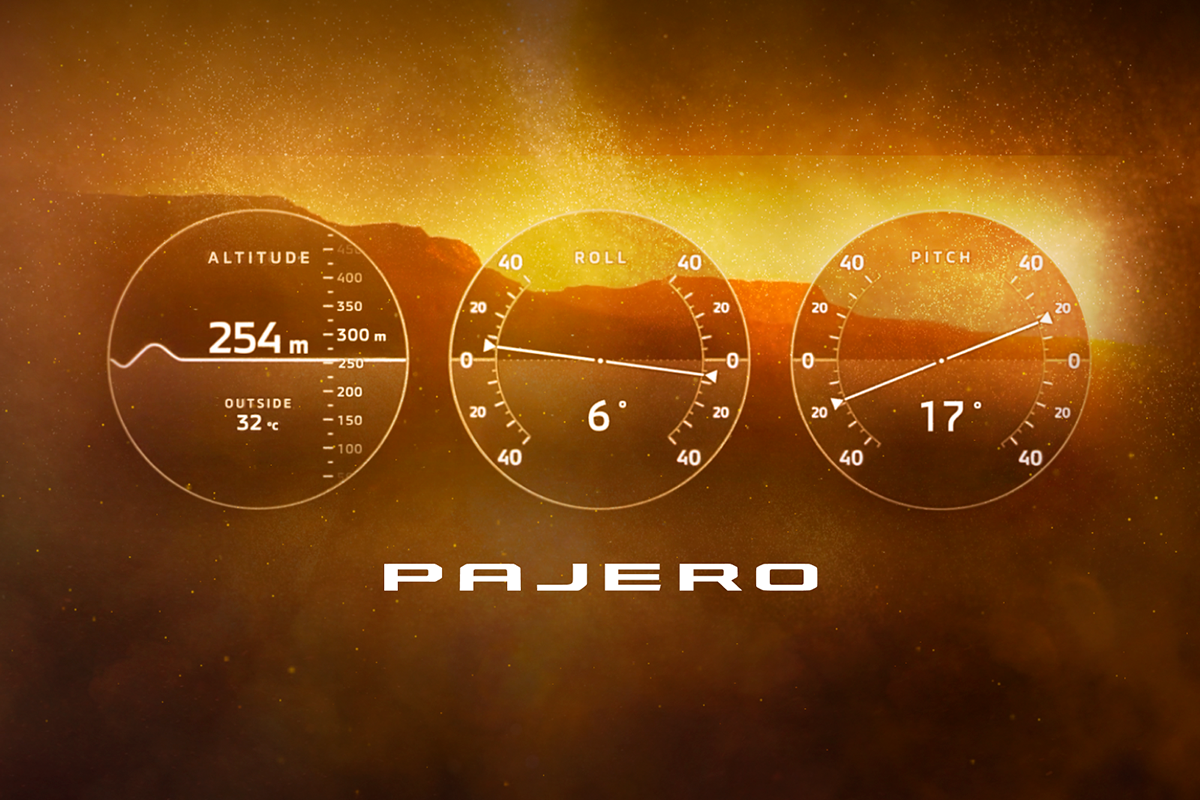
Multi Meter displays altitude, heading, body angles and torque distribution between the wheels. Photo: Mitsubishi Motors
Two large screens and the return of off-road instruments
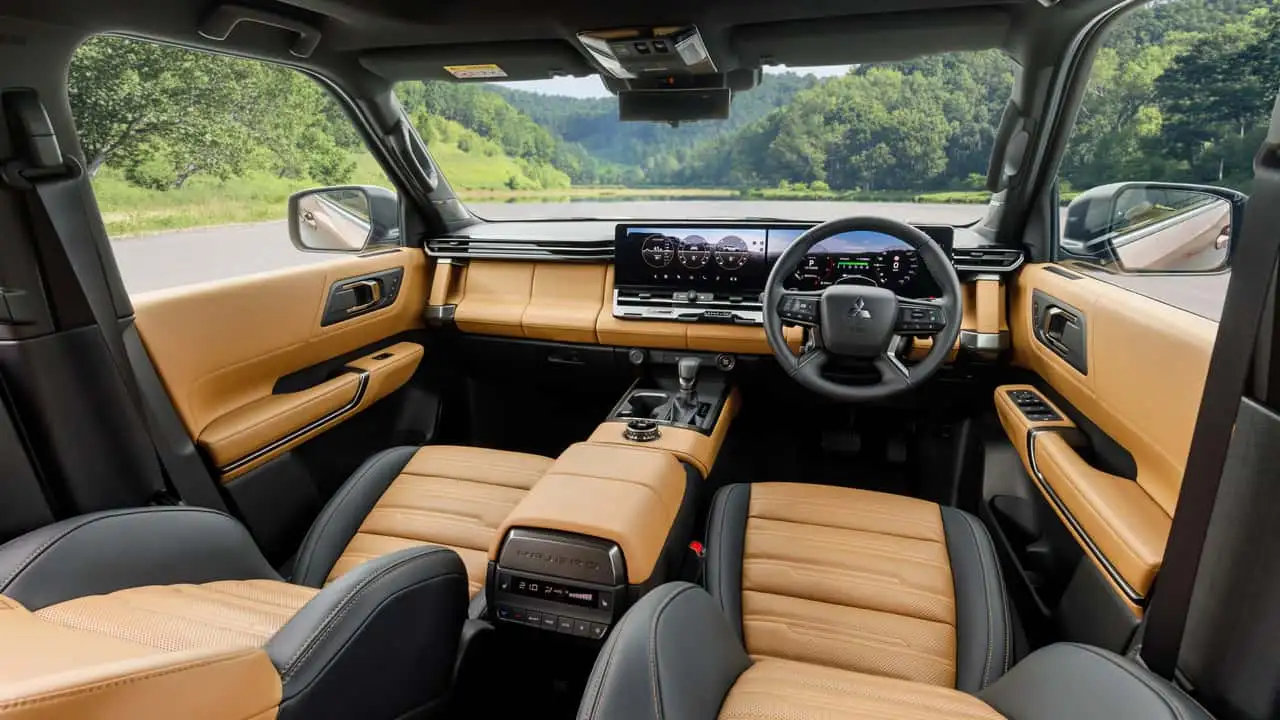
The dashboard has a horizontal construction, intended to help the driver judge the car’s lean. Upper versions use two 14.3-inch screens, while other configurations will have 12.3-inch displays.
Pajero brings back in digital form the group of three auxiliary instruments known from the first generations. The Multi Meter interface can display altitude, compass heading, outside temperature, the body’s longitudinal and lateral angles and torque distribution between the left and right wheels.
Climate control keeps buttons and rotary selectors separate from the screen. The equipment list presented in Japan also includes wireless phone charging, three-zone climate control and a Dynamic Sound Yamaha Ultimate audio system.
MI-PILOT assistance and cameras for difficult terrain
The safety pack includes MI-PILOT, automatic emergency braking, forward-collision warning, lane-keeping assistance and a system that intervenes in the event of mistaken accelerator application.
Exterior cameras can generate a 360-degree view and an image of the area immediately under the front. The latter is useful on routes where the high bonnet hides obstacles close to the wheels.
Exact equipment will differ between versions and markets. Mitsubishi has not yet published the full range structure or independent safety-test results.
Will the new Mitsubishi Pajero reach Romania?
Mitsubishi has confirmed the global return of the Pajero name, also known as Montero in some countries, but has not published the list of all European markets. Prices and delivery calendars are still being established.
In Romania the brand currently sells models such as Outlander PHEV, ASX and Colt, but the importer has not announced Pajero. The dimensions, diesel engine and off-road-oriented architecture place it in a different zone from the Mitsubishi SUVs now sold locally.
Until European homologation is confirmed, the new Pajero should be seen as a global return with uncertain local availability. A possible Romanian price cannot be estimated correctly before Mitsubishi sets the versions, taxes and equipment intended for the European Union.