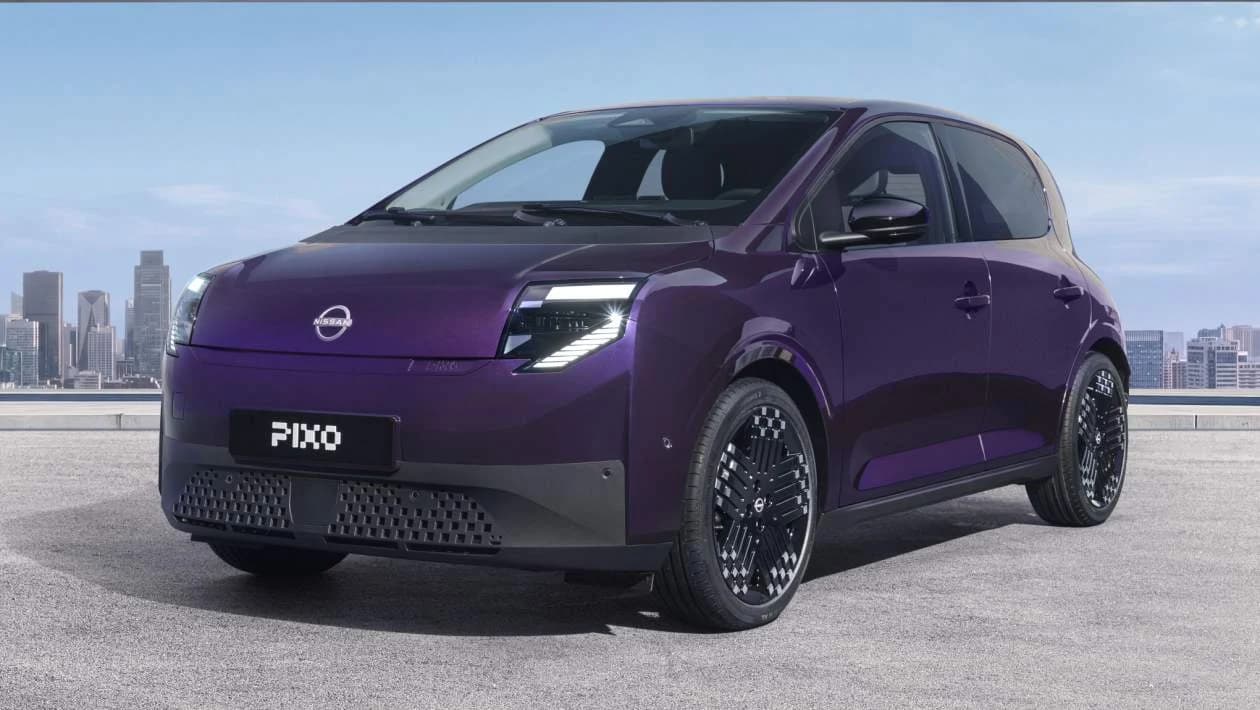
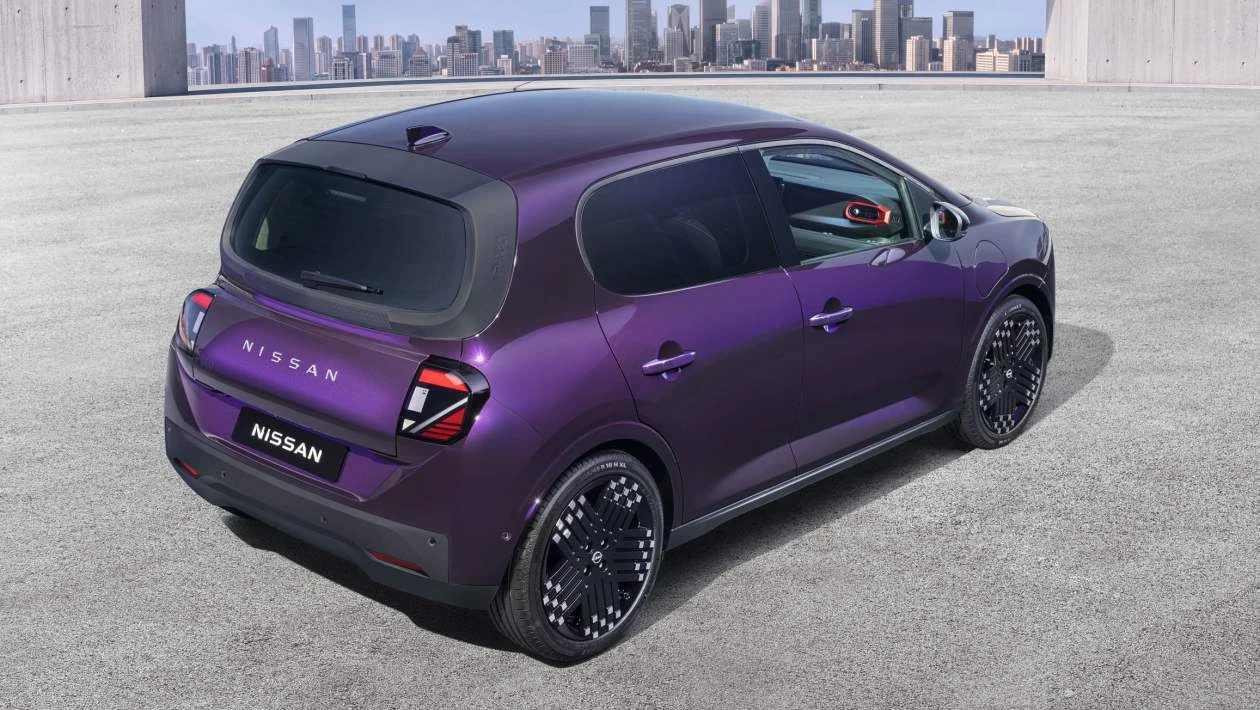
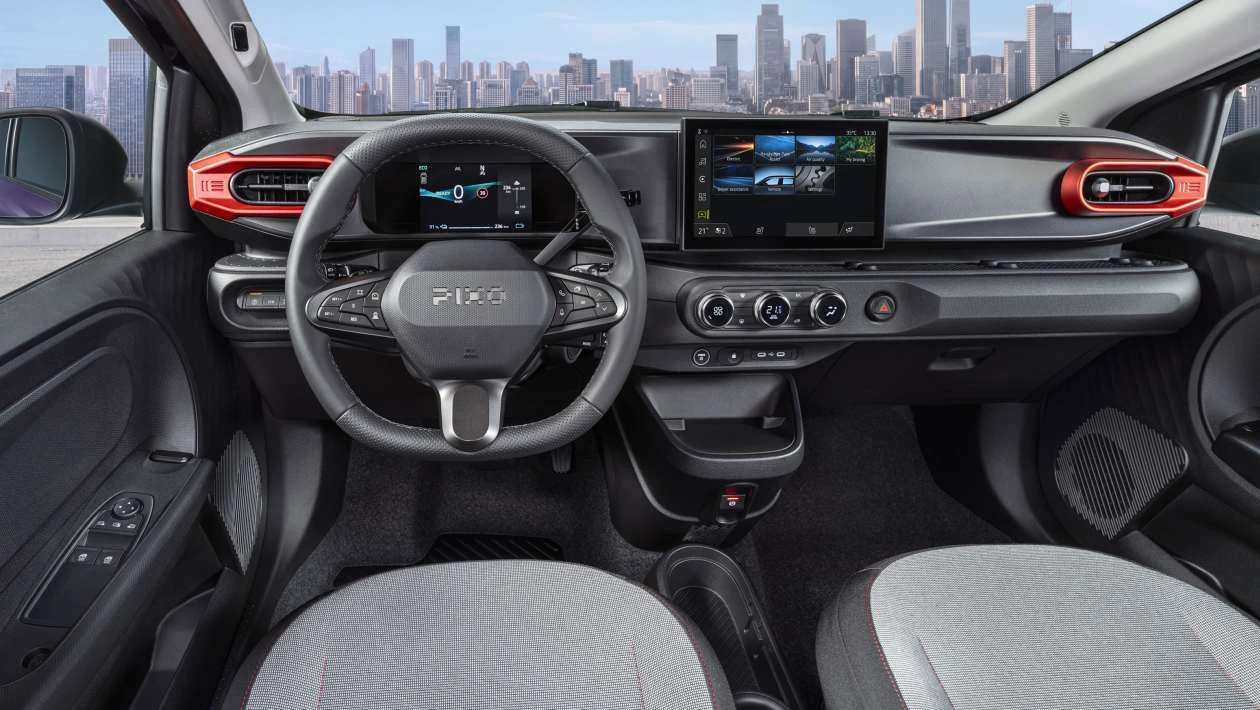
Nissan has revealed the new Pixo as a small electric city car for Europe. The A-segment hatchback uses an 80bhp electric motor, a 27.5kWh LFP battery and a maximum WLTP range of roughly 259–263km. It will sit below the electric Micra in Nissan’s European line-up, with sales expected to begin in early 2027.
The name returns after a gap of around 12 years, but the new model has no direct technical relationship with the petrol Pixo sold from 2009 to 2013. That earlier car was related to the Suzuki Alto. The new Pixo is part of the Renault-Nissan development relationship around compact electric vehicles and is designed specifically for European urban use.
Nissan’s smallest new EV
Nissan announced the Pixo name on 9 September and scheduled the full reveal for 23 September 2026. The company describes it as a fully electric A-segment city car developed and built in Europe for European customers. It joins the Leaf and Micra, while a new electric Juke is planned as a later addition to Nissan’s regional EV range.
The A segment is made up of the smallest mainstream passenger cars. They are bought for commuting, shopping, school runs and short urban journeys rather than regular motorway travel. In this class, a compact footprint, a small turning circle and low energy consumption can be more useful than a large battery or high top speed.
Nissan has given the Pixo its own visual identity even though it shares major engineering with Renault. The car has bespoke front and rear styling, pixel-inspired lighting, a different bumper treatment and dedicated wheel designs. Nissan also plans colours and small design details that are not simply carried over from the Renault Twingo.
Battery, range and charging
The revealed Pixo uses a 27.5kWh battery and a motor producing about 60kW, or 80bhp. Reported WLTP range is in the region of 259–263km, depending on the market and the way the figure is presented. WLTP is a standard test cycle, not a guarantee of the distance a driver will achieve in cold weather, at motorway speeds or with heavy use of heating and air conditioning.
A small battery can be an advantage in the city. It keeps mass and cost under control and can cover several days of commuting if the owner can charge at home or at work. The same battery is less suitable for frequent long-distance trips. The Pixo’s purpose is not to replace a large electric crossover; it is to make short urban travel possible with a smaller, more efficient vehicle.
DC charging is reported at up to 50kW. Renault’s closely related Twingo E-Tech electric can charge from 10 to 80 per cent in about 30 minutes when fitted with its fast-charging option. Nissan’s final equipment specifications still need to be checked by market, because charging hardware, standard equipment and available options can differ between countries.
An 80bhp front-mounted motor is adequate for urban traffic. Post-reveal reports quote around 12.1 seconds for 0–100km/h. That is not a performance-car figure, but it is appropriate for an A-segment EV focused on low-speed manoeuvrability. On faster roads, the modest power output and small battery will require more planning than a larger electric model.
A Renault Twingo cousin
The Pixo is part of a Renault-Nissan industrial project. Renault is responsible for developing and producing the basic vehicle, while Nissan applies its own exterior design and brand positioning. The shared AmpR Small family allows several compact EVs to use common components and manufacturing processes.
This commonality can reduce development time and production cost, but it does not make the Pixo identical to the Twingo. Software, seats, equipment, suspension tuning and noise insulation can all change the experience. The Pixo is also expected to retain practical solutions associated with the Twingo project, including a sliding rear-seat arrangement that helps owners divide the available space between passengers and luggage.
The Dacia Spring provides a different point of comparison. It follows a more explicitly low-cost approach and has its own body. The Pixo is closer to the Twingo in its engineering, while Nissan is using design and specification choices to give it a separate place in the market. The final price and standard equipment will decide how far the models overlap in real buying decisions.
Price, launch timing and European relevance
UK coverage has placed the Pixo’s target price below £20,000, with early estimates around £18,000 for the entry version. Those figures are not an official Nissan price for Romania or for the eurozone. The final amount will depend on equipment, taxation, transport costs and any local purchase incentives. Nissan has not yet published a Romanian price list or confirmed the exact date on which orders will open in every market.
The expected launch in early 2027 puts the Pixo into a growing group of small European EVs. Its rivals and relatives include the Renault Twingo E-Tech, the Dacia Spring and upcoming entry-level models from other manufacturers. Nissan’s advantage is the combination of a known European dealer network and a compact model placed below the electric Micra.
For Romanian buyers, the important questions will be practical. Will the Pixo be sold locally? What equipment will be standard? What warranty will cover the battery? Will fast charging be included or optional? And will the price remain close to the intended entry-level positioning after Romanian taxes and delivery costs? None of those answers should be assumed from UK reports.
The confirmed picture is therefore clear but limited: the Pixo is a European electric A-segment city car, it uses an 80bhp motor and a 27.5kWh battery, its WLTP range is around 260km, and its market arrival is expected in 2027. Nissan’s Romanian pricing, equipment and ordering timetable remain to be announced.
Image: Nissan/Auto Express. The images are taken from the supplied article gallery and stored locally as WebP files.