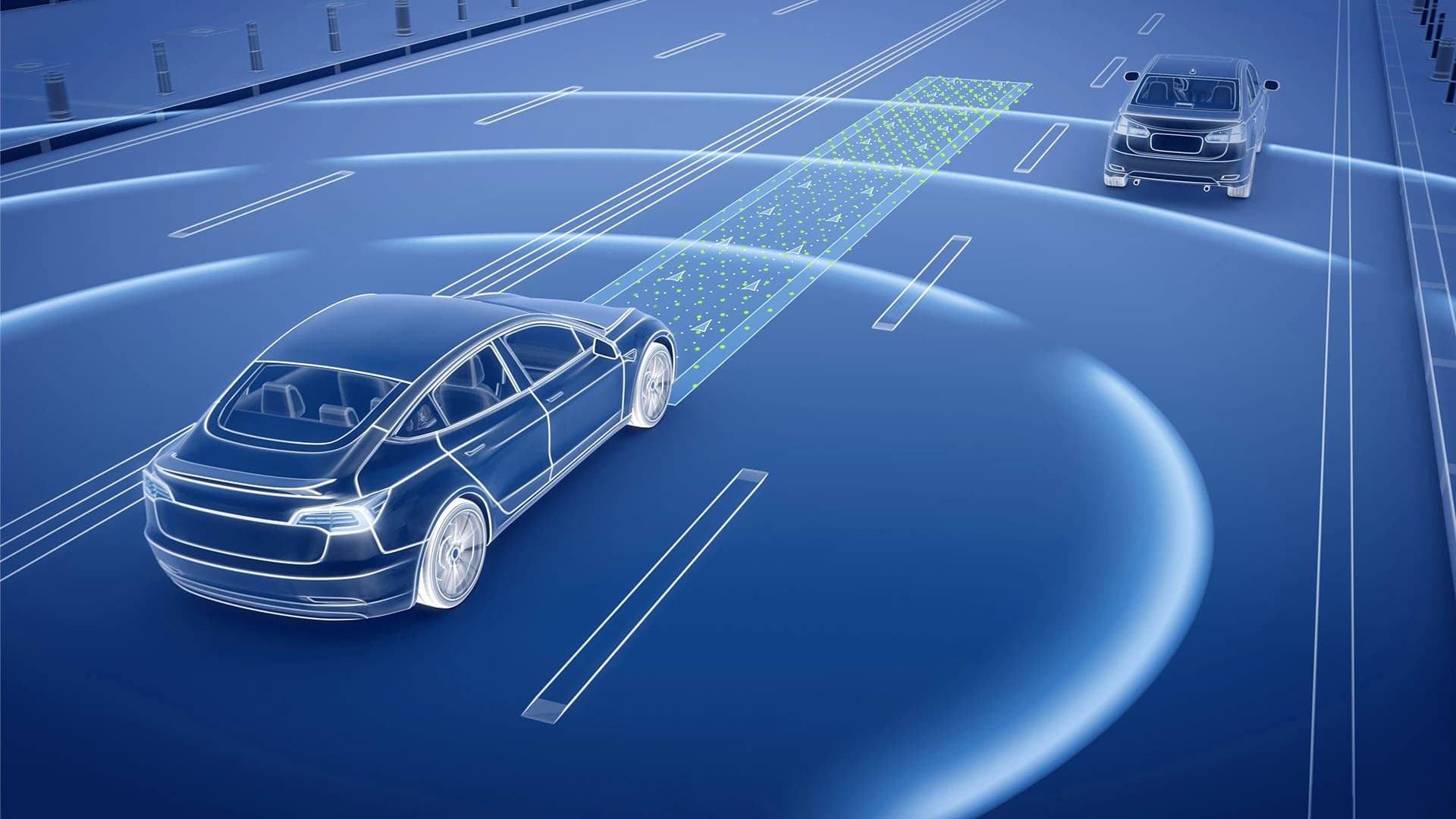
ADAS systems combine cameras, radars and software to follow the road and traffic. Illustrative image
Why manufacturers prefer Level 2 over Level 3 automated driving
Car manufacturers are investing more in Level 2 assistance systems, even though only a few years ago Level 3 seemed the next natural step. The reason is not that Level 3 is less capable, but that the legal and technical difference between the two levels makes it much more expensive and harder to introduce at scale.
At Level 2, the car can control steering, acceleration and braking at the same time, but the driver must continuously supervise traffic. At Level 3, the system drives on its own within the limits for which it has been approved, and the user can look away from the road. They must, however, be ready to take over when the car asks them to.
It is precisely this temporary transfer of responsibility to the car that changes costs, testing and the manufacturer’s liability.
The difference between Level 2 and Level 3
The SAE classification separates systems according to who executes the driving and who supervises the road environment.
| Characteristic | Level 2 | Level 3 |
|---|---|---|
| Steering, acceleration and braking | controlled simultaneously by the system | controlled by the system in the approved domain |
| Who watches the road continuously | the driver | the system, while the function is active |
| Hands can leave the wheel | sometimes, if the system allows it | yes, under homologated conditions |
| Eyes can leave the road | no | yes, temporarily |
| Who is responsible for driving | the driver | the system/manufacturer in the active interval, depending on legislation |
| Takeover at the car’s request | does not change the driver’s responsibility | the driver must respond to the takeover request |
“Level 2+”, “Level 2++” or “advanced Level 2” are not official steps in the SAE J3016 standard. They are industry names for systems that can drive without hands on the wheel on certain roads, change lane or follow a route. Regardless of the number of plus signs, the driver must remain attentive and responsible.
Why Level 3 costs more
A Level 2 system can use cameras, radars, ultrasonic sensors and a central computer. For Level 3 it is not enough that the car drives well in normal conditions. It must detect faults, keep control when a component fails and reach a safe state if the driver does not respond to the takeover request.
That can mean extra sensors, lidar, backup computers and redundancy for the electrical supply, steering and braking. The manufacturer must demonstrate that the entire chain works in all situations included in the system’s operational domain.
The cost does not stop at the parts fitted to the car. Software validation, road mapping, homologation in each region, updates and incident investigation add expenses over the model’s entire life.
By contrast, a capable Level 2 system can offer a large part of the comfort customers want — lane keeping, automatic following distance and assisted lane changes — with less hardware and without transferring responsibility from the driver.
BMW and Stellantis have scaled back Level 3 plans
S&P Global Mobility notes that BMW decided not to keep Personal Pilot L3 on the restyled 7 Series. The manufacturer is concentrating on a Level 2 system that is easier to extend to more models.
Stellantis suspended the AutoDrive Level 3 programme in 2025. Reuters reported at the time that the decision was linked to high costs, technical difficulties and uncertainty about customer interest. The group continues to develop assistance technologies through the company aiMotive, but the timetable for an L3 system for customers is no longer the one originally announced.
These withdrawals do not mean Level 3 is disappearing. Mercedes-Benz has homologated Drive Pilot for use in limited conditions, and several manufacturers continue testing. They do show, however, that Level 3 remains an expensive function, available on few models and only in certain countries, roads, speeds and weather conditions.
S&P Global Mobility estimates that adoption of advanced Level 2 systems will grow much faster than Level 3 between 2026 and 2030. A McKinsey report published in 2025 projects that cars with Level 2 systems could represent 52% of global sales in 2030, while Level 3 would remain below 1% in 2025 and could reach 16% only in 2035.
The takeover problem
Level 3 has a difficulty that Levels 2 and 4 treat differently: the driver may not watch the road, but must return to driving when the system reaches its limit.
If the person is reading, working or watching a screen, they need time to understand the traffic and the car’s position. The manufacturer must set the moment of the warning, the interval available for a reaction and the minimum safety manoeuvre if the user does not respond.
At Level 2, the requirement is simpler: the driver watches the road continuously. At Level 4, the vehicle must handle the situation itself in the area for which it is designed, without depending on an immediate takeover. Level 3 sits between those two models and combines temporary automation with the need for an available human.
What a buyer in Romania should check
For cars sold in Romania, terms in the configurator should not be confused with SAE levels. “Autopilot”, “semi-autonomous driving”, “hands-free” or the commercial name of a pack does not automatically confirm Level 3.
Before buying, four questions are relevant:
- whether the system requires continuous supervision of the road;
- whether it works on all roads or only on mapped motorways;
- whether it has speed and weather limits;
- whether the function is homologated and active in Romania, not only technically available on the car.
In local market practice, the ADAS systems offered widely are Level 2 and keep responsibility with the driver. The fact that the car can run for a period without hands on the wheel does not allow the driver to write messages, watch a film or ignore traffic.
Frequently asked questions
Is Level 2+ an official autonomy level?
No. The SAE standard defines levels 0–5. “2+” and “2++” are commercial terms for more capable systems, but responsibility remains with the driver.
Can a Level 2 car drive without hands on the wheel?
Yes, some systems allow this on compatible roads. The driver must, however, look at the road continuously and be able to intervene immediately.
What extra does Level 3 offer?
In approved conditions, the system watches the road environment and allows the driver to look away from the road. At the car’s request, they must take over.
Why is Level 3 not available on all expensive cars?
It requires redundant hardware, extensive validation, local homologations and the assumption of greater responsibility by the manufacturer. The function remains limited to certain roads and conditions.
Sources
- Automotive News Europe — the costs and complexity of Level 3
- S&P Global Mobility — why Level 2+ is advancing faster than Level 3
- Reuters — Stellantis suspended the AutoDrive Level 3 programme
- McKinsey — the automotive software and electronics market to 2035
- SAE International — levels of driving automation