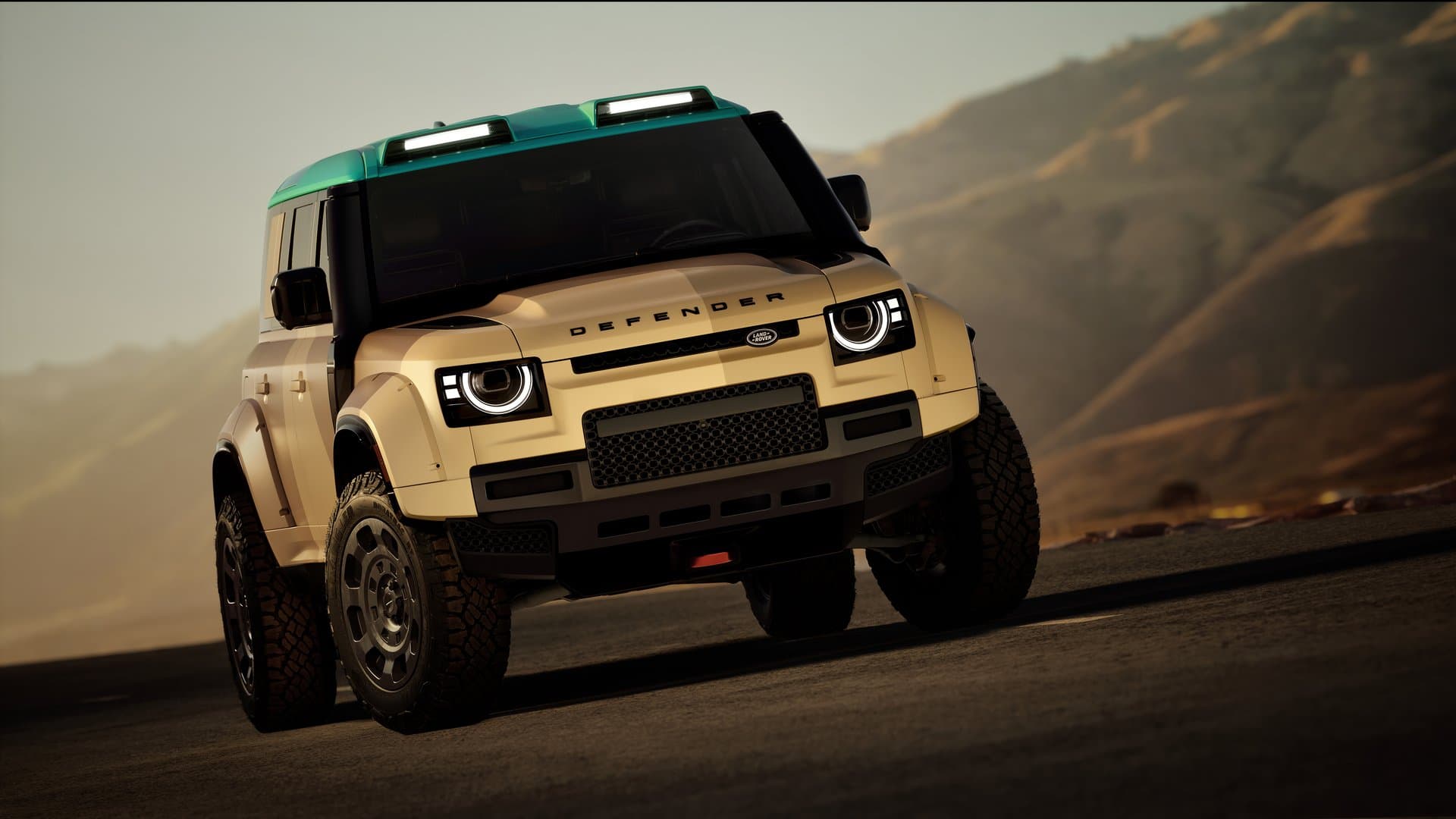
Defender D7X-R, a competition model derived from the current Defender. Illustrative image; the future electric generation has not been presented. Photo: Defender.
The next-generation electric Defender would have been postponed until after 2030
JLR would have suspended development of the next large Defender generation for two years, and the fully electric version would thus arrive after 2030. The information was first published by the British press and picked up by Motor1, but the company has not confirmed a new timetable.
The distinction is important: JLR had not officially announced that an electric Defender of the size of the current 90, 110 and 130 would be launched in 2028 or 2029. Those years came from estimates linked to the model’s life cycle. Therefore, this is about the reported postponement of an internal programme, not the withdrawal of a public launch date.
The current Defender would remain in production longer
The current Defender generation, with the L663 code, was presented in 2019 and is built at JLR’s plant in Nitra, Slovakia. The range includes three body lengths, versions with combustion engines and electrified configurations, but it does not have a fully electric variant.
According to the report in The Sunday Times, picked up by several publications, the complete redesign of the car was paused for about two years. JLR would have explained the decision to employees through the commercial success of the current model. Defender accounted for almost a third of the group’s sales in the financial year ending in March 2026, according to information cited by the British press.
JLR issued a response that confirms the importance of the model, not the postponement and not the year 2030. The company described Defender as one of its greatest successes and invoked high global demand. It did not offer details about the next generation’s platform.
Why the current architecture complicates an electric Defender
The British press argues that integrating a sufficiently large battery into the current structure is difficult. Defender uses the D7x architecture, designed for internal combustion engines, mild-hybrid systems and plug-in hybrid variants. The floor, suspension, off-road protection and the space needed for the transmission were not conceived from the start around a large, flat accumulator.
An electric Defender must keep ground clearance, wading capability, off-road angles and the strength of the underside. Protecting the battery can add mass and reduce usable space. These compromises explain why a conversion on the current architecture would be more difficult than designing a new generation.
JLR has not publicly confirmed this technical explanation for the pause. It should be treated as information attributed to the British publication’s sources, not as an official reason communicated by the company.
The postponement does not stop all of JLR’s electric projects
The group continues to work on the Range Rover Electric and Range Rover Sport Electric, both based on the MLA architecture. The first electric model built on the new EMA platform will be part of the Range Rover family and will be produced at Halewood, in the United Kingdom.
In June 2026, JLR also announced a more flexible strategy for powertrains. Range Rover, Defender and Discovery will be able to have, depending on model and market, mild-hybrid, full-hybrid, plug-in hybrid or fully electric variants. Jaguar remains the brand oriented exclusively towards electric propulsion.
The company confirmed that after the Range Rover Electric, Range Rover Sport Electric and Jaguar Type 01, other Range Rover and Defender models will follow on the EMA architecture. It did not, however, specify names, sizes or exact launch dates.
A smaller Defender would continue separately
Reports about the postponement say that the project for a more compact model inspired by Defender has not been stopped. It is informally called “baby Defender” or “Defender Sport”, but JLR has not confirmed either of these commercial names.
The future model would use the EMA platform, developed around electric propulsion and now also prepared for a full-hybrid system. A compact SUV on this architecture is a distinct project from the successor to the current Defender 90, 110 and 130. The launch of one does not mean the immediate replacement of the other.
For buyers, the difference matters because a smaller model will not necessarily offer the same towing capacity, the same space or the same off-road ability as the Defender 110 and 130. Specifications are not yet public.
What it means for current Defender customers
The information does not describe a halt in production, a delay of orders already placed or a recall. The current Defender continues to be sold and to receive updates. In July 2026, the range was expanded with new versions, colours, accessories and a six-seat configuration for the Defender 110.
A longer life cycle can allow JLR to amortise the investment and gradually correct problems of the current model. For the customer there is, however, a reverse: the platform and electronic architecture will remain on the market longer at a time when rivals are introducing dedicated electric SUVs.
Mercedes-Benz already sells the electric G-Class, and other brands are preparing electric vehicles with off-road positioning. JLR appears to prefer a later launch of a fully redesigned Defender instead of a hurried adaptation of the current structure.
The situation for Romania
Customers in Romania do not yet have a fully electric Defender in the configurator, nor an official date on which to expect it. Current powertrains and equipment remain relevant for a purchase made now; a supposed launch after 2030 is too distant for a price or total-cost comparison.
Buyers interested in a plug-in hybrid Defender must separately evaluate electric range, the possibility of daily charging and the car’s mass. The plug-in hybrid version does not become the equivalent of the future fully electric model just because it can cover part of its journeys without starting the combustion engine.
Until JLR announces the next generation, the only firm information is the strategy with several types of propulsion and the continuation of investment in electrified platforms. The two-year pause and the launch after 2030 remain press information, supported by sources close to the company.