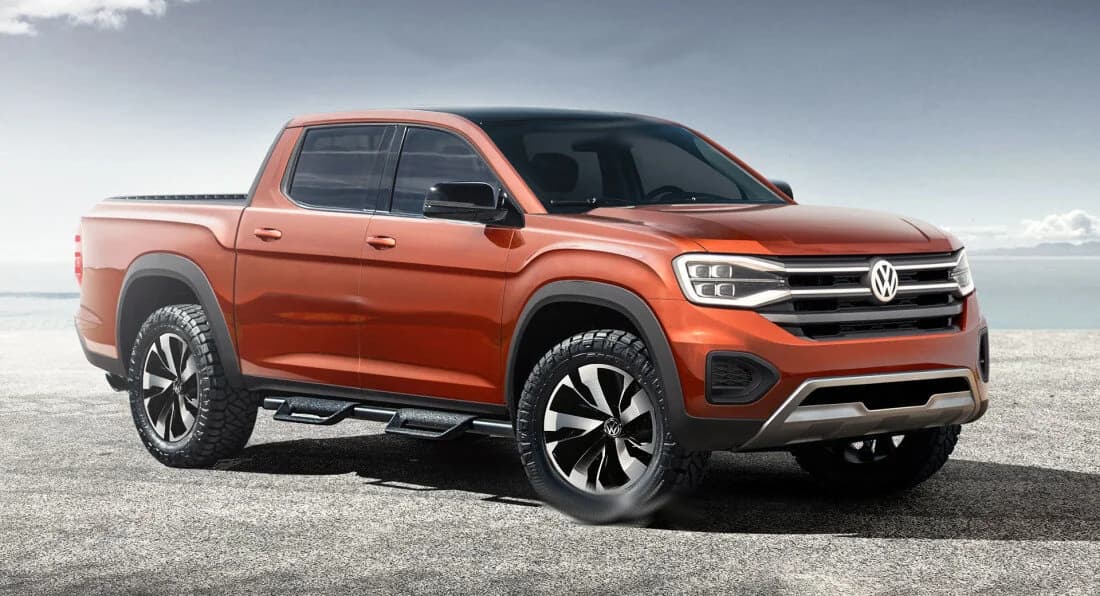
Design sketch previously published by Volkswagen for the Amarok family; it does not represent the final shape of the 2027 South American model. Photo: Volkswagen
The new Volkswagen Amarok appears in first images. The hybrid pick-up will launch in 2027
Volkswagen has presented in Brazil a camouflaged prototype of the new-generation Amarok for South America. The pick-up will enter production in 2027 at the General Pacheco plant in Argentina and will use electrified propulsion.
The vehicle shown at Festa do Peão de Barretos still wears camouflage film, so the final shape of the grille, lights and bumpers cannot be fully assessed. The images do, however, confirm proportions different from those of the current South American Amarok and a new front light signature.
An Amarok separate from the model sold in Europe
The new vehicle is not the direct successor of the Amarok pick-up now sold in Europe. The European model is built in South Africa on the same architecture as the Ford Ranger, and Volkswagen has said the existing production partnership will continue for international markets.
The project shown in Brazil was developed specifically for South America. It will replace the first-generation Amarok, which continues to be built in Argentina after the 2024 update.
Volkswagen will therefore temporarily have two different Amarok families:
- the global model based on the Ford Ranger, available including in Europe;
- the new South American model, produced in Argentina and developed with technology from SAIC.
Volkswagen has not announced sales of the South American version in Romania or the rest of the European Union.
SAIC technology, Volkswagen design and tuning
The German manufacturer has not yet published the platform or a full technical sheet. Volkswagen Argentina has, however, confirmed cooperation with the Chinese group SAIC, its industrial partner in China for several decades.
Prototypes photographed during testing have proportions and body elements close to the Maxus Interstellar X, also known on some markets under other commercial names. The Brazilian motoring press reports that this model’s platform will form the basis of the future Amarok.
Using a shared architecture does not mean Volkswagen will only change the badges. The company says the new pick-up is being developed and designed in South America. Steering, suspension, software, driver-assistance systems and finishes can be calibrated separately for the region’s roads and customer requirements.
Volkswagen confirms electrification, not power figures
At the prototype presentation, Volkswagen confirmed that the new Amarok will be electrified and will become the most powerful version in the model’s history. The company has not communicated the exact type of hybrid system, battery capacity, electric range or total power.
Reports that the range-topping version could be named Amarok 800 TSI, could exceed 470 hp and could deliver around 800 Nm come from the Brazilian press. Those figures should not be treated as final specifications until Volkswagen confirms them.
The current generation’s V6 turbodiesel is also not confirmed for the new vehicle. A move to a hybrid assembly would be a significant change for South American customers, where the 3.0-litre engine is one of the current Amarok’s main commercial arguments.
Investment of about €500 million in the Argentine plant
Volkswagen has allocated the equivalent of about €500 million to product development and the modernisation of the General Pacheco plant. The sum covers new production technologies, digital processes and work on the factory’s infrastructure.
The Amarok has been assembled at Pacheco for more than 15 years. At the time of the April 2025 announcement, Volkswagen indicated more than 770,000 units produced there.
Production of the new generation is scheduled to start in 2027. The Brazilian press points to the first quarter of the year for the commercial launch, but Volkswagen has not yet published an exact date.
What the prototype images show
Compared with the initial sketch, the camouflaged example shows a high bonnet and a front end split on two levels. Daytime running lights sit high, and the main headlamps sit lower. A light bar appears to link the lamps to the central emblem.
The profile and rear end point more directly to the Maxus model used as a starting point. Volkswagen can still change exterior panels and details until the production version is presented.
The interior has not been officially revealed. Information about three screens, including one for the passenger, also comes from press reports and is not confirmed by the manufacturer.
What it means for the Romanian market
For now, the new Amarok in the images is not a model intended for Romania. European customers have access to the current generation produced on the Ford Ranger basis, with a different technical range.
The South American project remains relevant to Volkswagen’s strategy. It shows how the manufacturer uses different alliances by region: Ford for the global Amarok and SAIC for the pick-up built in Argentina.
Any expansion into Europe would require homologation for EU rules, a service network prepared for the new hybrid system and a separate commercial decision. Volkswagen has not announced any of those steps.
Sources
- Volkswagen Newsroom — official announcement of the new Amarok generation for South America
- Volkswagen do Brasil — investments for the new Amarok and production in Argentina
- Motor1 Brasil — presentation of the camouflaged prototype in Barretos
- Motor1 — images and available information on the 2027 Volkswagen Amarok