Images: Peugeot/Stellantis Media official press material.
Peugeot E-208 GTi launches with 280 hp and 375 km WLTP
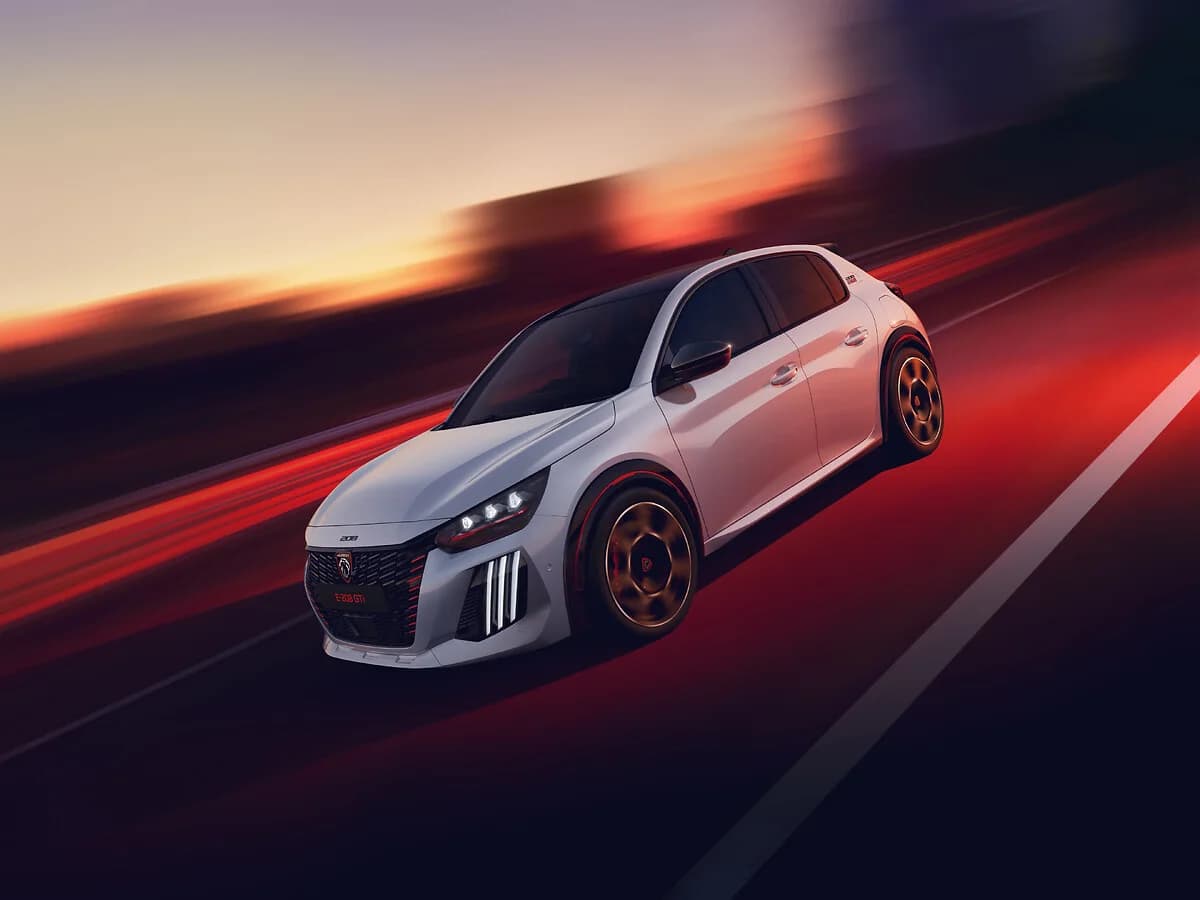
The Peugeot E-208 GTi has entered its European commercial phase as the brand's first fully electric GTi. The production car delivers 207 kW (280 metric hp) and 345 Nm, reaches 100 km/h in 5.5 seconds and offers up to 375 km on the combined WLTP cycle when fitted with its efficiency-focused Hankook tyres. French pricing starts at €42,900; prices and delivery timing remain market-specific.
Those are the final figures announced in June 2026, rather than the provisional numbers used when Peugeot first showed the car. The manufacturer improved the claimed acceleration by 0.2 seconds and now publishes two WLTP range values because the tyre choice materially changes efficiency. It is a useful distinction for a car expected to work both as a daily B-segment hatchback and as a performance model.
A familiar battery, with different priorities
The front-mounted M4+ motor is built in Trémery, eastern France, by E-Motors, the joint venture between Stellantis and Nidec Leroy-Somer. Peugeot Sport revised the power electronics and control software. Official output is 281 PS—equivalent to approximately 207 kW or 280 metric horsepower—with 345 Nm of torque.
Peugeot quotes 5.5 seconds from 0 to 100 km/h, 3.2 seconds from 80 to 120 km/h and 25.8 seconds for the standing kilometre. Top speed is electronically limited to 180 km/h. These are manufacturer figures, not Carboratory test results, and Peugeot has not supplied an independent timing method with the release.
The 54 kWh gross, 51 kWh usable battery is shared in capacity with the regular E-208, but its thermal strategy has been changed for sustained high-load driving. Coolant flow is managed according to temperature so that the system can avoid power reduction during repeated acceleration or a long climb. That is Peugeot Sport's stated engineering objective; only repeatable road and track testing can establish how consistently the car achieves it in hot weather or at a low state of charge.
With the no-cost Hankook Ventus S1 evo3 tyre option, the official combined range reaches 375 km WLTP. Standard Michelin Pilot Sport 4S tyres lower it to 352 km. The 23 km difference is a transparent illustration of the trade-off between rolling efficiency and the grip expected from a hot hatch. Neither figure predicts motorway range or winter use without adjustment for speed, temperature and cabin heating.
Hardware changes beneath the GTi details
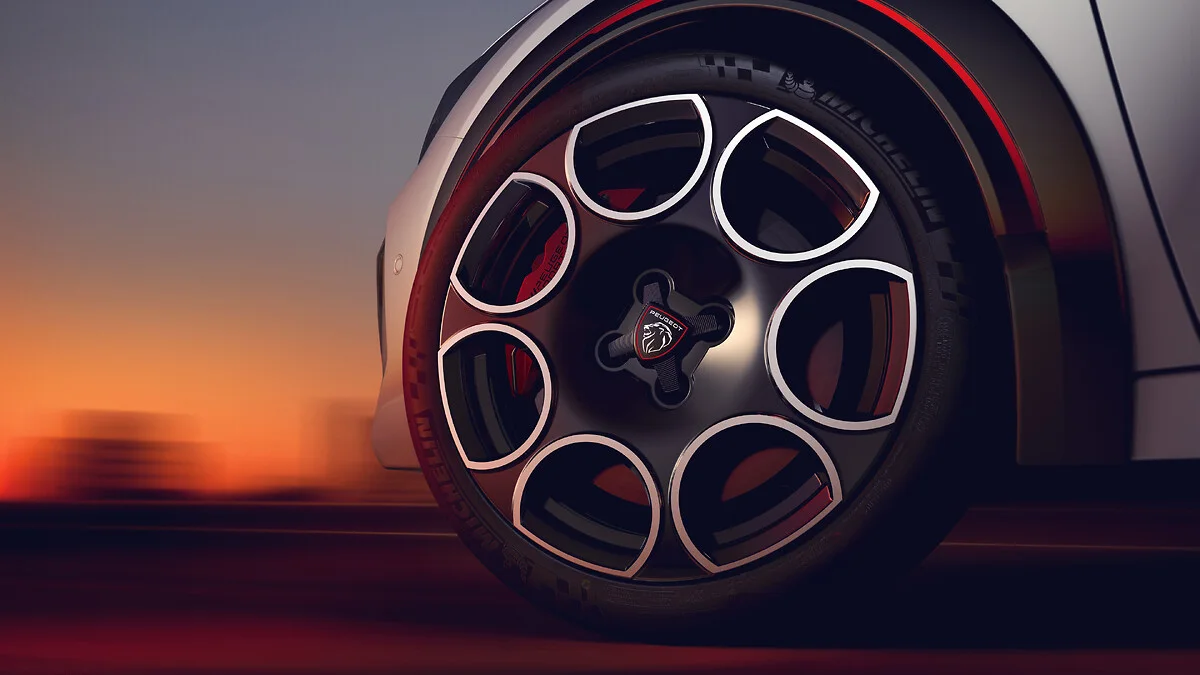
The 18-inch wheel reveals a fixed four-piston front caliper. Image: Peugeot/Stellantis Media.
Peugeot Sport lowered the body by 25 mm and widened the tracks by 56 mm at the front and 28 mm at the rear. The 18-inch wheels carry 215/40 R18 tyres and visually reference the perforated wheels of the 205 GTi. A 31 mm rear anti-roll bar has been added while the original 17 mm front bar is retained, indicating that the chassis balance—not merely roll stiffness—was a central development target.
Specific springs, dampers with hydraulic bump stops and a mechanical limited-slip differential integrated into the reduction gear complete the main changes. The differential matters on a front-wheel-drive EV with instant torque because it can direct drive to the tyre able to use it, rather than relying only on selective braking. Peugeot has therefore altered the way the car deploys power, not simply its throttle map.
Front braking is handled by 355 mm discs and fixed four-piston calipers. The rear brakes remain those of the standard E-208. Stability control gains a Sport calibration, and regenerative braking is disabled in that mode to give the driver a more conventional and repeatable response during hard driving. The release does not claim unlimited stability-control deactivation for public-road use, so “Sport” should not be read as the absence of every electronic safeguard.
The cabin mixes 205 references with current connectivity
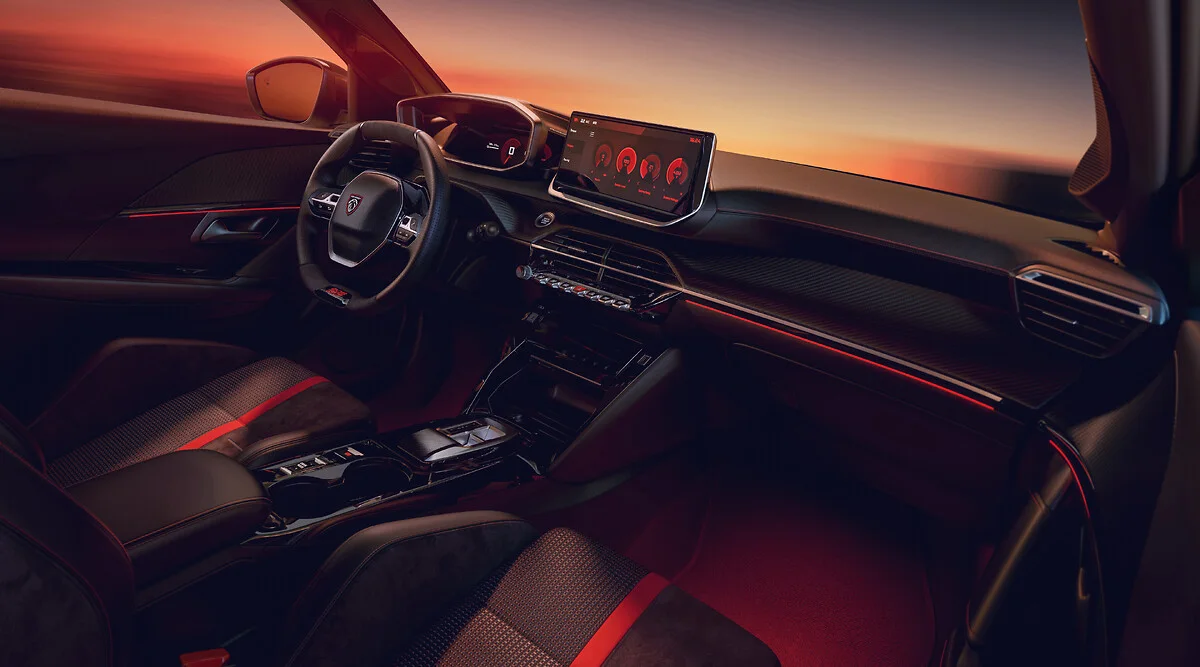
The GTi cabin uses dedicated seats, a compact steering wheel and red performance displays. Image: Peugeot/Stellantis Media.
Inside, the i-Cockpit layout is retained but paired with front seats that have integrated head restraints, prominent lateral support and a red centre strip. Their pattern refers to the 205 GTi 1.6 and 1.9 without recreating the older car's sparse interior. Red carpets, belts and stitching extend the theme, while the compact steering wheel combines perforated leather and Alcantara.
The digital instrument panel and centre display receive GTi pages and a red default theme. A synthesised sound linked to motor speed can be enabled or switched off. Standard technologies listed by Peugeot include connected TomTom navigation, wireless Apple CarPlay and Android Auto, a connected route planner, the MyPeugeot app and vehicle-to-load functionality for external electrical devices.
At 7.4 kW AC, a full charging session is quoted at 4 hours 40 minutes. A 100 kW DC charger can take the battery from 20% to 80% in less than 30 minutes. The peak charging rate is not remarkable beside newer 400- or 800-volt EVs, although the modest battery capacity keeps the stated stop below half an hour. Charging curves and cold-weather preconditioning behaviour were not detailed in the announcement.
Price, warranty and what is still unknown
Peugeot opened French orders from €42,900 including local taxes, while individual European subsidiaries publish their own prices and specifications. The Romanian model page, for example, confirms the car but still displays provisional 5.7-second and 350 km figures and does not show a retail price. That discrepancy is why a price from one country should not be presented as a Europe-wide or Romanian figure.
The company advertises Peugeot Care vehicle coverage of up to eight years or 160,000 km and a battery warranty with the same distance and time ceiling in Europe. Exact eligibility, servicing requirements and market application belong in the customer's local contract. Likewise, the availability of both tyre packages and the delivery schedule need confirmation from each national importer.
On paper, the E-208 GTi is more than an appearance package. Its mechanical differential, wider tracks, dedicated damping, stronger front brakes and revised battery cooling are measurable interventions. The unanswered questions concern real-world range, repeatable braking, steering feedback and how the chassis manages its mass on imperfect roads. Those points, rather than the historic badge alone, will decide whether Peugeot has built a convincing electric successor to its small GTi line.