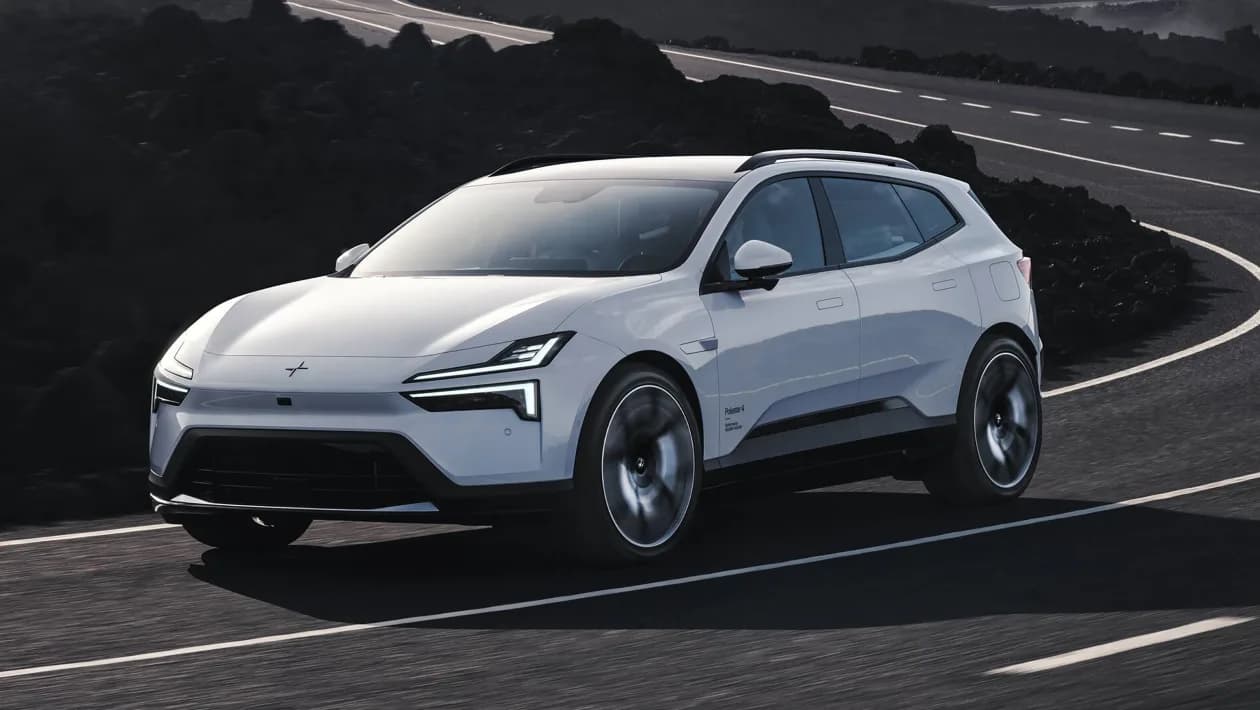
The new SUV version keeps the frontal identity of the Polestar 4, but gets a more practical body. Photo: Polestar
Polestar 4 gets an SUV version with a rear window and up to 630 km of range
Polestar is expanding the 4 range with an SUV version that restores a conventional rear window, enlarges the boot and quotes up to 630 km of WLTP range. The new derivative does not replace the current Polestar 4 coupé, known for its fully closed rear and an interior mirror fed by a video camera. The two bodies will be sold in parallel.
The company opened orders on 2 September 2026 in selected markets, and the commercial introduction is scheduled for the last quarter of the year. Polestar has not so far confirmed official sales in Romania, nor a price for the local market.
The rear window returns, but the camera remains useful
The most important change is visible at the rear. The Polestar 4 coupé eliminated the rear window and sent the image from a roof-mounted camera to a digital mirror in the cabin. The solution freed headroom for rear passengers, but split the audience between those who value the camera’s field of view and those who prefer a direct optical view.
The Polestar 4 SUV has a conventional rear window, fitted in a more upright tailgate. The car keeps the light bar that crosses the rear, and the proportions are closer to a raised estate than to a coupé SUV. The layout also allows a luggage cover, a part that was not needed on the windowless variant.
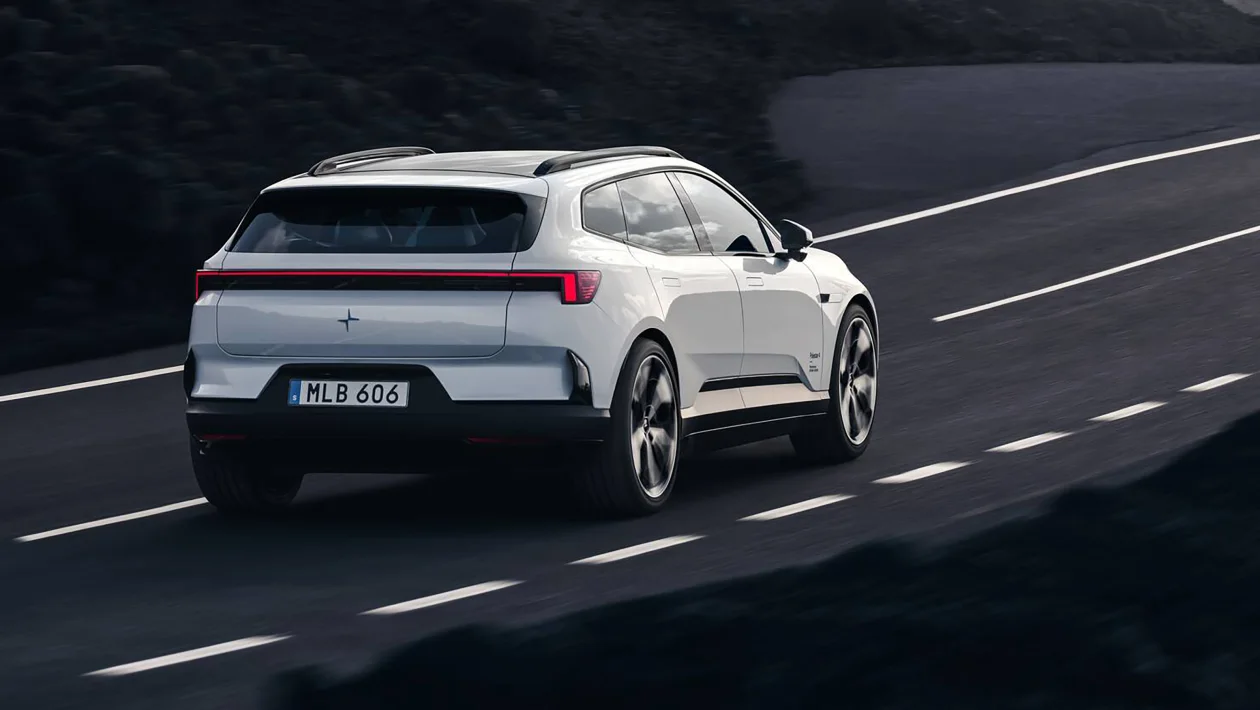
The more upright tailgate brings a rear window, extra luggage space and a retractable parcel shelf. Photo: Polestar
Almost the same dimensions, with more space at the rear
The new SUV measures 4,840 mm in length and 2,139 mm in width, figures almost identical to the coupé. The difference appears in height: the SUV is 22 mm taller, including thanks to the longitudinal roof bars fitted as standard. These can support a load of up to 100 kg, according to information presented at the debut.
The straighter roof shape adds 25 mm of headroom for rear passengers. The boot gains 30 litres with the bench in the normal position and reaches 655 litres when loaded to the roof. With the backrests folded, capacity rises to 1,665 litres, 129 litres more than the coupé.
Polestar says the transformation required only 48 new components. Besides the roof and tailgate, the SUV version gets its own wheel designs, with a diameter of up to 22 inches, and new colours. The electrochromatic panoramic roof can be darkened in zones, not only uniformly across the whole surface.
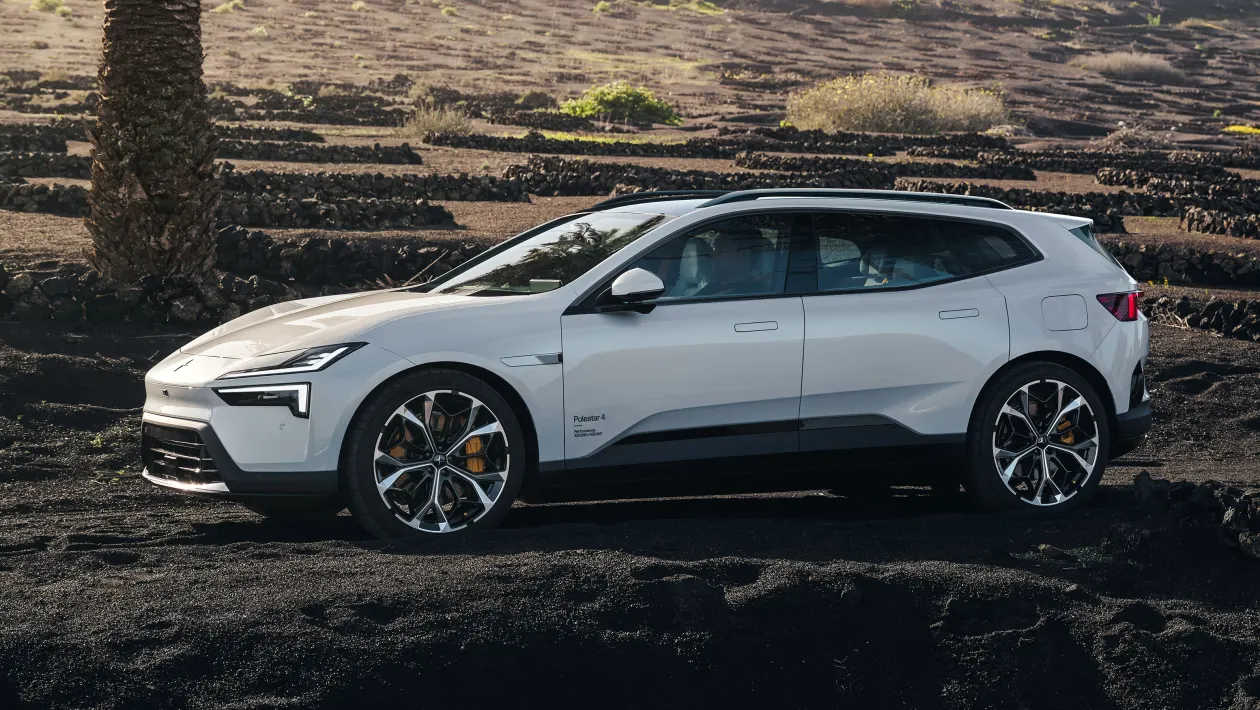
The profile shows the higher roof and the longitudinal bars fitted as standard. Photo: Polestar
100 kWh battery and a maximum of 630 km WLTP
The Polestar 4 SUV still uses the SEA platform and a 400 V electrical architecture. The battery has a capacity of 100 kWh, and optimisations to the pack and tyres allow the single rear-motor version to reach 630 km WLTP. The dual-motor all-wheel-drive variant quotes up to about 600 km WLTP.
DC rapid charging reaches 200 kW. In ideal conditions, the move from 10% to 80% takes about 30 minutes. That is a solid result for a battery of this size, although premium rivals with 800 V architecture, such as the BMW iX3, can accept noticeably higher peak power.
The range comprises two main configurations:
- Rear motor, with a motor on the rear axle and about 272 hp;
- Dual motor, with all-wheel drive and 544 hp.
The Dual motor version accelerates from 0 to 100 km/h in 3.9 seconds. The Performance pack adds recalibrated ZF dampers, Brembo brakes and Pirelli P Zero tyres. Polestar has also made small chassis-calibration changes to account for the different shape and mass of the new body.
More radars for assistance functions
The sensor layout changes compared with the coupé. The new SUV uses five cameras and five radars, instead of the 12 cameras and single radar on the existing version. The company considers that the new arrangement can work more robustly when sensors are dirty or weather reduces visibility.
This change is not equivalent to a promise of autonomous driving. Final capabilities depend on software, homologation and equipment in each market, and Polestar has not yet detailed all the functions that will be active at the first European deliveries.
Familiar interior, with Google Gemini and a V2L function
The dashboard remains close to that of the current Polestar 4. The central screen gets nine shortcuts, versus six previously, and the Google Gemini assistant is integrated for voice interactions. The Harman Kardon audio system available for the SUV has 12 speakers and a declared output of 1,400 W.
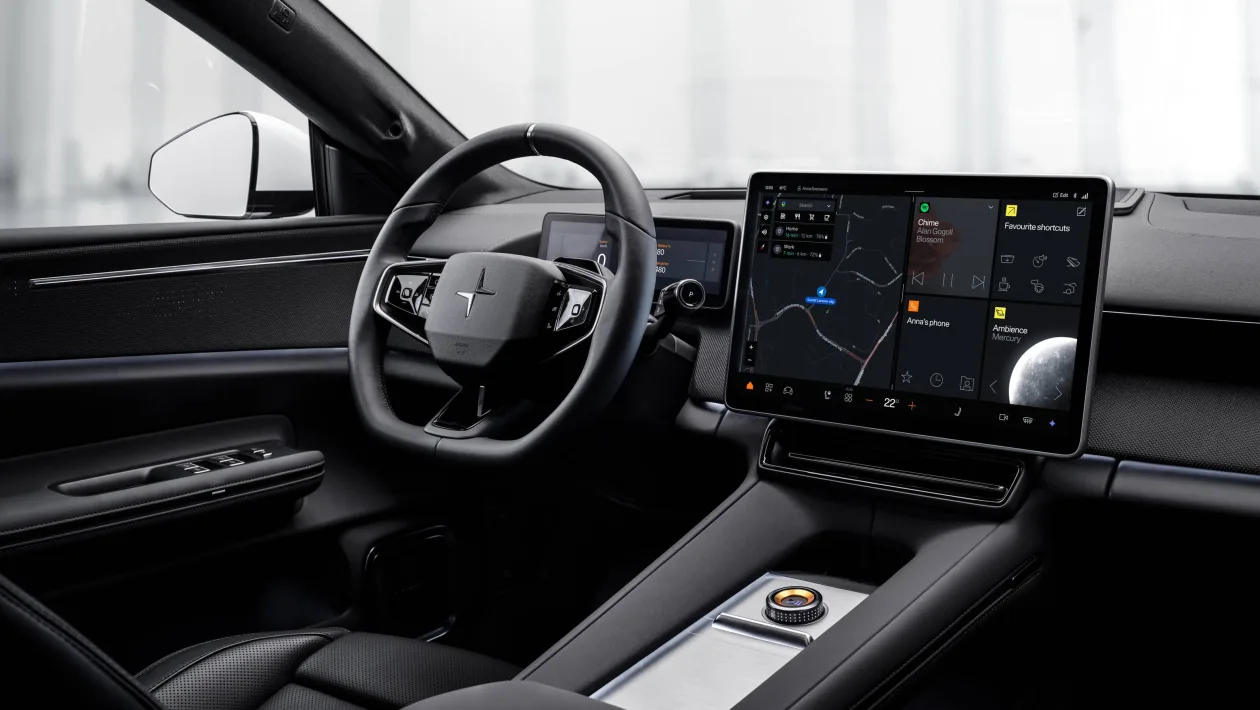
The cabin keeps the large central screen and digital instrument cluster of the coupé version. Photo: Polestar
The SUV also introduces the Vehicle-to-Load (V2L) function to the Polestar 4 family. Through a compatible adaptor, energy from the high-voltage battery can power electrical appliances. A dedicated camping mode keeps climate control and the screen active for longer periods when the car is parked. Polestar intends to offer V2L later on the coupé variant as well.
Upholstery options include MicroTech and a 3D knitted material made 89% from PET waste. Leather remains optional, and the company says suppliers must meet its own animal-welfare requirements.
Production in South Korea, uncertain availability in Romania
Polestar officially confirms that the new Polestar 4 SUV is produced in Busan, South Korea, and that it will be offered in most markets where the brand operates. The company does not, at the time of writing, have an official commercial structure for new passenger cars in Romania.
For a Romanian buyer, that means prices announced in other countries cannot be treated as local prices. Any purchase through import requires checking the warranty, service availability, connectivity and compatibility of digital functions in Romania.
The new derivative resolves the most discussed peculiarity of the coupé without abandoning the original idea entirely. Those who prefer the radical design and video mirror can still choose the Polestar 4 coupé; those who need a direct view, a larger boot and a higher roof now get the SUV alternative.