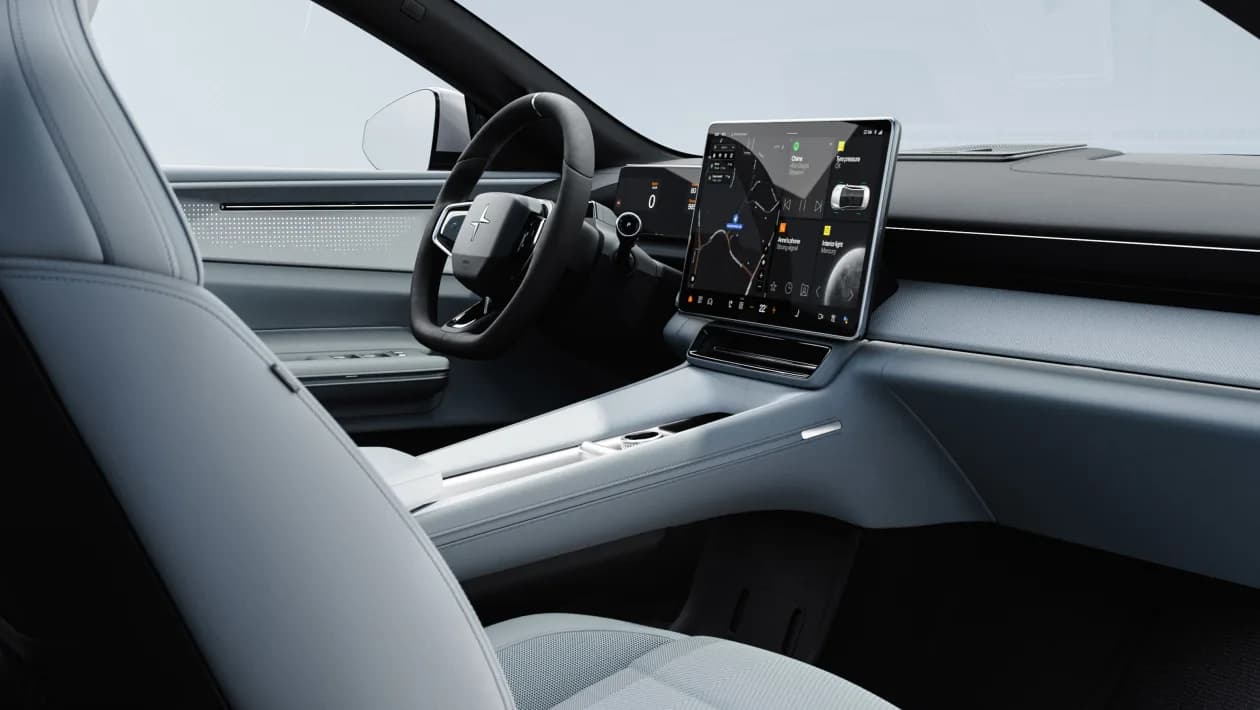
The Polestar 4 moves the adjustment of several everyday functions into the central screen. Photo source: Polestar
Polestar 4 after months of use: range convinces, digital controls complicate daily life
A Polestar 4 Long Range Dual Motor used long-term by British journalist Paul Horrell has gone through the journeys and charging sessions reported up to August 2026 without major incidents. The criticism is not aimed at the electric system, but at the way some simple operations have been transferred to electric motors, menus and contextual controls.
In the sixth report published by Top Gear, the author lists five functions he considers harder to use than conventional solutions: retractable handles, keyless access without buttons on the key, mirror adjustment, the video rear-view mirror, and vents controlled from the screen.
The experience belongs to a single car and a single driver, so it is not a reliability study. It is relevant, however, for a buyer who wants to know how the interface behaves after the novelty of the first days has worn off.
Real-world range of about 467 km
The test car is the dual-motor version, with a 100 kWh battery and all-wheel drive. Horrell says he obtains about 467 km between charges in his use and that he has not yet encountered a failed charging session.
The reported figure is below the official WLTP range of up to 590 km, which is common in real-world use. Temperature, speed, route, climate control, tyres and driving style all affect consumption. The report does not offer a controlled protocol, so the 467 km should be read as personal experience, not as range guaranteed for every owner.
Polestar states for the Dual Motor version a power output of 400 kW (544 hp), torque of 686 Nm and 0–100 km/h acceleration in 3.8 seconds. The front motor can be disconnected when it is not needed, to reduce consumption.
| Official specification | Polestar 4 Long Range Dual Motor |
|---|---|
| Battery | 100 kWh, 400 V architecture |
| Power | 400 kW / 544 hp |
| Torque | 686 Nm |
| WLTP range | up to 590 km |
| DC charging | up to 200 kW |
| 10–80% charging | 30 minutes in optimal conditions |
| 0–100 km/h | 3.8 seconds |
1. Retractable handles do not always respond as the driver expects
The door handles extend electrically from the bodywork when the driver approaches. In the reported experience, the system does not respond every time, and touching the dedicated area can bring the handle out. A second accidental touch can retract it just as the user tries to open the door.
The situation becomes less intuitive when the driver stops to pick up a passenger. The doors must be unlocked from the control on the driver’s door for the exterior handles to become accessible. A conventional handle would remove this sequence, even if it would be less aerodynamically efficient.
2. The buttonless key does not quickly resolve a missed unlock
The Polestar 4 is meant to unlock automatically when it detects the key. The test author says the function works in most situations, but not always. The practical problem is that the remote has no buttons the driver can press immediately.
The alternatives are the card held against the pillar or the phone app. The app also allows remote access and can be useful when the car is lent out, but it requires setup and dependence on a phone. For an operation of a few seconds, the variety of digital solutions does not necessarily guarantee a faster fix.
3. The mirrors are adjusted through the steering-wheel controls
Polestar has removed the dedicated physical buttons for adjusting the side mirrors. The driver must enter the right menu, confirm the function, select the left or right mirror and then use the directional keys on the steering wheel.
The operation is not frequent after the driving position has been set, but it returns when parking or when several people use the same car. In the test, both mirrors dropping automatically in reverse creates an extra situation: to raise only the traffic-side mirror, the driver must go back into the menu.
4. The rear camera does not offer the same perception as a mirror
The Polestar 4 has no rear window. Instead of a conventional rear-view mirror there is a screen that displays images from a camera mounted at the rear. The solution maintains visibility even if the rear seat is occupied or the boot is loaded to the roof.
Horrell notes three limits, however: the image does not offer binocular depth perception, it can be affected by direct light, and it requires the eyes to change focus compared with looking at the road. For that reason, the author ends up using the side mirrors more than in a car with a rear window.
The reaction can vary from one driver to another. A test before purchase should include parking, lane changes and night driving, not just a short trip in light traffic.
5. Airflow direction is changed from the screen
The vents have electric mechanisms, and airflow direction is adjusted by swiping on the screen. The advantage is that the position can be stored in the driver’s profile, along with the seat and mirrors.
The drawback appears when the flow needs to be corrected on the move. The driver reaches for the screen, watches the interface respond and then checks whether the air is arriving in the desired direction. A vane operated directly allows the same change without a menu and without visual confirmation.
What the test actually says about the Polestar 4
The report does not conclude that the Polestar 4 is an unsuccessful car. On the contrary, the author notes that he appreciates the car as a whole and that range and charging meet his needs. The dissatisfaction is about the gap between the technical ability to automate a function and the usefulness of that automation in daily life.
For a buyer, the practical conclusion is simple: battery specifications and power are not enough to evaluate a modern electric car. Handles, the key, rearward visibility, mirror adjustment and climate control should be tried repeatedly in a test drive. They are functions used more often than maximum acceleration and can shape the daily experience for the entire period of ownership.