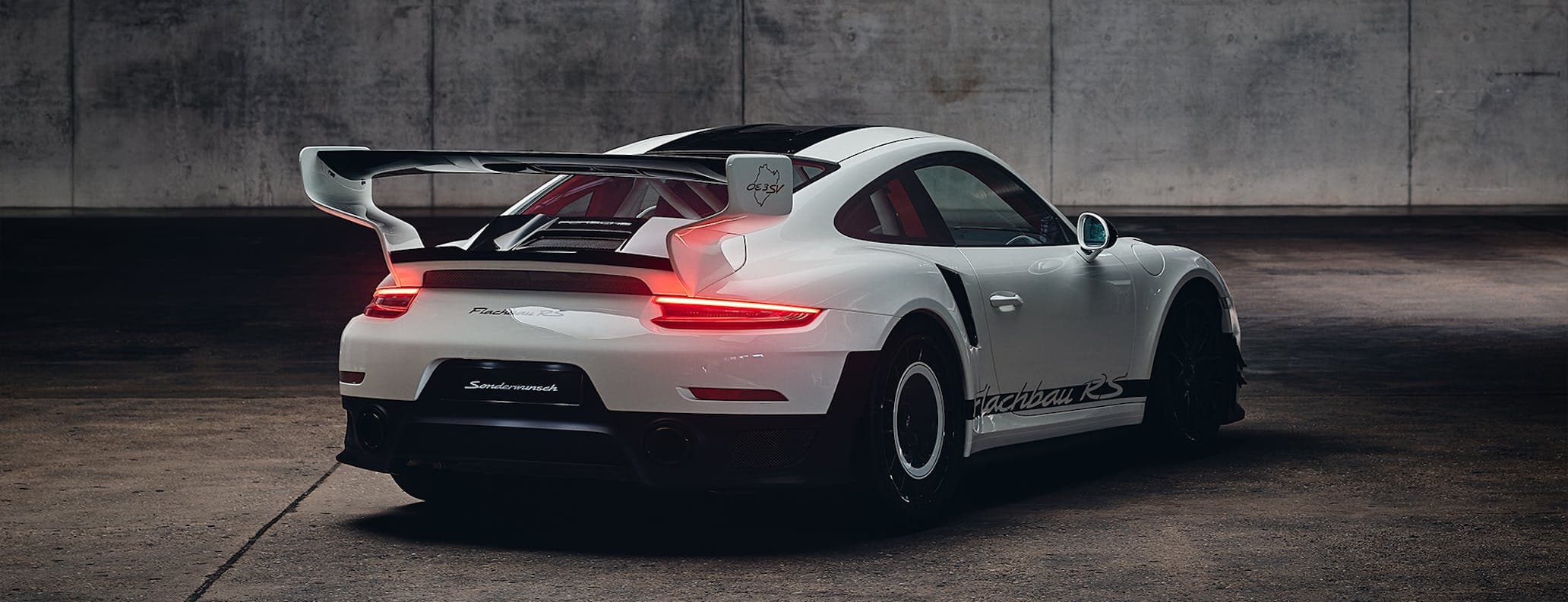
The Porsche 911 Flachbau RS is a Sonderwunsch project built as a single example. Photo source: Porsche AG
Porsche 911 Flachbau RS brings back the “flat nose” in a one-off of 700 hp
Porsche has presented the 911 Flachbau RS, a car built as a single example for a customer of the Sonderwunsch programme. The project starts from a 911 GT2 RS of the 991.2 generation, built in 2018 and fitted with the Weissach package, but it receives new bodywork inspired by the 935/78 “Moby Dick” racing car.
The Flachbau RS is homologated for use on public roads. It is not a limited edition available to order, nor a confirmed indication that Porsche is preparing a production version with the same name.
What Flachbau means
“Flachbau” can be translated as “flat construction” and refers to the low shape of the front end. In the 1980s, Porsche offered through its special-order programme a conversion for the 911 Turbo, with flattened wings and pop-up headlamps in place of the usual round lights. The company says it sold 948 such conversions between 1982 and 1989.
The historical reference is the Porsche 935, the racing car derived from the 911 Turbo. The 935/78 variant received the nickname “Moby Dick” because of its white, very elongated, aerodynamically optimised bodywork. The customer for the current project asked both for the Flachbau silhouette and for a rear wing close to that of the 911 GT3 R rennsport.
The round headlamps have been replaced with slim LED units
The front end was redesigned, not merely covered with different panels. The wings are lower and include vents to extract air from the wheel arches. Their shape forced engineers to modify even the fuel-filler cap and its mechanism, and the front bumper is entirely new.
In place of the 911 GT2 RS’s round headlamps there are three stacked LED units on each side, for dipped beam, main beam and daytime running lights. The dipped-beam and main-beam units are each less than four centimetres high, and the daytime running lights measure under two centimetres.
The body is painted in Grandprixweiß, a shade introduced by Porsche in 1974 and recreated for this project from a historic 911 in the company’s collection. Matt-black areas and exposed carbon fibre outline a U-shaped motif on the bonnet, taken from the graphics of the 935/78.
Aerodynamics developed with Manthey
The Flachbau RS uses components derived from the Manthey package, including the front splitter, the floor structure, the diffuser and the aerodynamic discs fitted to the rear wheels. The rear wing has S-shaped mounts and is inspired by the 911 GT3 R rennsport, but sits about five centimetres higher.
The wing angle can be adjusted manually in three positions. Porsche states that, at 340 km/h and in the maximum-downforce configuration, the rear axle generates 554 kg of vertical aerodynamic force. Compared with a GT2 RS with the Manthey package and an equivalent wing position, the difference is 2% in the high-downforce setting and 3% in the low-downforce setting.
The 700 hp engine remains standard
The engine has not been modified. The Flachbau RS keeps the 3.8-litre twin-turbo boxer of the 911 GT2 RS, with 700 hp, a PDK transmission and rear-wheel drive. Porsche quotes a top speed of 340 km/h, identical to the figure associated with the base car.
The team instead reduced mass by 31.6 kg compared with a GT2 RS with the Weissach package. The PCM multimedia system, the audio installation, some of the sound-deadening materials and several carpets were removed. Wiring remains visible behind the seats, and the exposed metal is painted in the same white shade as the exterior.
Items required for road use, such as the warning triangle and the towing eye, are kept in a removable box. The owner can take it out quickly when using the car on track.
Three prototypes and 50 laps of the Nordschleife
Development lasted almost three years and involved the Sonderwunsch departments, Style Porsche, Porsche Motorsport, engineers in Weissach and Manthey specialists. Changing the front structure and fitting the large wing required impact simulations, airbag-function checks, structural analyses and aerodynamic calculations.
Porsche built three test cars. The programme included the wind tunnel, the track at Mendig, durability tests at Weissach and 50 laps of the Nürburgring Nordschleife. The company says the loads applied to the rear wing during validation equated to about 150,000 km of use, and the car covered more than 1,000 km on the Nordschleife.
Porsche also mentions laps completed in less than seven minutes, but it does not publish an official time, the timing conditions or a homologated record attempt. The information describes the pace of testing, not a result that can be compared directly with official circuit rankings.
How much the Porsche 911 Flachbau RS costs
Porsche has not disclosed the price paid by the customer. The Factory Re-Commissioning programme within Sonderwunsch involves an individual assessment of each project, and the cost depends on the development and parts required.
The plaque on the dashboard, inscribed “Factory One-Off 2026 | Flachbau RS”, confirms the car’s status: there is a single example. Although Porsche registered the names “Flachbau” and “Flachbau RS” in 2025, the 2026 presentation ties them to this particular project; the company has not announced production of further units.