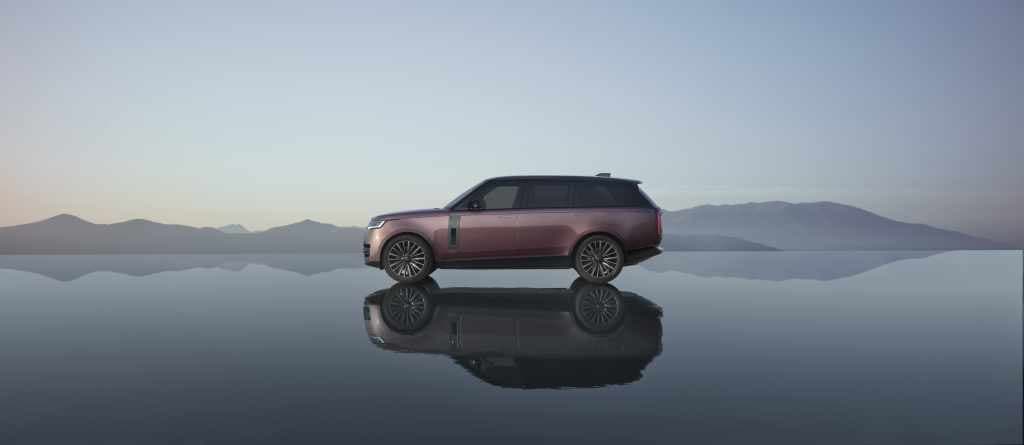
Range Rover Electric keeps almost the same silhouette as the combustion versions. Photo: Range Rover/JLR
The first electric Range Rover has 550 hp, 600 km of range and 350 kW charging
Range Rover has presented the first fully electric version of its flagship model. The new Range Rover Electric EV550 has two motors, all-wheel drive, a usable battery of 118.5 kWh and a homologated range of up to 600 km WLTP.
Orders opened in several markets on 2 September 2026, and production is taking place at Solihull, in the United Kingdom, on the same MLA-Flex architecture used by the mild-hybrid, plug-in hybrid and combustion versions. Price and configurations for Romania have not been announced.
Two motors and 850 Nm
Each axle gets a 260 kW permanent-magnet electric motor. Combined system output is about 405 kW, equivalent to 550 hp, and peak torque reaches 850 Nm in Dynamic Launch mode and in the modes for rough terrain.
JLR quotes 0-60 mph in 4.3 seconds. The manufacturer did not publish a standardised 0-100 km/h time in the European press material, so the US figure should not be treated as an exact equivalent.
The motors are produced in-house by JLR and use silicon-carbide semiconductors. The system can vary torque distribution on the rear axle between 0% and 100%, and traction control reacts in about 50 milliseconds.
118.5 kWh battery and up to 600 km WLTP
The pack has a usable capacity of 118.5 kWh and comprises 344 prismatic NMC cells, arranged on two levels. Range Rover quotes up to 600 km in the WLTP cycle and estimates real-world range of up to 535 km on its standardised route.
The gap between the two figures matters. The 600 km figure is a homologation value, useful for comparison with other models tested under the same procedure. Range on the road depends on speed, temperature, load, wheels, terrain and the energy used by climate control.
The ThermAssist system manages the temperature of the battery, motors and cabin. JLR says it can cut energy used for heating by up to 40% and add up to 40 km of range in certain conditions. Those figures come from the manufacturer's tests, not from an independent evaluation.
10-80% charge in 22 minutes
The electrical architecture runs at 800 V, and peak accepted power at a DC rapid charger is 350 kW. In optimal conditions, the battery can be charged from 10% to 80% in 22 minutes. Ten minutes at peak power can add up to 220 km of WLTP range.
On alternating current, the 22 kW onboard charger can take the battery from 0% to 100% in about seven hours. At a 7 kW wallbox, the same operation takes about 19 hours.
The 350 kW and 22-minute figures describe the best-case scenario. Real power can drop depending on battery temperature and state of charge, the condition of the station and how energy is shared among posts at the same site.
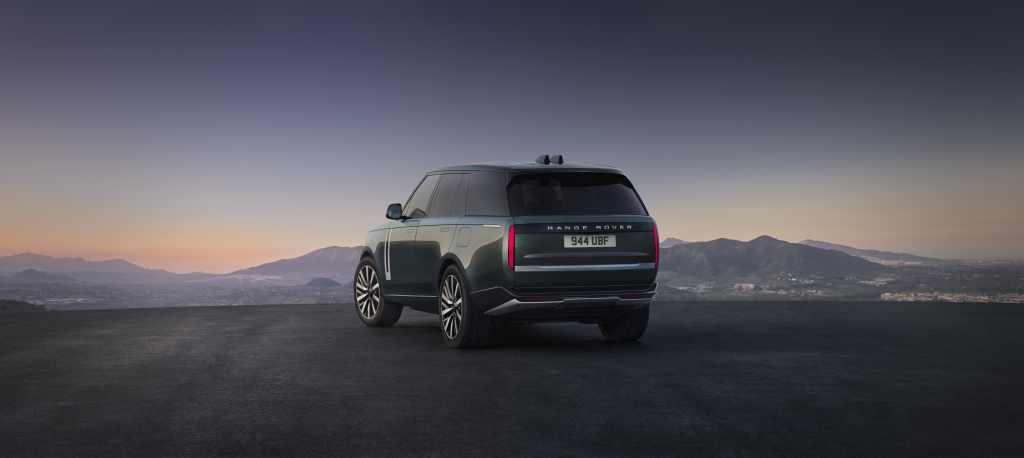
The electric version can be ordered with a standard or long wheelbase, depending on the market. Photo: Range Rover/JLR
Almost three tonnes, but it keeps its off-road ability
Range Rover Electric weighs about 2,885 kg in the standard-wheelbase configuration. The high mass is a consequence of the battery, the dimensions and the comfort equipment, even though the structure uses aluminium.
The dual-chamber air suspension and the lowered centre of gravity are calibrated to limit body movement. One-pedal driving works with Terrain Response and can stop the car without pressing the brake pedal, including on low-grip surfaces.
Wading depth reaches 900 mm, in the same order of magnitude as the combustion versions. The car can start on a 33-degree slope and continue climbing on gradients of up to 45 degrees, according to JLR tests.
These figures describe the vehicle's technical capacity; they do not recommend entering any watercourse. Depth, current, ground consistency and a safe exit must be checked before going in.
Design close to the current Range Rover
The electric version does not adopt an entirely different body. Visible changes are concentrated on the grille, wheels and the lower part of the car, where panels have been aerodynamically optimised.
The range includes standard- and long-wheelbase bodies, depending on the market, as well as SE, Autobiography, SV, SV Black and SV Ultra levels. There will also be a First Edition available in three colours: Belgravia Green, Santorini Black and Varesine Blue.
The cabin keeps the Pivi Pro interface and the layout known from the current Range Rover. Ultrafabrics and Kvadrat materials can replace leather on certain versions, and the active noise-cancellation system creates distinct acoustic zones for occupants.
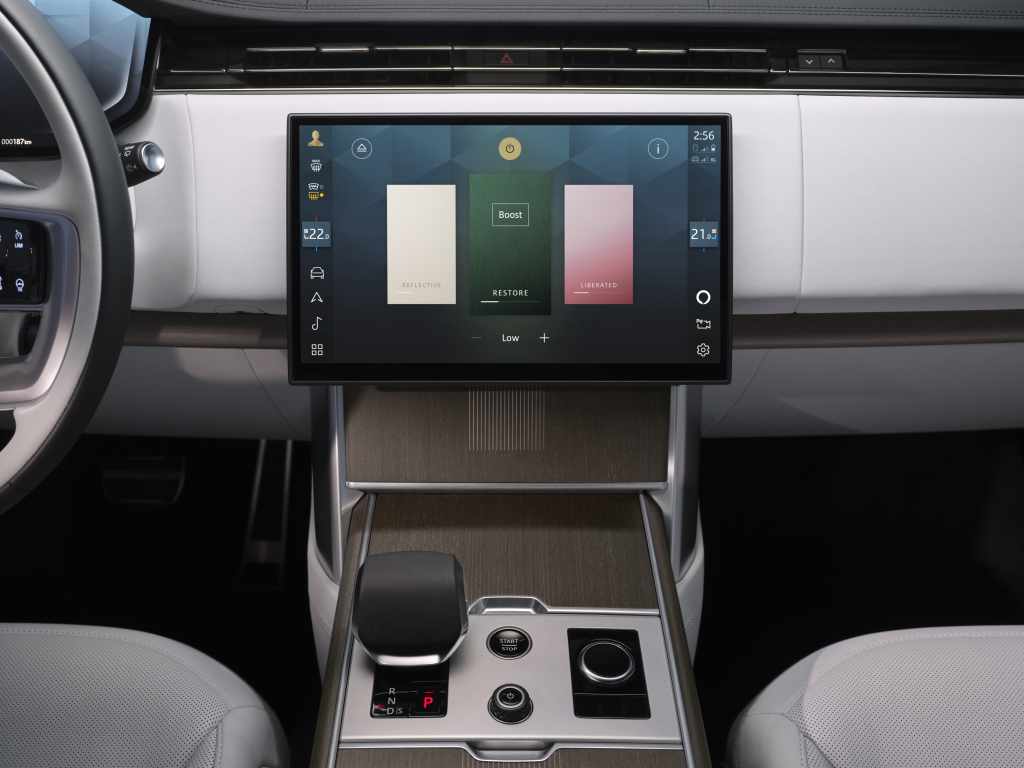
The interface includes information on charging, range and energy management. Photo: Range Rover/JLR
Eight-year battery warranty
The battery is covered for eight years or 160,000 km, whichever comes first. Exact conditions and the minimum capacity threshold can differ by market and will need to be checked in the local warranty contract.
JLR uses a system called Battery Digital Twin, which tracks more than 900 diagnostic parameters. Data and remote software updates allow some deviations to be identified before they cause a fault visible to the owner.
The model can supply up to 3.6 kW to external equipment through the vehicle-to-load function. Vehicle-to-grid compatibility, which would send energy into the grid, is planned for a later stage.
When Range Rover Electric arrives in Romania
JLR has opened orders in the United Kingdom, the United States and other markets, and the first cars are expected at dealers towards the end of 2026 or in 2027, depending on the region. The Range Rover Romania website does not yet display a price or a local configurator for the EV550.
Availability of the long-wheelbase body and SV versions differs between markets. The European price cannot be transposed directly to Romania because taxes, standard equipment and delivery costs are set locally.