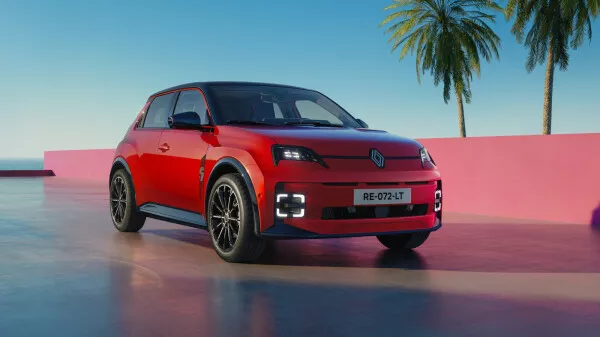
Renault 5 E-Tech electric in the new Flamme Red colour. Photo: Renault
Renault 5 gets more range and a base version with an LFP battery
The Renault 5 E-Tech electric is receiving a technical update less than two years after its commercial debut. Versions with 40 and 52 kWh batteries can cover more kilometres between charges, and the base Five variant will switch to a 36.5 kWh LFP battery and will be able to connect to DC fast chargers.
Renault has opened orders for the updated range in the European markets where the model is sold. Some of the new features will become available in the coming weeks, and the car will be displayed at the Paris Motor Show, scheduled for 12 to 18 October 2026.
Renault Romania’s website already displays the new ranges for the 40 and 52 kWh versions. The new LFP battery appears rounded to 37 kWh and is announced for orders towards the end of 2026.
Up to 430 km of WLTP range
Renault has redesigned the side mirrors and the lower body elements and has optimised the battery electronics. The capacity of the existing accumulators does not change, but certified consumption falls enough to increase range.
| Version | Motor | Previous range | New range |
|---|---|---|---|
| Urban Range, 40 kWh | 90 kW / 120 hp | 312 km WLTP | 315 km WLTP |
| Comfort Range, 52 kWh | 110 kW / 150 hp | 410 km WLTP | 430 km WLTP |
The difference is modest for the 40 kWh battery, just 3 km. The 52 kWh version gains 20 km and becomes the more suitable choice for trips outside the city if range is the priority.
The figures are obtained in the WLTP cycle. On the road, distance depends on temperature, speed, use of air conditioning and driving style. At motorway speeds or in winter, real-world range will be lower than the homologation figure.
LFP battery and fast charging for the Five version
The most important change is the new entry-level configuration. The current pairing of the 95 hp motor and the 40 kWh NMC battery will gradually be replaced by a more compact 80 kW / 110 hp motor and a 36.5 kWh LFP battery. Renault Romania presents it as a 37 kWh battery.
The accumulator uses cell-to-pack technology, in which the cells are integrated directly into the pack, without the intermediate module level. Renault indicates a range of up to 305 km WLTP and a time of 3.5 seconds for acceleration from 0 to 50 km/h.
Although the new battery has a lower capacity than the current 40 kWh pack, the Five version receives a practical feature that the base configuration did not offer: DC fast charging. Maximum power is 80 kW DC, and the onboard charger for alternating current is 6.6 kW.
LFP chemistry does not use nickel and cobalt in the cathode and is known for thermal stability and a long service life. The disadvantage versus NMC is lower energy density, which is why Renault uses the cell-to-pack architecture to limit the volume and mass penalty.
Gemini instead of the classic Google assistant
The OpenR Link multimedia system will be able to receive Gemini, Google’s artificial-intelligence assistant, through an optional over-the-air update. Renault says the driver will be able to make more natural requests, interrupt the answer and change language during the conversation.
The range also receives Smart driving mode, which replaces MySense. The car can switch automatically between Eco, Comfort and Sport depending on driving style. For example, it can select Sport during an overtaking manoeuvre and Eco after reducing speed. The modes remain accessible manually on the screen or by voice command, but the Multi-Sense button disappears from the steering wheel.
Renault includes 2 GB of data per month for three years for the applications installed in the car. The manufacturer estimates that the traffic is enough for up to 40 hours of music at standard quality or about three hours of video content.
A magnetic Qi2 wireless charger with cooling also appears in the cabin. According to Renault, it can restore up to 50% of a phone’s battery in one hour, avoiding overheating. The eCall system becomes compatible with 4G mobile networks.
New colours and options
The palette will include Flamme Red and Schiste metallic Grey, depending on equipment. Customers will be able to choose a Negru Étoilé roof, a red or Warm Titanium roof outline and new Vibrant5 and Hyper5 graphics.
The 18-inch Techno wheels optionally receive a gold finish on Techno and Iconic Cinq trims. The Iconic Cinq version’s upholstery will be mixed blue, instead of the yellow used until now.
What changes for buyers in Romania
At the time of publication, Renault Romania lists the Evolution 120 hp, 40 kWh version from €27,500, Techno with the same powertrain from €29,600, and the 52 kWh and 150 hp variants from €31,450 for Techno. The prices are those displayed by the configurator and can be changed through campaigns or options.
Renault has not yet published the local price of the new Five version with the LFP battery on the local website. The range page does confirm, however, that the approximately 37 kWh accumulator will be available to order towards the end of 2026.
For anyone who charges at home and uses the car mainly in town, the 36.5 kWh LFP battery can reduce the entry cost without dropping range below 300 km WLTP. For frequent trips between cities, the 52 kWh version remains more suitable through its 430 km range and DC charging of up to 100 kW.
Frequently asked questions
What is the maximum range of the new Renault 5?
The Comfort Range version with the 52 kWh battery reaches 430 km WLTP, compared with 410 km before the update.
What range does the Renault 5 with the LFP battery have?
Renault announces up to 305 km WLTP for the 36.5 kWh LFP battery, called 37 kWh on the Romanian website.
Does the new base version have fast charging?
Yes. The Renault 5 Five with the LFP battery will have charging at 80 kW DC and 6.6 kW AC.
When can it be ordered in Romania?
Renault Romania indicates availability for orders towards the end of 2026. The local price of the updated Five version has not yet been displayed.