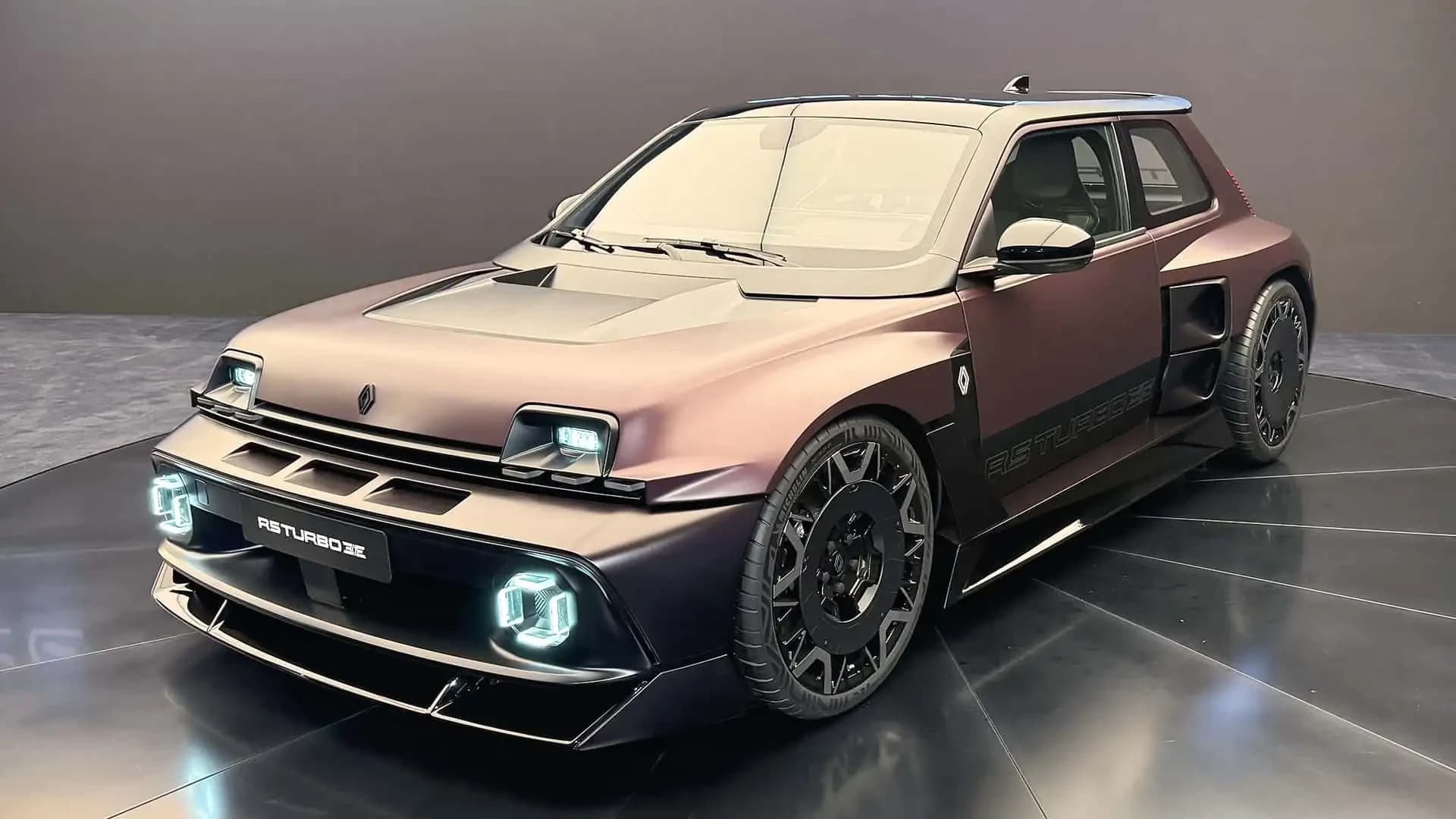
Renault has reportedly secured more than 1,000 orders for the electric 5 Turbo 3E, according to reporting from Motor1. That would put more than half of the planned 1,980-car production run in customers’ hands on paper, even though deliveries are not scheduled until 2028. The figure was discussed around the 2026 Paris Motor Show and should be understood as a reservation or priority-order count rather than proof that every car has completed its final retail contract.
A limited production run
Renault plans to build 1,980 numbered examples. The number refers to 1980, the year when the original Renault 5 Turbo was launched. The new car is not a conventional high-performance version of the current Renault 5 E-Tech. It is a two-seat, rear-wheel-drive electric model developed around a dedicated platform and a much more expensive purchasing process.
Renault’s reservation system initially asked customers to pay €50,000 for priority access. The brand announced an introductory recommended price of €155,000 including VAT for the first 500 priority signatories, excluding options, accessories and personalisation. More recent Renault material lists a provisional recommended price from €160,000, subject to change when sales open. These figures are not the final price of every car.
The distinction matters because the Turbo 3E is being sold as a highly personalised, made-to-order product. Renault says customers will be able to choose exterior colours, interior materials and other finishes. The company has set up dedicated locations around Paris where customers can work through the specification with the brand’s design team.
Personalisation could push some cars beyond €350,000
Motor1 reports that Renault CEO François Provost expects some fully personalised examples to cost more than €350,000. That is an estimate for extensively configured cars, not a published base price. It also shows why the number of orders alone cannot be used to calculate the model’s revenue or the average transaction value.
The full personalisation programme is planned for mid-2027. Renault has said that the first deliveries are scheduled for 2028, after further development and final homologation. Until that process is complete, some technical and commercial details can still change. Renault’s own material marks the vehicle’s specifications as subject to change before homologation.
Electric performance in a compact body
The 5 Turbo 3E uses two electric motors mounted inside the rear wheels. Renault quotes a combined output of 555 horsepower, or 410 kW, and 4,800 Nm of torque at the wheels. The company estimates a 0–100 km/h time of less than 3.5 seconds and a 270 km/h top speed on a circuit.
A 70 kWh battery sits in an 800-volt electrical architecture. Renault’s projected WLTP range is above 400 km, pending homologation. DC charging is rated at up to 350 kW, with a claimed 15-to-80 percent time of around 15 minutes when the car is connected to compatible infrastructure.
Renault lists an approximate unladen mass of 1,450 kg including the battery. The car measures 4.08 metres long, 2.03 metres wide and 1.38 metres high. The dedicated platform, wide body and rear-wheel-drive layout separate it technically from the regular Renault 5 E-Tech. The absence of rear seats and rear doors also helps define the car’s packaging and its intended use.
Why the Turbo name remains
The original Renault 5 Turbo and Turbo 2 used a mid-mounted petrol engine and were connected to Renault’s rally programme in the 1980s. The new model has no combustion engine and no turbocharger. The name is instead a reference to the earlier cars’ competition-derived image, while the “E” identifies the electric powertrain.
Renault says the 5 Turbo 3E is being developed by Alpine and will be assembled at the Jean Rédélé Alpine plant in Dieppe. Ampere contributes software and electronic architecture, while Mobilize provides services intended to simplify EV use, including charging and bidirectional functions. Renault has named Europe, the Middle East, Japan and Australia among the intended markets.
What 1,000 orders do and do not tell us
If the reported figure is correct, more than half of the planned production is already allocated before the first customer cars are delivered. It does not tell us how many buyers have completed a final specification, how many reservations might be withdrawn, or whether every market will receive the same allocation. The count also combines the commercial process described by Renault with reporting from people involved in the project.
For a prospective buyer, the relevant questions are the reservation terms, the final price, the homologated specifications, the delivery schedule and local availability. The 5 Turbo 3E is not positioned as a volume hot hatch. It is a small production programme that uses a high-power electric system, a dedicated platform and an unusually involved ordering process. The 2028 deliveries will show how closely the production cars match today’s projected figures.