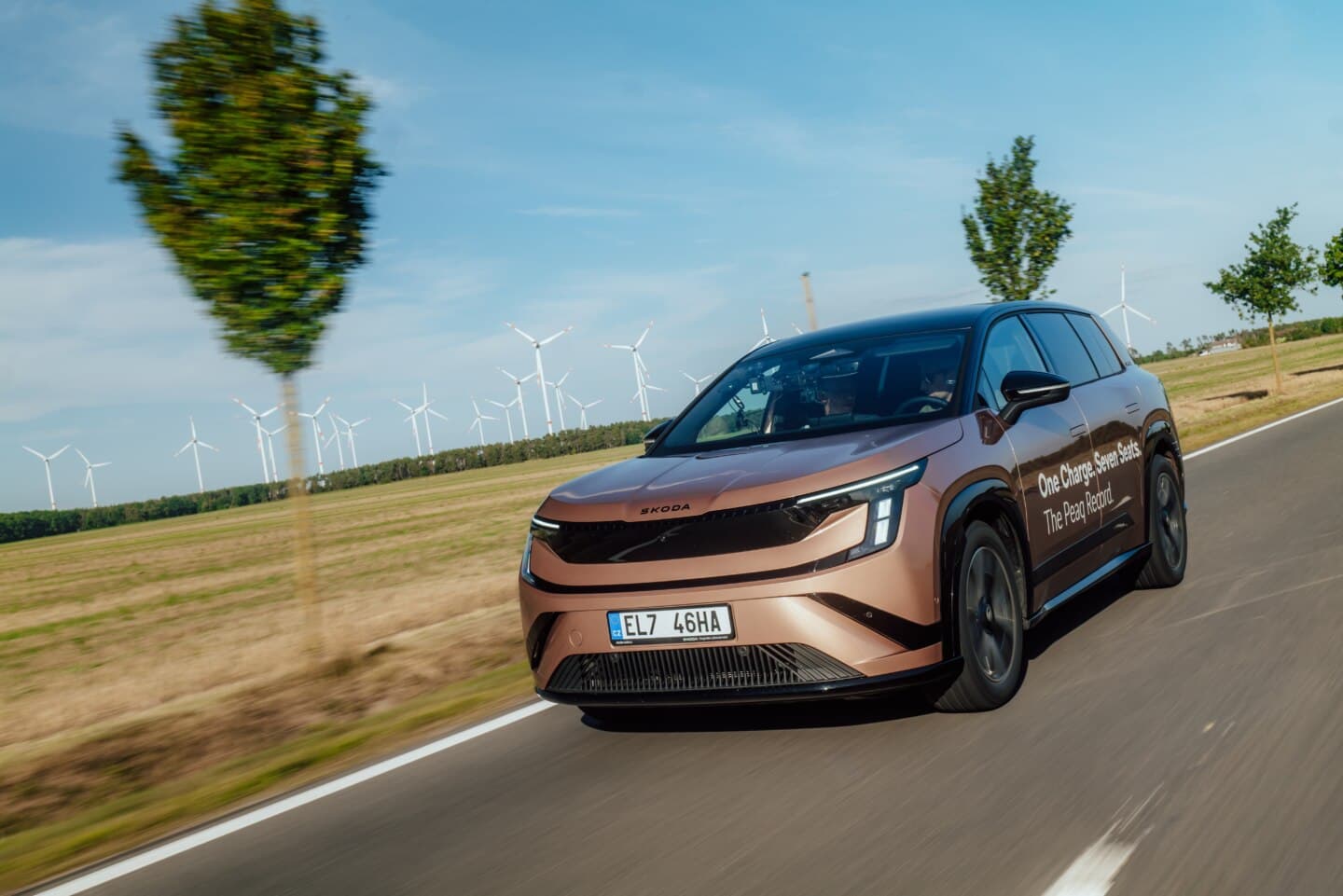
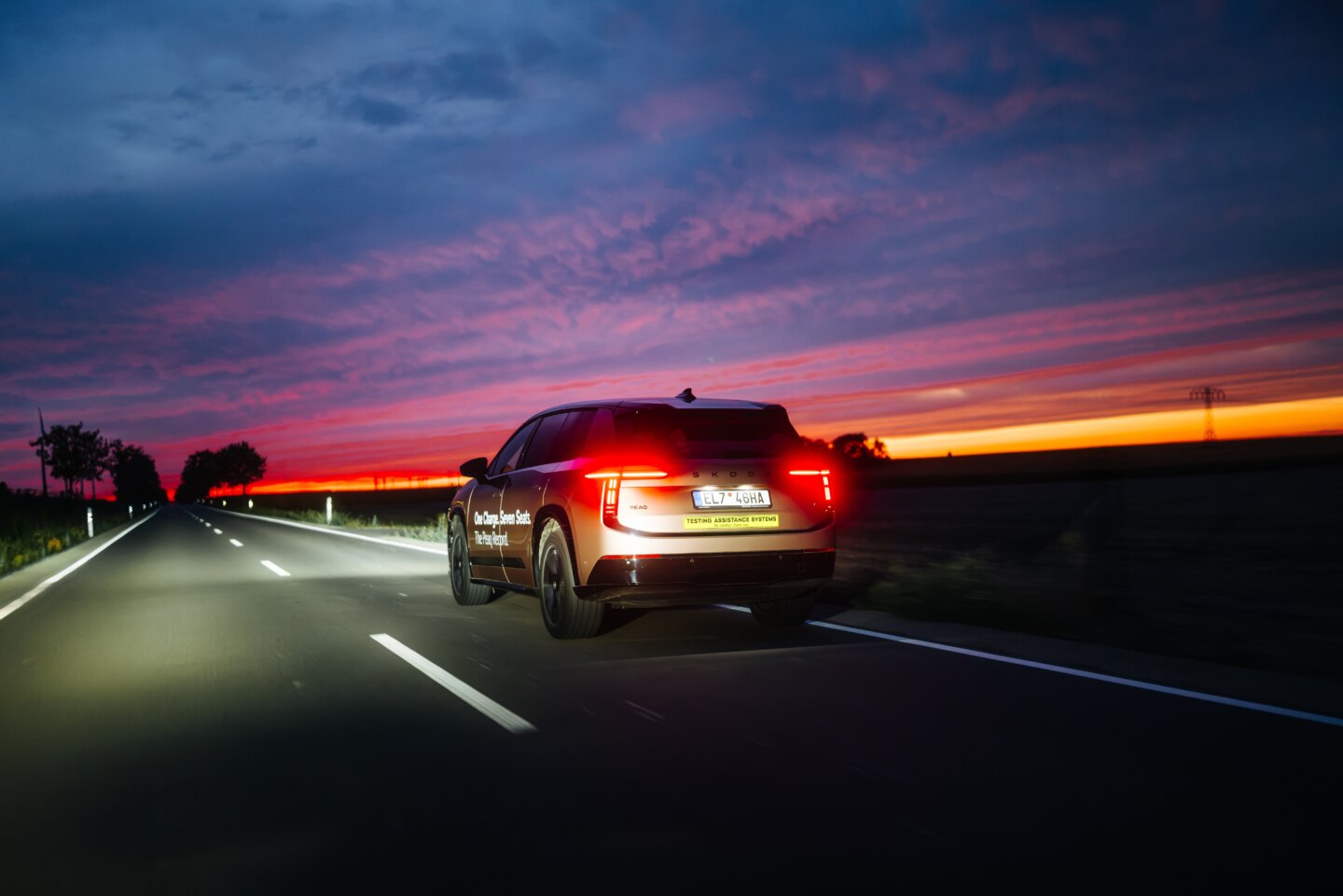
The Škoda Peaq 90 used in the test was a production car, with no technical modifications. Photo source: Škoda Auto
Škoda Peaq covered 936 km on a single charge. How the record was set
A Škoda Peaq 90 covered 936 km without recharging, from Mladá Boleslav in Czechia to Zandvoort in the Netherlands. The manufacturer reports an average consumption of only 9.2 kWh/100 km, and the test was supervised by the technical organisation TÜV SÜD.
The result exceeds the tested version’s official maximum WLTP range of 647 km by 289 km, or about 45%. The 936 km is nevertheless a record obtained on a route and with a driving style optimised for efficiency, not the range a driver should expect in daily use.
Which car was used
The test was carried out with a rear-wheel-drive Peaq 90 taken from series production. The charge port was sealed before departure, and the car received no technical modifications.
| Specification | Škoda Peaq 90 tested |
|---|---|
| Battery | 91 kWh gross / 86 kWh usable |
| Power | 210 kW |
| Drive | rear |
| Maximum WLTP range | 647 km |
| Consumption in the test | 9.2 kWh/100 km |
| Distance covered | 936 km |
The car ran on wheels of about 48 cm and standard low-rolling-resistance tyres. The model’s declared drag coefficient is 0.249.
The calculation confirms the order of magnitude of the result: an 86 kWh usable battery, consumed at an average of 9.2 kWh/100 km, theoretically allows almost 935 km. Minor differences can come from rounding of the published figures.
A route chosen specifically for efficiency
The run started on Tuesday, 25 August 2026, at noon, at Škoda’s headquarters in Mladá Boleslav. The car crossed Germany and reached Zandvoort on Wednesday afternoon. At the wheel, Škoda employees Marek Jež and Jakub Krs took turns, usually at intervals of about two hours and more often during the night.
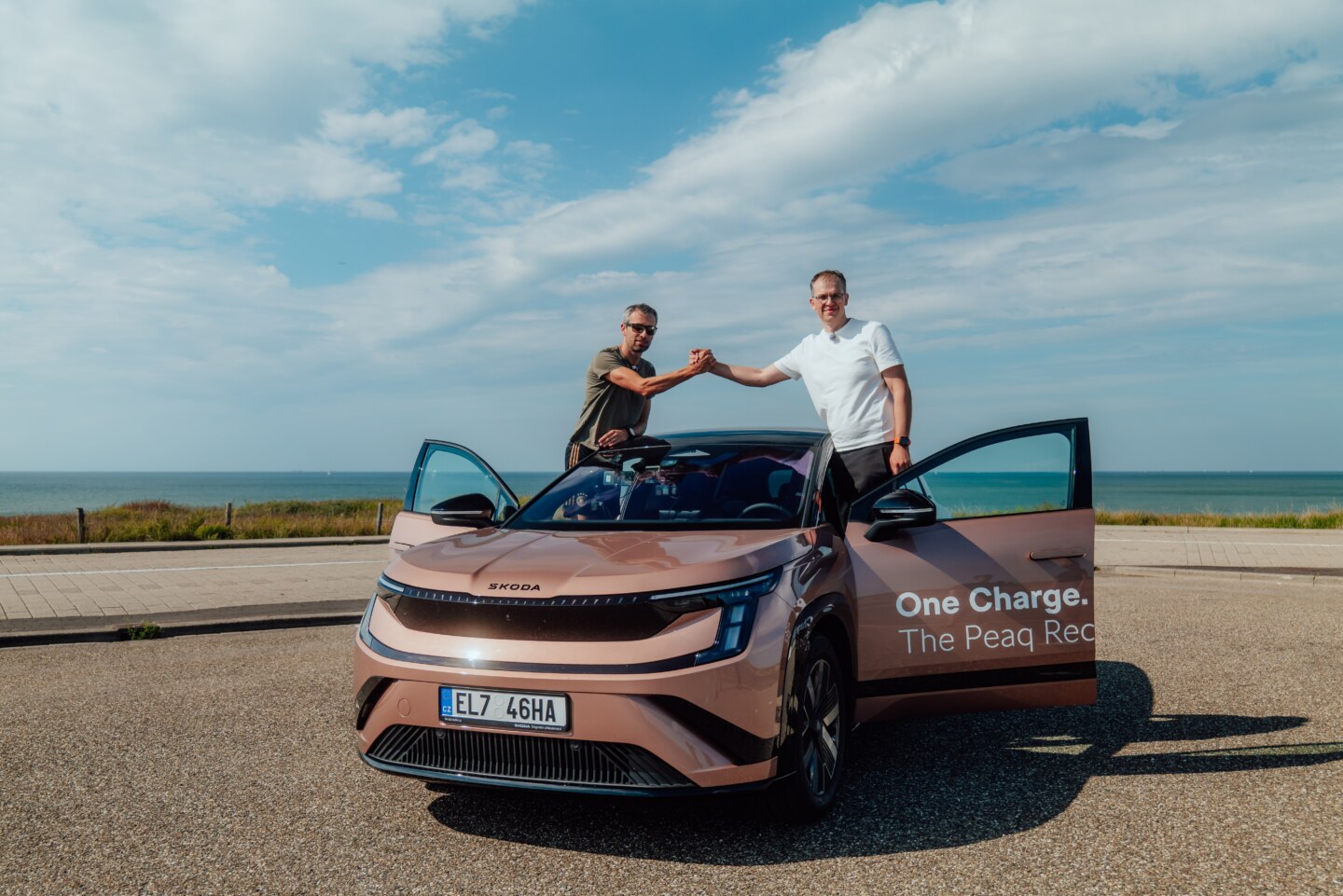
Marek Jež and Jakub Krs swapped at the wheel periodically along the route. Photo source: Škoda Auto
The route was set with the help of an artificial-intelligence system and avoided motorways and heavy traffic as far as possible. Secondary roads were preferred, on which the drivers could keep a steady pace. Breaks and driver changes did not involve charging the battery.
How consumption was cut to 9.2 kWh/100 km
The drivers accelerated progressively, anticipated traffic and avoided hard braking. Regenerative braking was used selectively: energy recovery is useful when the car has to slow down, but an unnecessary deceleration later requires another acceleration and can raise total consumption.
The weather also favoured the attempt. Škoda notes that it did not rain, so the tyres did not meet the extra resistance of a wet road. The company did not, however, publish the journey’s average speed, the exact temperature or how the climate control was used. Without those data, the record cannot be turned into a universal estimate for other routes.
The charge port remained sealed until the end of the 936 km. Photo source: Škoda Auto
Why the record is not everyday range
The test took place on public roads and with a production car, but it was organised by the manufacturer in conditions chosen for minimum consumption. A steady pace on secondary roads, dry weather and economical driving techniques do not reproduce an ordinary journey with motorway, overtaking, intensive climate control, traffic and frequent stops.
Even the drivers involved indicated that an ordinary customer will not drive in the same way. For comparisons between models and for planning a purchase, the WLTP figure of up to 647 km remains the standardised benchmark. Real range can be lower or, in very good conditions, higher, depending on speed, temperature, terrain, vehicle load and climate-control use.
The 936 km result shows mainly how efficient the Peaq 90 package can become when all variables are favourable. It does not prove that the car can repeatedly cover this distance in normal use.
How the performance was validated
According to Škoda, the attempt was monitored by TÜV SÜD, and the performance was recognised in the Czech Book of Records for the longest distance covered by an electric car on a single charge. The manufacturer also presents it as a range record for seven-seat electric SUVs.
The validation confirms that the procedure set for this attempt was followed. It is not equivalent to a WLTP measurement or to an independent comparative test among several cars, carried out under the same conditions.