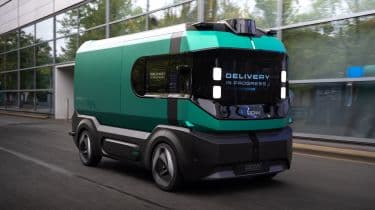
Stellantis Pro One and the Chinese company UQI Robotics have presented Box-on-Wheels, an autonomous electric concept intended for last-mile freight transport. The vehicle has no driver’s cab, steering wheel or conventional windscreen, so almost its entire volume can be used for cargo and equipment.
The concept had its public debut on 14 September at IAA Transportation 2026 in Hanover. Stellantis describes it as a platform still in an evaluation phase, not as a van ready for sale.
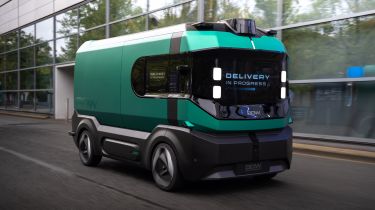
Press image: Stellantis Box-on-Wheels, presented at IAA Transportation 2026.
A body built around cargo space
Box-on-Wheels has an almost rectangular shape, with the wheels pushed to the extremes of the body. At the front is a large screen, placed where the windscreen would be, and above it the sensor array used by the autonomous driving system can be seen. Access to the cargo compartment is through a roller-type door at the rear.
Stellantis lists possible uses as urban distribution, proximity deliveries and transport in controlled spaces such as factories, hospitals and airports. Removing the cab can increase usable volume relative to the vehicle’s footprint, but the manufacturer has not communicated dimensions, payload or compartment capacity.
Electric propulsion, no battery data
The official partnership announcement confirms that Box-on-Wheels is fully electric. Battery capacity, range, motor power and charging time are not specified. Information on top speed and the exact automation level is also missing.
UQI Robotics contributes the autonomous systems, software, artificial intelligence and perception technologies. The company was created in 2020 by UBTECH and Miracle Automation and says it has installed more than 7,000 robots in 66 cities and regions. Stellantis Pro One is responsible for adapting the solution to the requirements of European operators and integrating it into fleets.
The first validation stages are scheduled in Europe. The companies will analyse operational performance, usefulness for customers and the possibility of expanding the project before considering other markets.
Why it is not yet a van you can buy
Box-on-Wheels was demonstrated outside the Stellantis stand in Hanover, but the existence of a working prototype does not mean series production has been approved. There is no launch date, price or list of countries where it might operate.
In Romania, using a driverless vehicle on public roads would also depend on the type-approval framework, rules on autonomous driving and authorisation of operations. In the near term, controlled environments — industrial sites, warehouses or airports — are easier scenarios to test than autonomous delivery on streets open to traffic.