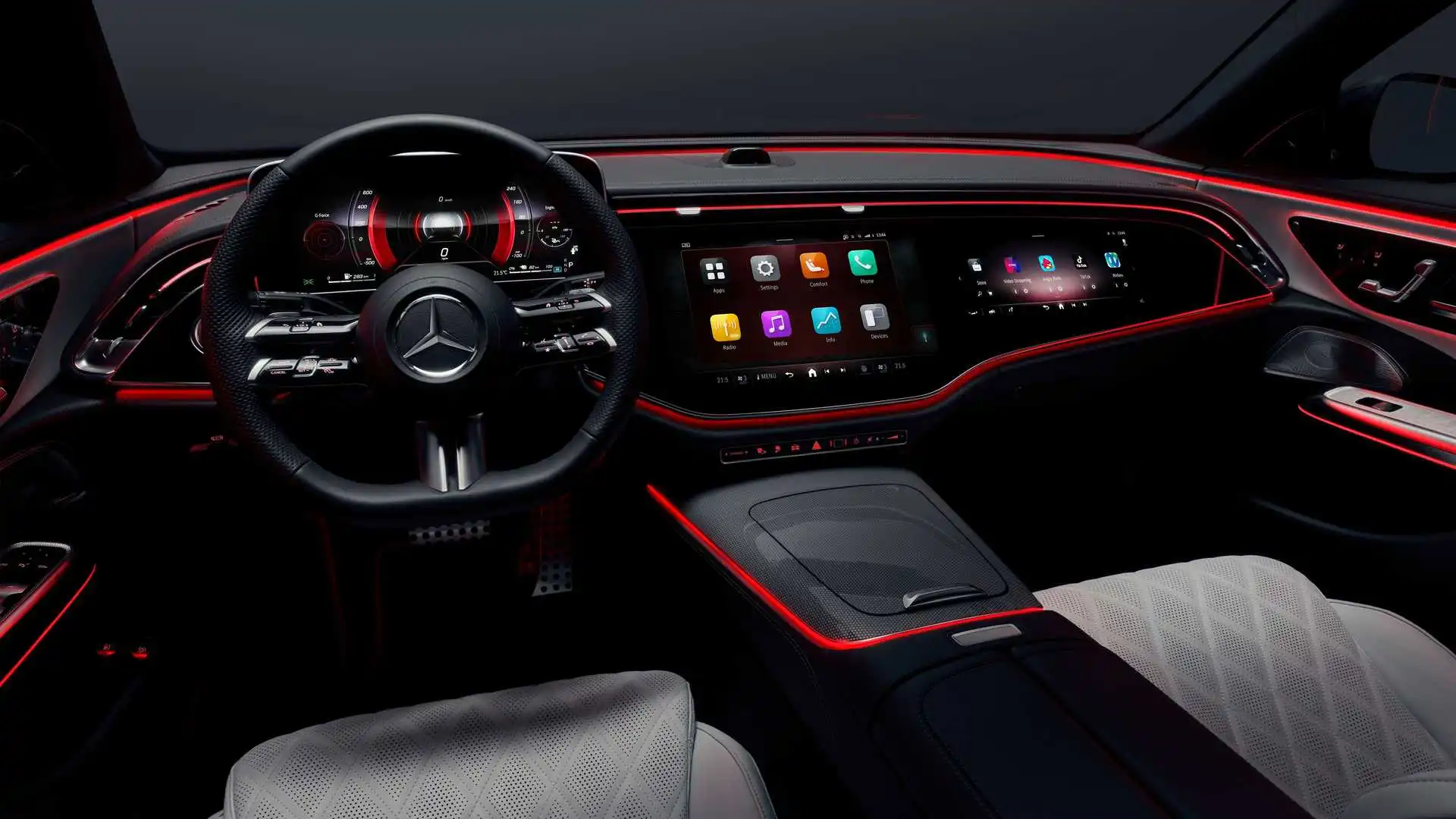
Dedicated passenger screens appear more often on new cars, but the J.D. Power study indicates low use. Illustrative image. Photo source: Mercedes-Benz
Study: drivers prefer car technology that works simply. 35% have not tried the passenger screen
Owners of new cars value functions that work quietly and reduce the number of operations more than the highly visible technologies in the cabin. 35% of people who have a dedicated passenger screen say they have never tried to use it, according to the 2026 edition of the J.D. Power U.S. Tech Experience Index.
The result does not show that drivers reject technology as a whole. Automatic start, climate control that adjusts its own settings and memorised preferences for each driver received good scores. The difference is the effort required of the user and the usefulness of the function on ordinary trips.
How the study was conducted
J.D. Power analysed responses from 68,084 owners of 2026 model-year cars, surveyed after the first 90 days of use. Data were collected between June 2025 and May 2026 for vehicles registered in the United States from March 2025 to February 2026.
The assessment covered 40 technologies split into five categories: comfort and convenience, connectivity, driver assistance, functions for electric cars and intelligent technologies. The index combines the spread of each feature with owner satisfaction and the number of problems encountered.
The sample is large, but the results describe the American market. They cannot be transferred automatically to all Romanian or European drivers, where equipment, models sold and usage habits differ.
The passenger screen is rarely used
The screen placed in front of the passenger recorded 21.3 problems per 100 vehicles, one of the weakest results among the technologies tracked. Besides the 35% who have not tried the function, only 6% of owners said they use it on every trip.
The study's wording matters: the 35% did not say they turn the screen on and find it useless, but that they have not tried to use it. J.D. Power had also indicated a possible explanation in an earlier edition: only a small share of cars carry a front-right passenger every day. The feature can thus remain without a user on most journeys.
An extra display also complicates handover at purchase. The dealer has to explain yet another interface after already covering the central screen, phone pairing, configuration menus and assistance systems.
Invisible functions scored better
Intelligent start received the best overall rating and generated only 2.4 problems per 100 vehicles. The system starts or stops the car according to the driver's actions, without the need to hunt for the key or press a button every time.
Intelligent climate control and memorised driver preferences also had high satisfaction and few complaints. These systems work in the background: they adjust temperature or restore seat position and personal settings without requiring menu navigation.
"The technology customers appreciate most is often the one they barely notice, because it simply works," explained Doron Hikry, customer relationship director at J.D. Power. According to him, manufacturers gain more if they solve a concrete problem without adding effort or stress for the driver.
More automation did not automatically bring more satisfaction
The study also compared two types of Level 2 assistance systems. Conventional ones, which require hands on the wheel and constant road supervision, outperformed Level 2+ systems that allow hands-free driving under certain conditions on execution and overall experience.
Hands-free systems reported slightly fewer problems — 13.8 per 100 vehicles, versus 14.3 for hands-on-wheel systems — but the extra functionality did not produce higher satisfaction. J.D. Power interprets the result as a sign that owners currently feel more comfortable with systems that assist them in a clear way than with ones that take over more tasks.
Both categories remain Level 2 systems. The driver is responsible for driving and must constantly supervise traffic, including when the system's rules allow hands off the wheel.
Cadillac and Hyundai lead the technology rankings
Cadillac took first place in the overall ranking and in the premium-brand category, with 641 points out of 1,000. Genesis followed with 559 points, and BMW with 524.
In the volume segment, Hyundai won for the seventh consecutive year, with 524 points. GMC and Kia shared second place, each with 470 points.
Awards for individual technologies went to features with an easily explained function: camera rear-view mirrors on Cadillac Escalade and Toyota Tundra, blind-spot cameras on Genesis GV70 and Hyundai Palisade, digital keys on the phone, one-pedal driving on BMW iX and charge scheduling on Hyundai Ioniq 9.
What the results mean for buyers in Romania
The options list of a new car can include equipment that looks good in the configurator but is rarely used after delivery. Before paying for a package with more screens, a buyer should check whether the front passenger travels often enough and whether the display can run independent content while moving, within the limits set by legislation.
On a test drive it is worth checking the operations repeated daily: temperature adjustment, demisting, changing the audio source, connecting the phone and switching off an alert. The number of screens says little about experience quality if basic controls are slow or buried in several menu levels.
The study also shows that a simple feature is not necessarily a rudimentary one. Successful automation is the kind that removes an operation, not the kind that moves the same task into a new interface.